

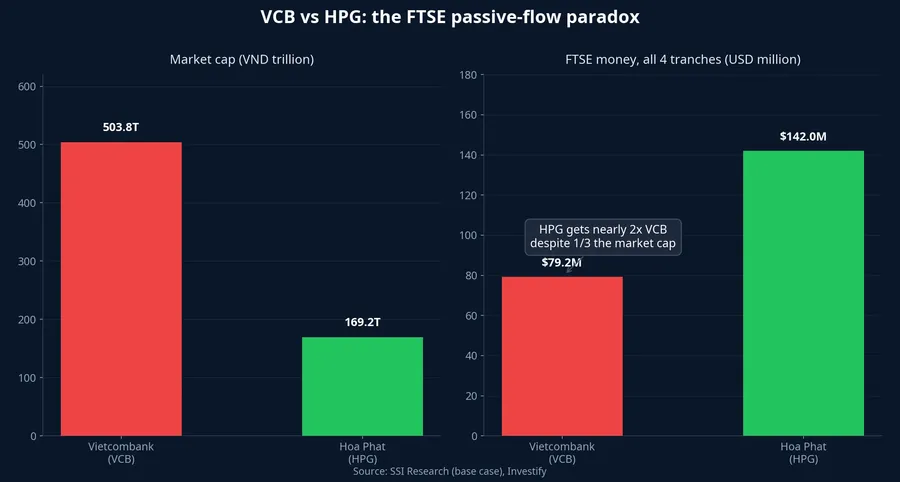
Vietcombank's market cap is nearly three times Hoa Phat's. Yet when FTSE Russell splits the passive money tied to the market upgrade taking effect September 21, 2026, three independent brokerage models estimate Hoa Phat will receive more than Vietcombank, in one case almost double. This isn't a modeling error. It's the direct consequence of a technical rule FTSE applies to every emerging market, and that rule is reshuffling foreign capital in an order that looks nothing like the market-cap rankings investors watch on their screens every day.
The big picture here: an index upgrade isn't simply a story about how much money flows in. It's a story about whether Vietnam's market is actually "buyable" for international capital, and that buyability hinges on two factors most retail investors never see: free-float ratio and remaining foreign ownership headroom.
The money arrives in four tranches over 13 months
FTSE Russell isn't adding Vietnamese stocks to its global indices in a single trade. The rollout is split into four tranches weighted 10%, 20%, 35% and 35%, running from September 2026 to September 2027.
| Tranche | Timing | Weight added | Estimated size (SSI base case) |
|---|---|---|---|
| 1 | Sep 2026 | 10% | approximately $221 million |
| 2 | Mar 2027 | 20% | approximately $442 million |
| 3 | Jun 2027 | 35% | approximately $773.5 million |
| 4 | Sep 2027 | 35% | approximately $773.5 million |
Per an ETF note SSI Research published on August 24-25, if Vietnam's weight in the FTSE Emerging All Cap Index holds around 0.49%, cumulative passive inflows across all four tranches would total roughly $2.21 billion.Tap Chi Kinh Te Tai Chinh SSI is explicit that this is an illustrative scenario built on the assumption the weight holds steady, not a forecast.
The first tranche this September is only about $221 million, roughly VND 5,765 billion at the August 26 exchange rate of VND 26,086/USD, spread across all 27 newly added names in a rebalancing window rather than a single closing auction. Seven-tenths of the remaining money doesn't arrive until June 2027 or later.
The allocation table runs opposite the market-cap ranking
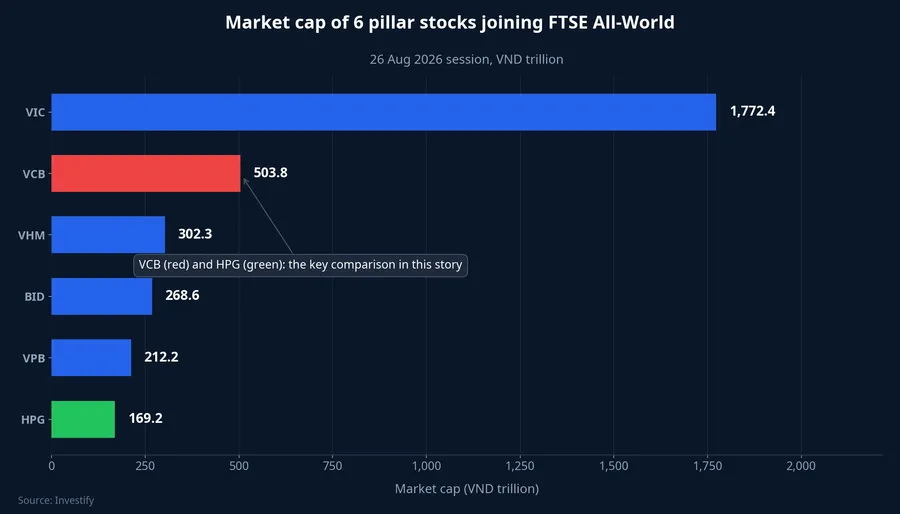
This is where the FTSE flow departs from most investors' intuition. Lay the estimated allocations next to actual market caps from the August 26 session, and the mismatch is immediate.
| Ticker | Market cap (VND trillion) | Free-float ratio | Estimated FTSE money, all 4 tranches |
|---|---|---|---|
| VIC | 1,772.4 | not disclosed | approximately $690 million |
| VCB | 503.8 | 11% | approximately $79.2 million |
| VHM | 302.3 | 30% | approximately $246.8 million |
| BID | 268.6 | 6% | not among the top-10 recipients |
| VPB | 212.2 | 55% | approximately $96.8 million |
| HPG | 169.2 | 55% | approximately $142 million |
Vietcombank's market cap is nearly three times Hoa Phat's, yet Hoa Phat's estimated passive allocation is nearly double Vietcombank's. VPBank is also allocated more than Vietcombank despite a smaller listed size, while BIDV, the third-largest bank on the exchange, doesn't even appear in SSI's top-10 recipient list. FTSE's "large-cap" and "mid-cap" labels describe a stock's position within the index, not how much money it stands to receive.
Why free-float and foreign room are the real gatekeepers
FTSE's own methodology fully explains this paradox: it's a technical rule, not a judgment on business quality. FTSE screens each stock's weight through two consecutive filters.
The first is free-float, the share of stock actually tradeable on the exchange after stripping out state and strategic shareholders; stocks at 5% or below are excluded from the index in principle. Vietcombank sits at just 11% because the state controls most of its equity, BIDV is even tighter at 6%, while Hoa Phat and VPBank both reach 55%, five times Vietcombank's ratio.
The second filter is remaining foreign ownership headroom, calculated as the foreign ownership limit minus the stake foreigners already hold, divided by that same limit.CafeF A stock not yet in the index needs at least 20% headroom to qualify, and all 27 names in this review fall into that category. As of July 13, 2026, foreign investors held 1.69 billion VCB shares, equal to 20.205% of the 30% cap.VietTimes Vietcombank clears the second filter but gets pulled down hard by the first.
This same rule explains why MWG, TCB and REE are entirely absent from the 27-name list despite being large, liquid, well-run businesses: all three are close to their foreign ownership caps. For an index fund, a stock it can't buy more of is a stock it can't use, regardless of how good the underlying business is.
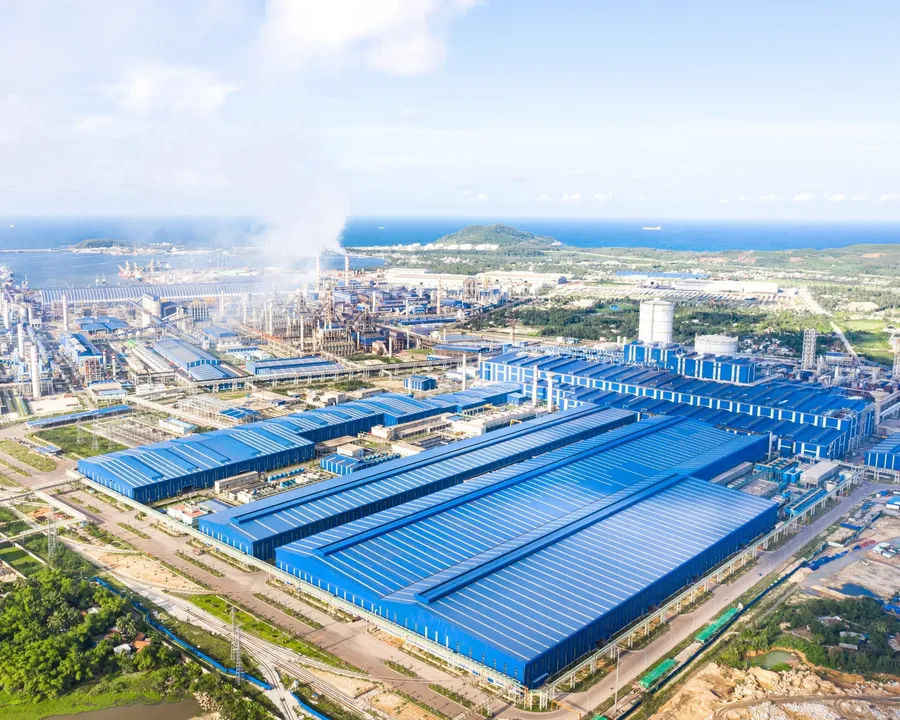
Three independent models, the same order
A counter-intuitive result is easy to write off as one model's error. Not here. Mirae Asset's August 11 report estimated total inflows of $1.533 billion, with Hoa Phat getting more than double Vietcombank ($92 million versus $45 million).Nguoi Quan Sat Vietcap used an entirely different scale, putting HPG at $82.7 million while VCB doesn't crack its top tier, after lifting its total projection from VND 52,600 billion to VND 78,900 billion on Vietnam's new 0.49% weight.Elibook The three models' totals diverge by more than 40% because each assumes a different fund size, but the allocation order matches exactly: stocks with more foreign headroom always rank above stocks near their cap, regardless of market cap. Three independent models landing on the same order is a strong signal that the order reflects FTSE's real mechanism, not one broker's assumption.
Set against real trading flows, the scale looks modest
Passive money is predictable demand, but it doesn't trade in a vacuum. Between August 3 and August 26 on HOSE, foreign investors were net sellers of five of the six pillar stocks tied to this upgrade, pulling VND 1,034.5 billion out of VPB and VND 924.6 billion out of VHM; Hoa Phat was the only one bought net, at VND 246.2 billion. The comparison is worth spelling out: VPBank's entire estimated passive allocation across all 13 months and four tranches is only about VND 2,525 billion, meaning foreign investors pulled out nearly half that amount in just 18 trading sessions in August alone. For Vietcombank, roughly VND 2,066 billion across the whole rollout compares with VND 350.7 billion in net selling in a single month. In other words, a full year of FTSE money isn't large enough on its own to reverse active net-selling pressure; it's a steady, predictable layer of additional demand, not an overwhelming buy.
It's worth acknowledging that the upgrade isn't the only factor at play here, and possibly not even the strongest one. The VN-Index closed the August 26 session at 1,821.32 points, up 1.67%; VIC rose sharply by 4.31% to VND 230,000, VCB gained 1.52% and HPG gained 1.15%. August's rally ran parallel to the FTSE news, but at least two other explanations are competing for credit: expectations of a lower domestic rate cycle, and company-specific stories. VIC is the clearest case for not attributing every move to a single cause: it's simultaneously the biggest FTSE recipient, carries its own corporate news flow, and has been the single strongest index mover in this period.
The three criteria that actually matter
For anyone holding one of the stocks in the upgrade basket, the useful question isn't "is my stock on the list" but "how much room does my stock still have for foreign money." Three criteria, in the exact order FTSE applies them, answer that: remaining foreign ownership headroom, measured as a percentage of the cap rather than of total shares outstanding (stocks below 20% don't make the new basket at all); free-float ratio, where companies with state or strategic shareholders holding most of the equity get discounted heavily regardless of nominal market cap; and liquidity relative to the incoming capital, which determines whether the flow is large enough to move prices or simply absorbed into existing trading volume.
These same criteria mean the current order isn't fixed. If a company raises its free-float ratio, or policy loosens the foreign ownership cap, its weight can rise at a later review.
What to watch next
The March 2027 review is the first and most important test of this whole story. Vietnam's weight in the FTSE Emerging All Cap Index moved from 0.34-0.35% at the March 2026 review to 0.49-0.50% in August 2026. If the next review pushes the weight higher again, SSI's $4.28 billion scenario gains ground; if the weight holds around 0.49%, the actual outcome will track closer to the $2.21 billion base case.
Until then, September 21 is still worth marking, but for a different reason than the market usually gives it credit for. It isn't the day money floods in. It's the day the allocation table switches on, and that table splits money according to the share of stock foreign funds can actually buy, not according to a company's size on the ticker board.