


On August 26, 2026, shares of TNT Group JSC closed at their ceiling price of VND 9,500, up 6.98%. Matched volume for the entire session was just 179,600 shares, worth less than VND 1.7 billion in total turnover. That is small enough that most people scanning the board would scroll right past it. But four days earlier, a much larger sum of money had quietly moved back and forth between TNT and a small securities firm on UPCoM. Reading that sequence correctly matters far more than watching the ceiling-price candle on August 26.
The buyer has surfaced
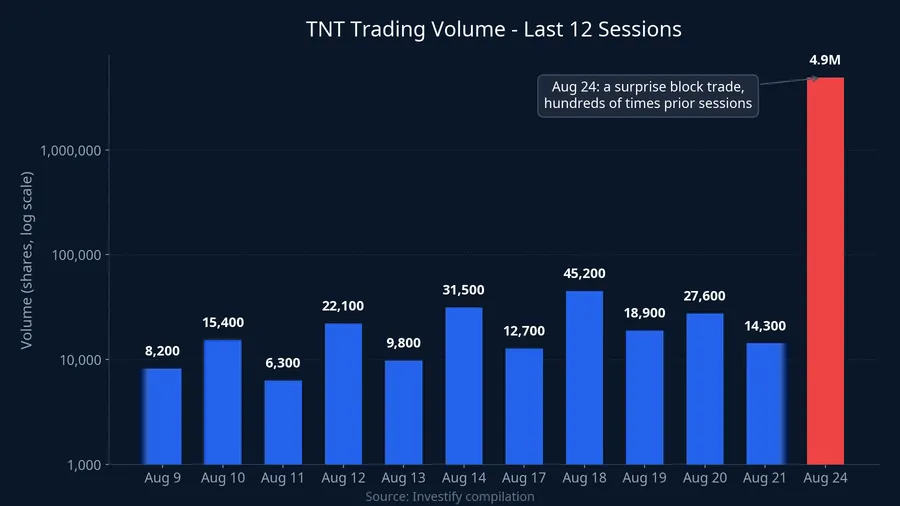
On August 24, exactly 4,900,000 TNT shares changed hands in a negotiated block trade. That block was roughly 27 times the matched volume of the ceiling-price session itself, and more than 900 times the volume of the prior session, when TNT matched just 5,300 shares.
According to Vietstock, the buyer was SBS Securities (UPCoM: SBS).Vietstock The firm bought 4.9 million TNT shares, equal to 9.61% of charter capital, becoming a major shareholder in the process. The deal was worth nearly VND 39.7 billion, at an average of about VND 8,100 per share, exactly the floor price of that session. On paper, this is a perfectly valid large-shareholder disclosure. What sets it apart from an ordinary proprietary-trading decision is what happened just before it.
Four days earlier, the money flowed the other way
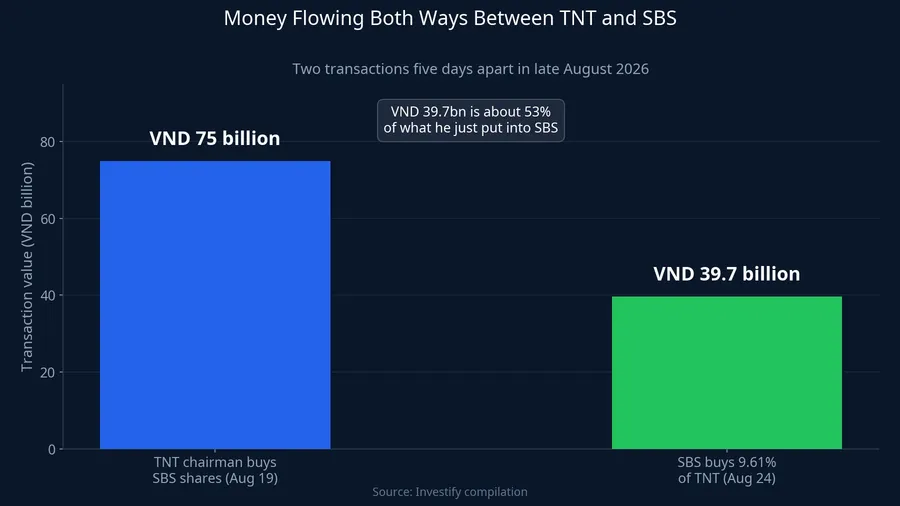
On August 19, SBS closed a private share placement. The original plan was to sell 15 million shares at VND 10,000 each to two individual investors, raising up to VND 150 billion. In the end only 9.5 million shares were placed, worth VND 95 billion; the remaining 5.5 million went unsold and were cancelled.Vietstock
The investor who took his full allotment was Nguyễn Gia Long, Chairman of the Board of Directors of TNT Group JSC (HOSE: TNT), who also happens to be TNT's largest shareholder with 24.9% of charter capital. Long spent VND 75 billion buying 7.5 million SBS shares. The other individual investor in the deal took just 2 million of the 7.5 million shares he had registered for.
The VND 10,000 price tag needs to be set against SBS's actual market price. On August 19, SBS closed at VND 4,500 per share, meaning Long paid roughly 2.2 times the market rate for a block of stock that cannot be transferred for a full year. That is not a price a purely financial investor would have much reason to accept.
Four days after Long's money went into SBS, SBS turned around and spent nearly VND 39.7 billion buying 9.61% of the company he chairs. That figure is about 53% of what Long had just put in, and roughly half the size of SBS's entire proprietary trading book at the end of Q2 2026 (the book's fair value at that point was just over VND 78 billion, per Vietstock). This is not a side bet for SBS: it is one of the largest positions the brokerage currently holds.
Where SBS and TNT actually stand
SBS is a small, UPCoM-listed brokerage. In the first half of 2026, it posted more than VND 70 billion in operating revenue, up 25% year-on-year, and net profit of nearly VND 38 billion, reversing a loss of over VND 47 billion in the same period of 2025. But most of that profit came from more than VND 44 billion in other income tied to old bad debt, according to Vietstock, not from core brokerage or proprietary trading.Vietstock Accumulated losses at SBS still stood at roughly VND 1,445 billion as of the end of Q2 2026.
The context behind the capital raise is worth noting too. Người Quan Sát reported that SBS is under pressure to lift its equity to at least VND 250 billion in order to join the central clearing system operated by VSDC, while equity stood at only about VND 227 billion as of the end of Q1 2026.Người Quan Sát An earlier attempt to place 50 million shares and raise VND 500 billion had already failed back in May 2026.FireAnt
TNT, for its part, has charter capital of VND 510 billion across 51 million shares outstanding and has been listed on HOSE since 2010. Its official profile lists mining and real estate as core segments, but its recent operations have shifted toward trading: in Q2 2026, TNT said its main activity was construction sand, specifically river sand imported from Cambodia.

TNT's results cut two ways. In Q2 2026, the company posted more than VND 106 billion in net revenue, down 19% year-on-year and its second straight quarter of declining revenue. Net profit for the quarter was nearly VND 8.6 billion, lower than the prior quarter but far above the VND 651 million booked in the same period of 2025; for the first half, net profit came to nearly VND 17.8 billion, 2.7 times the year-ago figure. Shrinking revenue alongside expanding profit points to improving margins, but it will take a few more quarters to tell whether that is a durable trend or the result of a handful of favorable contracts.
The liquidity math anyone buying at the ceiling has to solve
Strip out the two sessions with large negotiated block trades, and TNT's average matched volume over its last ten sessions comes to only about 31,300 shares per session. Divide SBS's 4.9-million-share block by that pace, and it would take roughly 156 trading sessions — more than seven months — to sell it off through the order book, assuming the price does not fall as it sells.
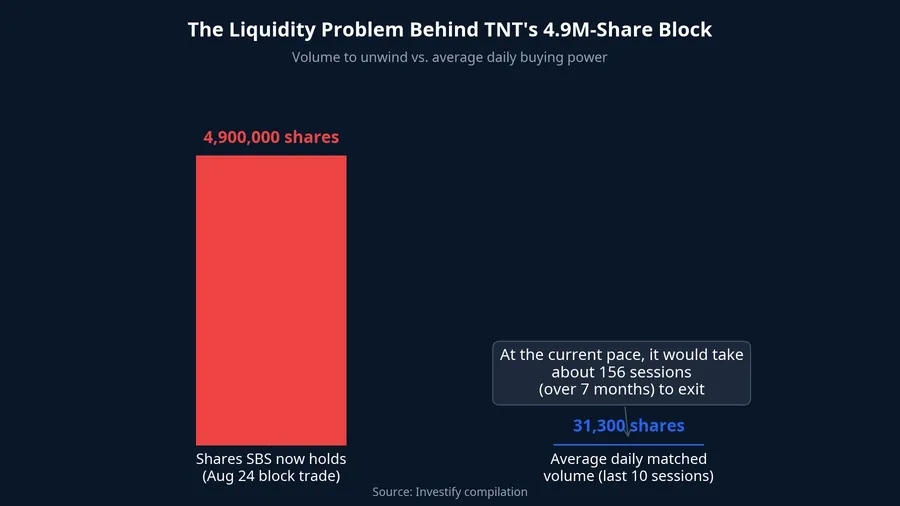
That number says two things. For SBS, this is a position that can only be exited through a negotiated deal, the same way it was built. For individual investors, the same math applies to anyone buying at the ceiling: in a stock where a normal session matches only a few tens of thousands of shares — and one recent session matched just 5,300 — there is no guarantee of finding a buyer at that price later.
It is also worth being honest about causation. Nothing proves the August 26 ceiling-price session happened because news broke that SBS had become a major shareholder. The report on the deal was published on that exact date, so a news-driven reaction is plausible. But with liquidity this thin, a very small amount of buying is enough to push the price to its ceiling without any major catalyst. TNT had already pulled back from a peak around VND 12,000 per share and bounced repeatedly whenever it dipped toward VND 8,500, which suggests demand at this price zone existed before the SBS deal was ever disclosed.
How to read a large-shareholder filing correctly
Under Vietnam's disclosure rules, any organization or individual who buys past the 5% threshold of a public company's charter capital must report their large-shareholder status to the company, the exchange, and the State Securities Commission. That filing is published on the disclosure pages of HOSE and HNX and on the company's investor-relations website, one of the few data sources individual investors can access for free, at the same time as insiders.
But it is worth remembering the limits of that kind of signal. A large-shareholder filing tells you who bought, how much, and on what date. It does not tell you why they bought, who sold to them, or whether any side agreement came with the deal. In TNT's case, the single most important piece of information — the identity of whoever sold the 4.9 million shares — has still not been disclosed.
The sensible way to read a situation like this is to treat the large-shareholder filing as a fact that needs further verification, not a signal to act on immediately. Before treating any large-shareholder transaction as a reason to buy alongside it, three questions deserve an answer: where did the buyer's money come from, does the buyer have any cross-ownership ties to company leadership, and does the stock have enough liquidity to exit. For TNT, the first two questions already have answers that sit well outside the bounds of a purely financial investment, and the third has been answered by a single number: 31,300 shares a session.
What to watch next
The signal worth watching over the coming quarters is not this week's TNT price, but what gets disclosed next. First, whether SBS spells out the purpose and intended holding period for this VND 39.7 billion position. Second, how SBS's proprietary trading book evolves in its Q3 2026 financial statements, and whether the TNT position is held or unwound. Third, whether TNT can sustain its profit improvement now that revenue has declined for two straight quarters. Those three answers — not a single ceiling-price session on VND 1.7 billion of turnover — are what will determine whether the TNT-SBS money loop turns out to be an ordinary financial investment or a cross-ownership structure that deserves more caution.