

On a corporate newswire, the phrase "bank raises charter capital" is filed almost automatically under good news: more capital means more room to lend, and more safety. HDBank's capital plan now before shareholders is worth a closer read, because a single filing bundles two fundamentally different kinds of capital increase, and only one of them actually brings new money into the bank.
One plan, three components
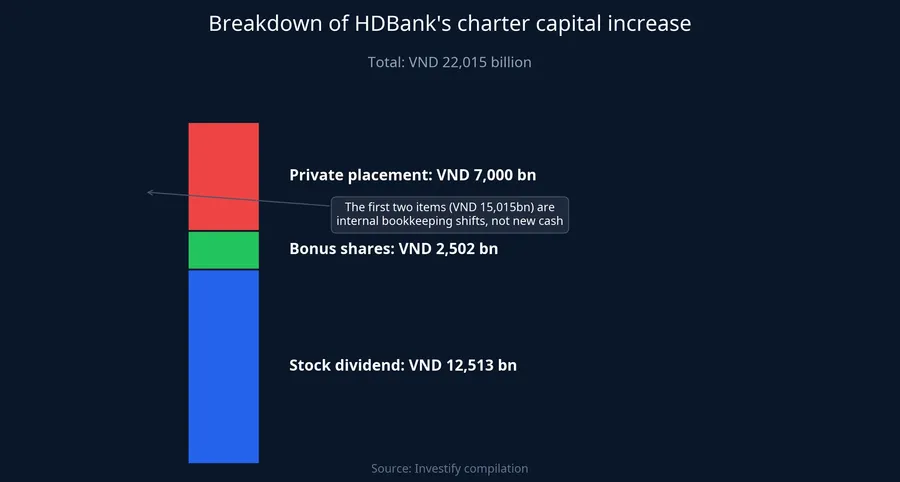
Per an August 4, 2026 disclosure and the shareholder meeting materials,Vietstock HDBank plans to raise charter capital from VND 50,052 billion to VND 72,069 billion, an increase of nearly 44%.MekongASEAN The more than VND 22,000 billion increase comes from three components with very different origins.
The first is a 25% stock dividend for fiscal year 2025, issuing roughly 1.25 billion shares from undistributed after-tax profit, worth approximately VND 12,513 billion. The second is a 5% bonus share issuance, about 250.2 million shares, drawn from the charter capital supplementary reserve, worth roughly VND 2,502 billion. The third is a private placement of up to 700 million shares to professional securities investors,Báo Đầu tư equal to nearly 14% of shares outstanding as of June 30, 2026, adding VND 7,000 billion to charter capital.
The first two components together total roughly VND 15,015 billion, more than two-thirds of the total increase, and none of it brings a single dong of new money from outside the bank.
Why a stock dividend doesn't make a bank richer
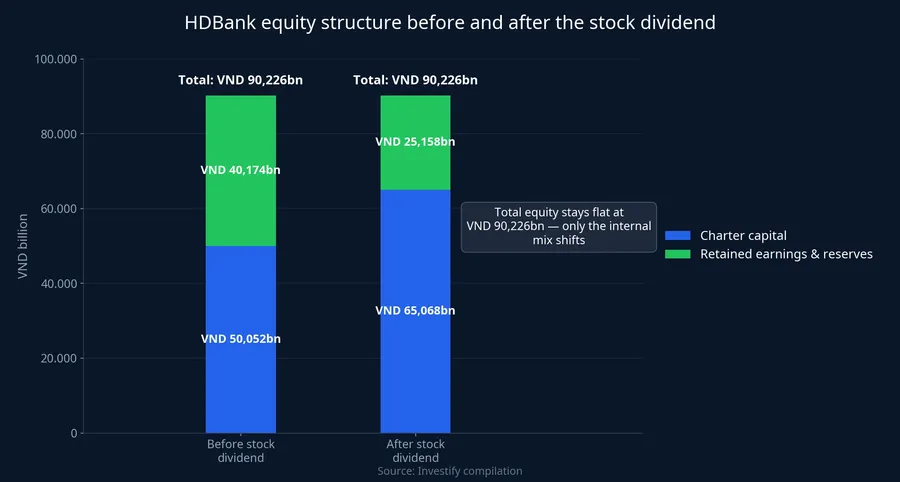
A bank's equity is made up of several line items: charter capital, share premium, reserves, and retained earnings. A stock dividend shifts a portion of retained earnings into charter capital; a bonus share issuance shifts a portion of reserves into charter capital. Both are transfers between line items within the same column, like moving cash from the left pocket to the right pocket of the same person, not new money coming in from outside.

HDBank's half-year figures show the scale of that column. As of June 30, 2026, equity stood at VND 90,226 billion, comprising VND 50,052 billion of charter capital, VND 24,460 billion of retained earnings, and VND 1,275 billion of share premium. After the stock dividend and bonus shares, charter capital rises to roughly VND 65,000 billion, while retained earnings and reserves fall by exactly the amount transferred. Total equity stays unchanged at VND 90,226 billion.
The knock-on effect is just as clear. HDBank's capital adequacy ratio (CAR) stood at 18.36% in the second quarter of 2026, and because both the numerator (own capital) and the denominator (risk-weighted assets) are unchanged, these two bookkeeping components don't lift CAR by a single percentage point. The bank's lending capacity after the stock dividend is exactly what it was before.
What genuinely changes is the share count. After a 30% issuance, each share represents a smaller slice of the same pool of equity. Book value per share falls from VND 18,026 to roughly VND 13,866. The reference price is adjusted accordingly: based on the August 25 closing price of VND 27,000, the theoretical reference price on the ex-rights trading day works out to around VND 20,769. Shareholders receive more shares, but their total holding value and ownership percentage are, in theory, unchanged.
The part the popular reading gets right
None of this means a stock dividend is an empty gesture. The real substance lies in a separate decision: HDBank is choosing not to pay VND 12,513 billion of 2025 profit in cash. Paying cash would send that money out of the bank and shrink equity by the same amount; paying in shares keeps the entire profit inside to fund growth. For a bank whose after-tax profit in the first half of 2026 reached VND 10,700 billion, up 33.2% year-on-year, retaining that profit is a substantive choice, not just an accounting entry.
The third component is where genuinely new money enters. Under the plan, the private placement price is set by the board but cannot be lower than the 30-session average closing price nor below book value as of June 30, 2026; any amount above par value is booked as share premium, so actual cash proceeds could exceed the VND 7,000 billion added to charter capital by a meaningful margin. This is the only component that increases equity and lifts CAR, and also the only one that dilutes existing shareholders' ownership stake.
The counter-example: fresh cash at ten times total assets
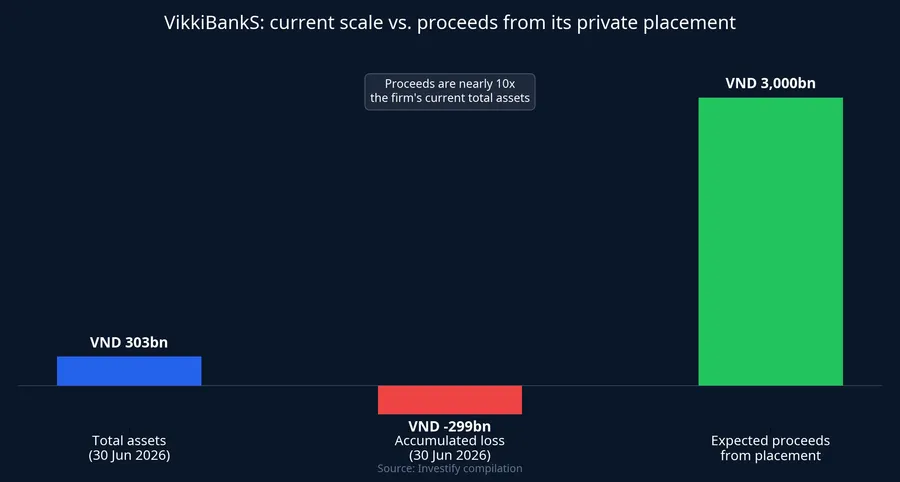
At the same time, a much smaller name is doing exactly the other kind of capital raise. Securities firm VikkiBankS is placing 300 million shares at VND 10,000 each with 12 individual investors,CafeF expecting to raise VND 3,000 billion and lift charter capital from VND 500 billion to VND 3,500 billion. The subscription and payment window runs from July 31 to September 30, 2026, and no final issuance result has been announced yet.
That VND 3,000 billion is genuinely fresh cash, and its size relative to the company is striking: VikkiBankS's total assets as of June 30, 2026 were just over VND 303 billion, against an accumulated loss of nearly VND 299 billion. For a securities firm, equity directly determines business capacity, since margin lending is capped as a multiple of equity, and the capital allocation plan reflects exactly that logic: VND 1,500 billion for margin lending and VND 1,000 billion for proprietary trading, 83% of the funds raised.
But real money comes at a real cost. After the issuance, the 12 new investors will hold about 85.71% of charter capital,Người Quan Sát diluting existing shareholders down to just over 14%. The ownership picture had already shifted earlier: at the end of February 2026, 85.01% of VikkiBankS was transferred to Kazon Investment JSC,Fili leaving Vikki Bank with only 4.99%. This placement is therefore both a capital injection and an ownership restructuring. New money into a company doesn't automatically translate into a benefit for the shareholders already holding it.

The entire securities industry is riding the same capital-raising wave. Per an SHS estimate cited by VnEconomy, total capital that securities firms plan to add in 2026 exceeds VND 77,800 billion, with execution so far reaching just under 50%.VnEconomy In other words, most capital-raise announcements on the market today are still at the planning stage, not completed outcomes.
How to read a capital-increase announcement
The first question for any capital-increase announcement is the source of funds. If the source is undistributed after-tax profit, share premium, or reserves, it's an internal shift within equity: share count rises, but equity and CAR stay flat, and book value per share falls in exact proportion to the dilution. If the source is cash paid in by investors through a private placement or a rights offering to existing shareholders, that's genuinely new capital, accompanied by ownership dilution and the question of what the money will be used for.
The second question is what stage the plan has reached. HDBank's plan has no final registration date yet, no ex-rights trading date, and no regulatory approval on file; the private placement is expected to roll out over 2026-2027. At VikkiBankS, the payment deadline still runs to September 30 with no official result yet. A filed proposal and a completed issuance are two very different states of certainty, even though both can appear under the same headline: "capital increase."
For investors holding HDB, the signals worth watching in the coming weeks are the ex-rights record date for the stock dividend and bonus shares, and more importantly, the private placement price once it's set. That price, measured against the VND 18,026 book value and against the market price at the time of issuance, will show how much dilution cost the new capital actually carries. That number says far more about the quality of this capital raise than the 44% figure in the headline.