


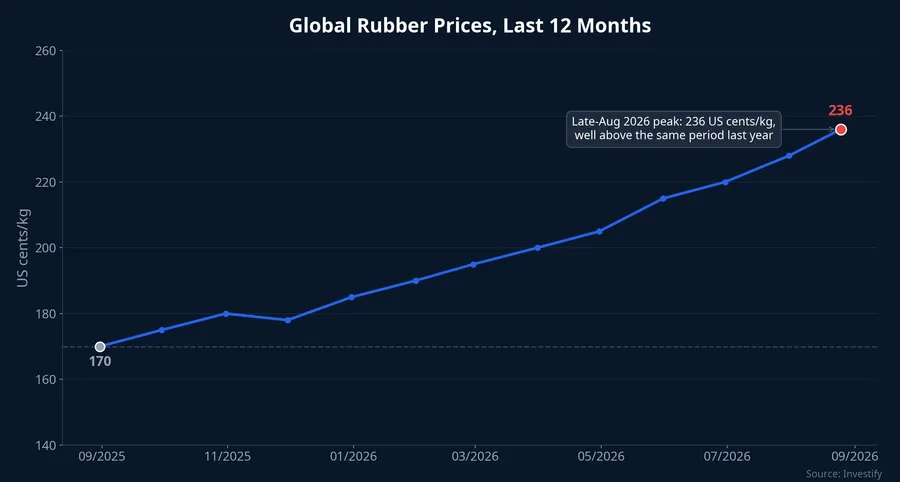
On August 25, rubber futures closed at 236.00 US cents/kg, up 29.88% year-to-date and 38.9% above the same session a year earlier. That's the highest level since 2013.Fili
The usual instinct when an industrial commodity spikes is to look at demand. Not this time. Global rubber demand is only growing modestly in 2026. What's actually moving is the supply side, and it's moving on two very different timelines.
Two supply shocks: Thai rain and Indonesian palm oil
Rubber trees give up their latex in a very specific way: workers slice the bark at dawn, sap drips into a cup, and it's collected the same day. Heavy rain floods the cup and washes the latex away, so when a growing region gets days of rain in a row, tapping simply stops, and that lost output can't be recovered. Thailand is the world's largest natural rubber exporter, and an August 26 report noted futures climbing to the 236-cent zone right as heavy rain disrupted tapping there.Fili This is a shock that can reverse quickly: once the rain clears, output recovers within weeks.
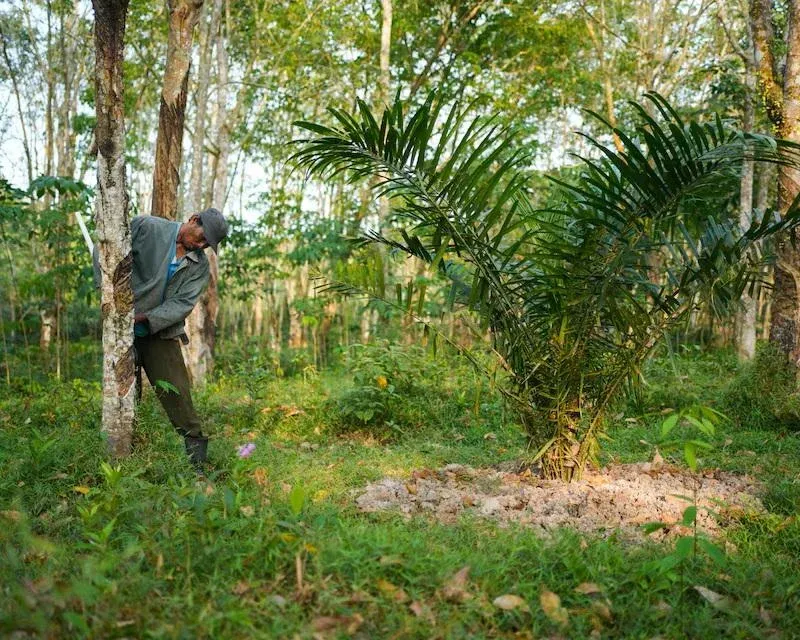
The second shock doesn't reverse nearly as fast. Indonesia's rubber-planted area has shrunk about 17% over five years, from 3.78 million hectares in 2021 to 3.13 million hectares in 2026, as farmers switch to oil palm, which needs less labor and benefits from biofuel demand.FireAnt Indonesian rubber output is forecast to fall from over 3 million tons to roughly 2 million tons. A newly planted rubber tree takes about seven years to yield latex, so land that has already converted to palm won't come back to the market in a single season, or a single year, no matter how high prices climb.
Combine the two, and the global balance tilts decisively toward shortage: 2026 natural rubber output is forecast at 15.31 million tons, below consumption of 15.41 million tons.Thời báo Tài chính Việt Nam The Association of Natural Rubber Producing Countries (ANRPC) also expects output to fall in both Indonesia and Vietnam this year, with Vietnam's decline at around 4.2%.
Vietnam's export data confirms this is a price cycle
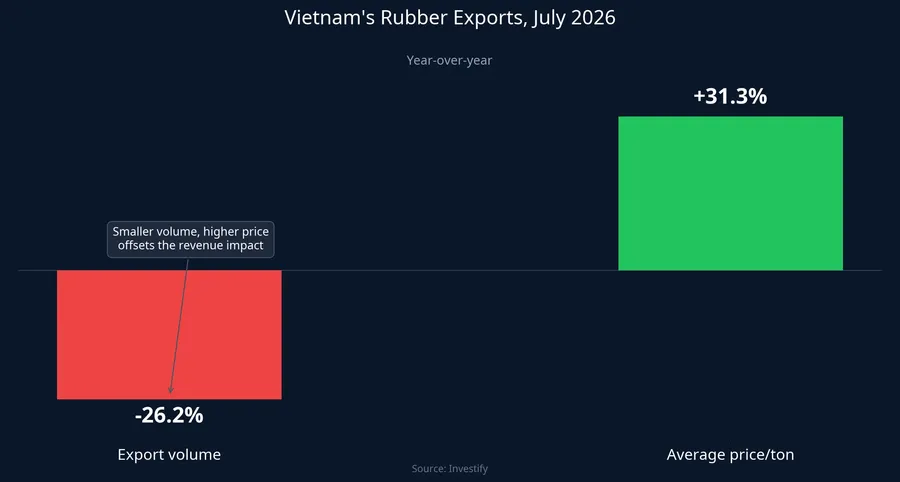
In July 2026, Vietnam exported 152,081 tons of rubber worth $324.2 million. Volume fell 26.2% year-over-year while the average price hit $2,132/ton, up 31.3%.FireAnt Over the first seven months, the totals were 788,006 tons and $1.55 billion, down 12.4% by volume and 4.6% by value year-over-year, with an average export price of $1,965/ton, up nearly 9%.Người Quan Sát Selling less while earning more per ton is the signature of a supply-short market, not a demand-driven one.
The customer map is shifting too. China's share of Vietnam's rubber exports fell from 70.8% to 58.7% over seven months, while Indonesia climbed to the number-two spot with roughly 59,000 tons, up more than 2.5x year-over-year. The country that used to be the world's second-largest rubber supplier is now buying Vietnamese rubber to make up for its own lost output.
PHR's 94% distribution: two very different components
On the exchange, the rubber name getting the most attention right now is Phuoc Hoa Rubber (PHR), which just set the schedule for a distribution the market is calling a combined 94% ratio, with the ex-rights date on September 11 and the record date on September 14.Vietstock That headline number bundles two things with completely different substance, and new investors should separate them before pricing in any expectations.
The first piece is a cash dividend for fiscal year 2025, a 14% ratio worth VND 1,400 per share, totaling about VND 190 billion, expected to be paid on October 15. This is real cash leaving the company. Against the closing price of VND 61,500 on August 26, that translates to a dividend yield of roughly 2.3%.
The second piece is a stock dividend at a 10:8 ratio, or 80%. PHR is issuing over 108 million new shares funded from its development investment reserve, raising charter capital from about VND 1,355 billion to VND 2,438 billion.VnEconomy This is purely a reclassification from equity reserves to charter capital: no new cash comes into the company, and every shareholder keeps the exact same ownership percentage. What investors gain is a larger float, which typically improves liquidity; what they lose is that every per-share metric, from EPS to book value, gets diluted. PHR's largest shareholder, Vietnam Rubber Group (GVR), holds 66.62%, so most of both the cash and the bonus shares flow back to the parent company.
Read the numbers: the profit came from land, not latex
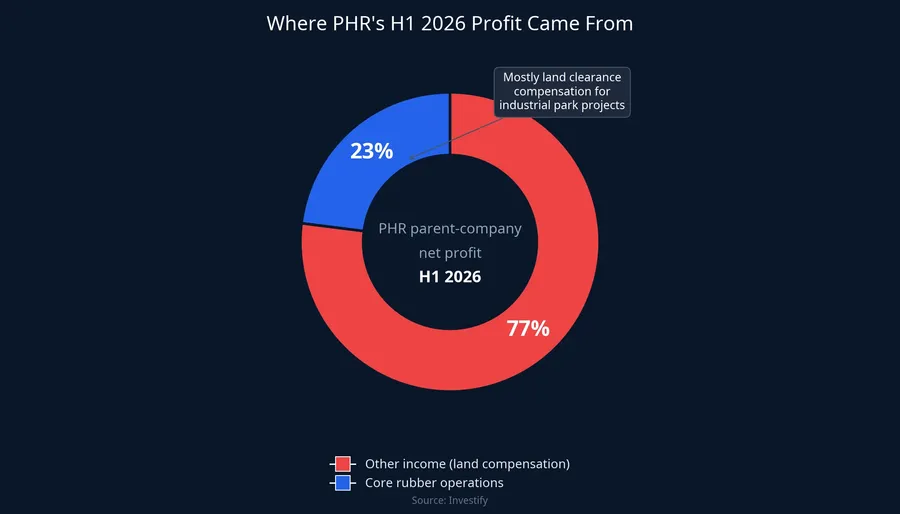
In H1 2026, PHR posted net revenue of VND 874.6 billion, up 28.7%, and parent-company net profit of VND 643.4 billion, up 245%. Looking at the profit line alone, that's a massive jump. But break it down and net other income accounted for VND 496.3 billion, roughly 77% of parent-company net profit, mostly land compensation for handing over plantation land to industrial park projects. For the Bac Tan Uyen 1 Industrial Park project alone, PHR could receive over VND 1,400 billion, recognized across several quarters.Tin nhanh Chứng khoán
What about the core business? Six-month gross margin came in at 29.3%, nearly flat against 29.7% a year earlier. Global rubber prices are up almost 30% and the gross margin of a company that taps latex for a living barely moved — that's worth explaining, not glossing over. The most plausible explanation is contract lag: most volume sells under contracts signed in advance, so August's new price level hadn't yet flowed into the H1 books, which also fits the fact that the seven-month average export price only rose nearly 9% while July's price alone jumped 31.3%. Lower domestic output and rising tapping labor costs, which track the same price environment, also offset part of the gain.
One detail on profit quality worth remembering: six-month operating cash flow came in at just VND 177.9 billion, only 0.28x parent-company net profit, due to a sharp rise in receivables. Most of the land-compensation profit on the books hasn't actually reached the bank account yet.
Other ways to play the rubber trade
Beyond PHR, listed rubber names include Dong Phu Rubber (DPR), Tay Ninh Rubber (TRC), DRI, and parent group GVR. PHR and DPR lean heavily on the land-conversion-to-industrial-park story; DRI is more purely a latex producer, with a six-month gross margin of 42.3%, the highest in the group; and GVR is a consolidated conglomerate where latex-price swings get diluted across a much broader set of operations.
For investors who want to track the commodity price directly rather than corporate earnings, RSS3 and TSR20 rubber contracts trade on the Vietnam Commodity Exchange (MXV), under the Ministry of Industry and Trade, through a licensed member firm.MXV But commodity futures carry leverage and intraday swings far larger than stocks, better suited to someone who already understands margin mechanics than as an entry-level product. Buying rubber-sector stocks means buying a company with multiple revenue streams, where the latex price is just one piece, as PHR illustrates; futures track the commodity price almost one-to-one, along with all the risk that comes with that.
Signals that will decide how long prices stay elevated
Southeast Asia's peak tapping season ends around September, so Thai weather through Q4 is the nearest variable to watch: continued rain gives prices a floor to hold, while favorable weather lets supply recover seasonally, making a pullback a plausible scenario. The second variable is Chinese buying, the world's largest consuming market, which is visibly weakening based on its share of Vietnamese imports; a recovery in China's tire and auto industries would keep prices at the new level, while a continued slowdown leaves this rally standing on supply alone. The third variable is regulatory: the EU's deforestation regulation (EUDR) requires traceability for rubber entering the bloc, so companies with complete plantation records will keep their access, while those unprepared could lose part of that market right when prices are strong.
The reasonable way to read this moment: it's a commodity price-cycle position, not a demand-growth story. For a price cycle, a small portfolio weight is the sensible size, and decisions should follow supply-demand developments rather than the stock's momentum. For PHR specifically, the number to watch in the Q3 report isn't total profit but the gross margin of its core latex business, the only place that will show whether global rubber prices have actually flowed through to operating results.