


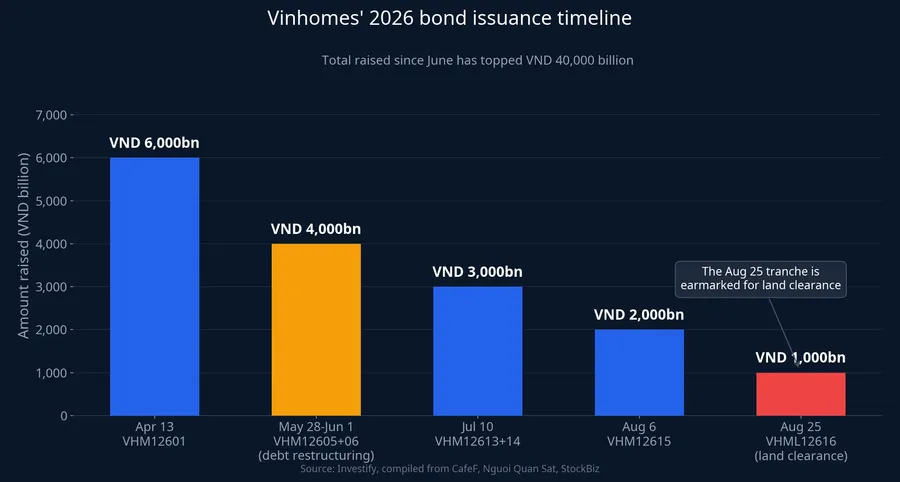
On August 25, 2026, Vinhomes announced plans to issue a VND 1,000 billion bond tranche, ticker VHML12616, with proceeds used entirely to advance land-clearance compensation payments for the Hanoi International Sports Urban Area.Nguoi Quan Sat Saigon Ratings rated the tranche vnAA+ with a stable outlook, though the interest rate, tenor, and collateral had not been disclosed at the time of the announcement.
On its own, VND 1,000 billion is a small sum for the largest listed real estate developer on the exchange. But placed on the project's own timeline, it's the newest piece of a financing cycle that has run continuously since late last year, and that cycle explains fairly well why a company posting blowout profits keeps returning to the bond market.
Seven Months, Over VND 50,000 Billion in Compensation
The Hanoi International Sports Urban Area, formerly known as Hanoi Olympic Sports Urban Area, spans roughly 9,171 hectares across 11 communes and wards of Hanoi, with a preliminary total investment of about VND 925,651 billion. Construction broke ground on December 19, 2025.Znews To date, the developer has paid out over VND 50,000 billion in compensation, covering more than 50% of the land-clearance volume, over roughly seven months.Nguoi Quan Sat Averaged out, that's over VND 7,000 billion in cash leaving the company every month, flowing to residents in the project area.
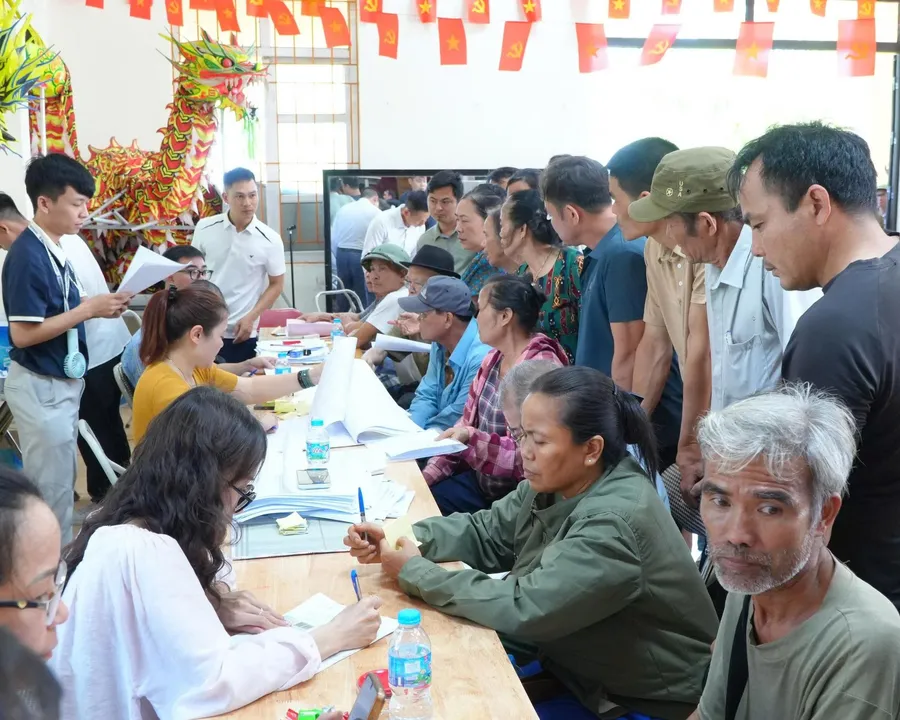
The key thing to grasp: compensation is an upfront cash outlay, paid at a stage when the project hasn't generated a single dong of revenue. The detailed 1/500 zoning plans for the four sub-zones were only approved this year, and the 411-hectare sports complex in Thuong Tin was just granted its own detailed zoning approval.Dan Viet The gap between paying residents and collecting money from homebuyers is measured in years, not quarters.
A Bond Issuance Cadence That Tracks the Cash Outflow
Starting April 13, 2026, Vinhomes opened its issuance run with the VHM12601 tranche, VND 6,000 billion. By June 25, total bonds issued since the start of the year had reached VND 21,000 billion, and the board approved raising up to another VND 15,000 billion.CafeF In late May and early June, two tranches, VHM12605 and VHM12606, raised VND 4,000 billion for an entirely different purpose: debt restructuring, repaying part of a bank loan under a credit agreement signed in April, secured against 40 million VIC shares held in Vingroup.Nguoi Quan Sat
On July 10, two more tranches, VHM12613 and VHM12614, sold out in a single day, raising VND 3,000 billion with a 36-month tenor and a first-two-period coupon of 12.5% per year that would not drop below that floor for the full three years.CafeF On August 6, the VHM12615 tranche brought in another VND 2,000 billion at the same rate floor.StockBiz Adding up the tranches issued since June, Vinhomes' total bond fundraising in 2026 has now topped VND 40,000 billion.
Why a Highly Profitable Company Still Needs to Borrow
Vinhomes just reported six-month net profit of VND 52,091 billion, with first-half operating cash flow of VND 89,468 billion, larger than the entire compensation bill paid so far. So why does it still need bonds? Three reasons come from the nature of that cash outflow itself.
First, operating cash flow already has somewhere to go: principal repayment, interest, capital contributions to other projects, dividends. It isn't idle money sitting around. Second, compensation must be paid on the timeline set by local authorities and individual households, not on the schedule of home sales; when a commune is ready to hand over land, the cash has to be there that same week, and a private bond tranche disbursed in a single lump sum matches that rolling-payment rhythm better than a bank credit line does. Third, at the land-clearance stage, the company doesn't yet hold a land-use rights certificate for the parcels being compensated, so it can't mortgage that land to a bank in the usual way, which is why these bond tranches rely on other collateral instead, such as VIC shares or guarantees from the parent company.
The Cost of This Funding Cycle
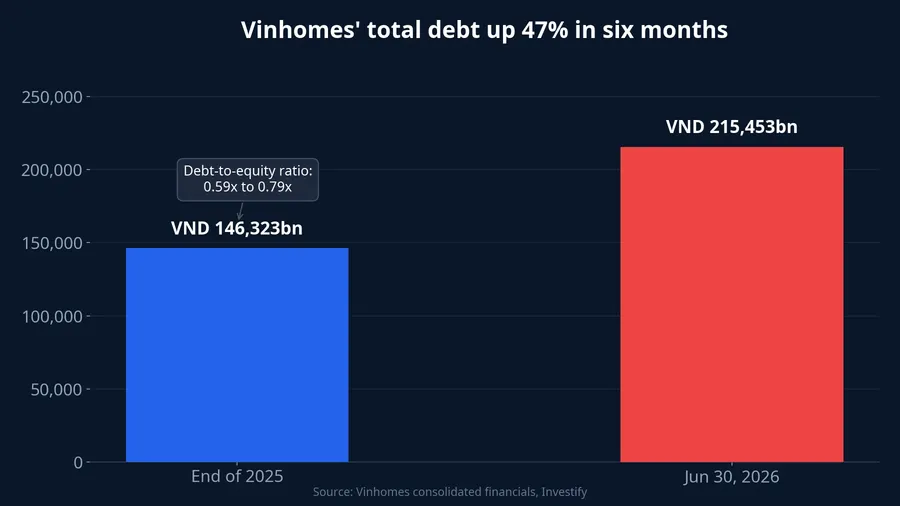
The balance sheet shows the price of speed. Vinhomes' total borrowings rose from VND 146,323 billion at the end of 2025 to VND 215,453 billion as of June 30, 2026, up 47% in just six months. The debt-to-equity ratio climbed from 0.59x to 0.79x: still in the low-to-moderate range for a real estate developer, but the direction is clearly upward.
Two other figures are worth watching. Cash plus term deposits stood at VND 58,974 billion, below short-term borrowings of VND 63,086 billion. And the 12.5% rate floor on recent tranches is attached to a debt pile that keeps growing, which means interest expense in coming quarters will likely run higher than in recent ones. VHM shares closed the August 25 session at VND 73,600, up 0.27%, for a market cap of VND 302.3 trillion.
Same Name, Two Different Kinds of Bond Risk
In under three months, Vinhomes announced two bond tranches of the same size, VND 1,000 billion each, but serving opposite purposes, and this is the most useful part of the story for bond investors.
VHM12606 in early June was a debt-restructuring bond: proceeds went to repay an existing bank loan, secured by the parent company's shares, with buyers effectively lending to replace an old creditor. VHML12616 on August 25 is a project-financing bond instead: money flows directly into an ongoing item with a measurable milestone, more than 50% of land-clearance volume completed.
Neither type is inherently better or worse, but they answer different questions: a project-financing bond asks whether the project is on schedule, while a debt-restructuring bond asks whether the company can line up a new source of repayment when that tranche matures. Same issuer, same rating, but the two questions still need to be asked separately. The default reading framework for corporate bond investors should therefore start with the disclosure itself, in this order: use of proceeds, collateral, then the coupon rate. The issuer's name is a necessary condition, not a sufficient one.
Where Retail Investors Stand
All of the tranches described above are private placements, unlisted. Under Decree 65/2022, only professional securities investors may buy them, meaning a portfolio of at least VND 2 billion held continuously for 180 days. Most retail investors cannot access these tranches directly, and cannot easily resell them when they need cash either.

For investors who want corporate bond exposure without meeting the professional-investor threshold, indirect channels remain open: open-ended bond funds, and government bonds traded on HNX at a VND 1 million face value. In exchange, yields sit well below the 12.5% per year noted above, and that gap is essentially the premium for spreading risk across many issuers rather than concentrating it in a single name.
The Investor Takeaway
Vinhomes' 2026 funding cycle is a reasonable answer to a cash-flow mismatch problem: compensation payments follow the pace of land clearance, while home-sale receipts follow the pace of project handover, two schedules that don't line up, and private bonds are the tool bridging that gap. This isn't a sign the company is short on cash, evidenced by first-half operating cash flow of VND 89,468 billion.
But the 47% debt growth in six months, and the gap between cash on hand and short-term borrowings, are two signals worth watching, not to reverse that read but to know what threshold would change the story. If the debt-to-equity ratio keeps climbing past the 1x range, or if a future tranche has to pay a coupon well above the current 12.5% floor, that's when the cost-of-capital math would genuinely turn worrying.
Three milestones will answer the rest of the story in the third quarter.
The official disclosure for VHML12616 will reveal the interest rate and collateral, showing how the market is pricing the risk of the land-clearance stage. Third-quarter financial results will show how much interest expense has risen and where the debt-to-equity ratio settles. And progress past the current 50% land-clearance mark will show how much longer the more-than-VND-7,000-billion monthly outflow has to run, since on a 9,171-hectare project, the second half is usually the harder half.