

VN-Index closed August 24, 2026 at 1,788.78 points, up 1.17%, extending an August 21 session that had gained 1.95%. Matched trading value on HOSE alone reached VND 15,261.2 billion, 1.11 times the 20-session average, a sign this rally had real money behind it.
Brokerage stocks were credited as the group leading the rebound, and that claim has some basis: SSI rose 2.41% to VND 21,250, contributing 0.66 points to VN-Index; VIX climbed 2.22% to VND 13,800, adding 0.55 points. Both ranked among the ten stocks that pulled the index up the most that session. But within that same group, one stock closed at its daily floor: LPS, the ticker of LPBank Securities, which had only been listed for six sessions.
A leading group, and 10 of 18 tickers in the red
Look at the sector as a whole and the picture is far less unified than the "leading group" label suggests. HOSE lists 18 brokerage stocks. On August 24, only 6 rose: SSI, VIX, TVS (+0.71%), DSC (+0.46%), ORS (+0.34%), TVB (+0.28%). Two closed flat, VCI and AGR. The remaining ten fell, including FTS down 1.30%, CTS down 0.86%, VND down 0.59%, and HCM down 0.19%. On HNX, SHS dropped 1.89% and MBS dropped 1.10%.
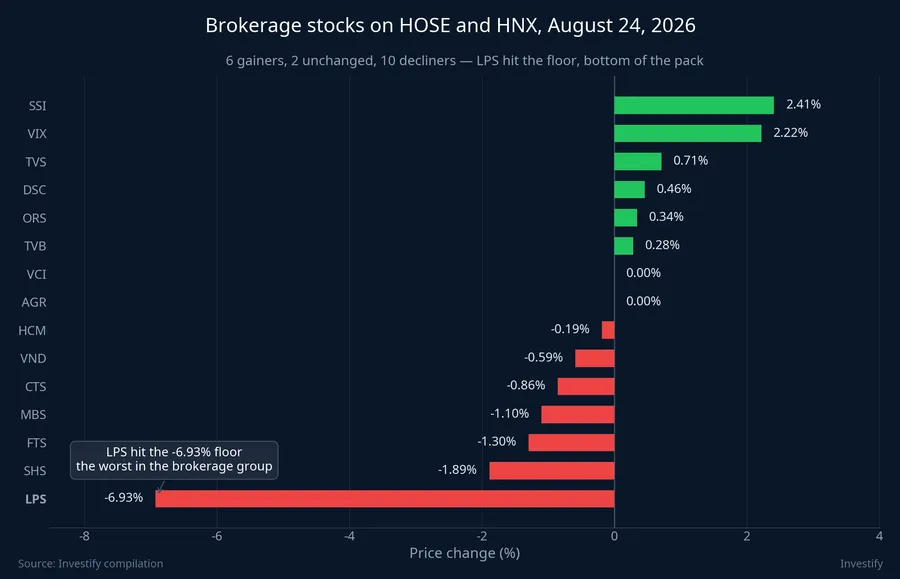
Equal-weighting the five largest HOSE brokerage names, the sector gained only about 0.77% that session, below VN-Index's own 1.17% gain. What gets called a "leading group" was really two leading stocks, with the rest sitting the rally out. And the ticker at the very bottom of the table, well clear of everything else, was LPS.
Six sessions from IPO price to the floor
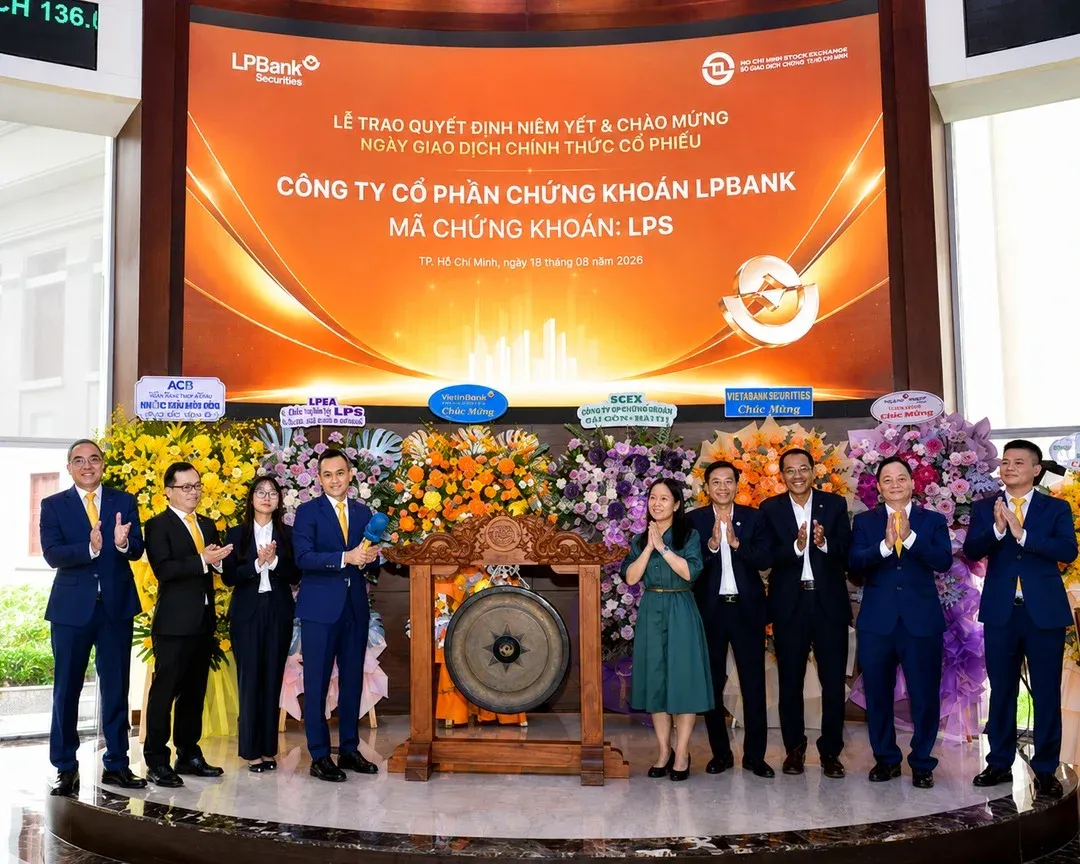
On August 18, 2026, LPS began trading on HOSE at a reference price of VND 30,000, putting its market cap above VND 42,260 billion.Tạp chí Kinh tế Tài chính The first-day band was ±20%; the stock touched VND 35,200 intraday before easing back to close at VND 31,800, up 6%.Tuổi Trẻ
Six sessions later, on August 24, LPS closed at VND 27,550, down 6.93%, exactly the floor of HOSE's standard ±7% band, cutting its market cap to roughly VND 38,800 billion. The more telling detail isn't the price drop but the volume: matched trading went from 315,400 shares on August 20, to 581,700 on August 21, to 2,326,500 on August 24, roughly four times the prior session. A drop to the floor alongside a fourfold jump in volume points to active selling, not a drift caused by an absence of buyers.
Against its own price history, LPS now sits 13.4% below its debut-day close, 8.2% below its VND 30,000 reference price, and 21.7% below the intraday high it touched on August 18.
All three of the sector's big recent listings sit below their debut price
LPS is not an isolated case. The three largest brokerages to list in the past ten months are all trading below their first-day reference price. TCX (Techcom Securities) listed on October 21, 2025 at a reference price of VND 46,800;Vietstock on August 24 it closed at VND 40,800, down 12.8%. VPX (VPBank Securities) listed on December 11, 2025 at VND 33,900;Mekong ASEAN on August 24 it stood at VND 25,550, down 24.6%. LPS, for its part, is down 8.2% from its reference price after just six sessions.
Set against the broader history, none of this is unusual: a Tuổi Trẻ analysis published January 3, 2026 covering 37 brokerage stocks with over a year of trading found 28 of them, 75.68%, were trading lower after their first 250 sessions.Tuổi Trẻ For a Vietnamese brokerage stock, the debut reference price is rarely an anchor of value. It's just the starting point of a re-pricing process.
What the market is actually re-pricing
LPS and SSI are in the same sector, so sector alone doesn't explain why the two diverged so sharply on August 24. What separates them is the price the market had already paid in advance, and where the profit behind that price is coming from.
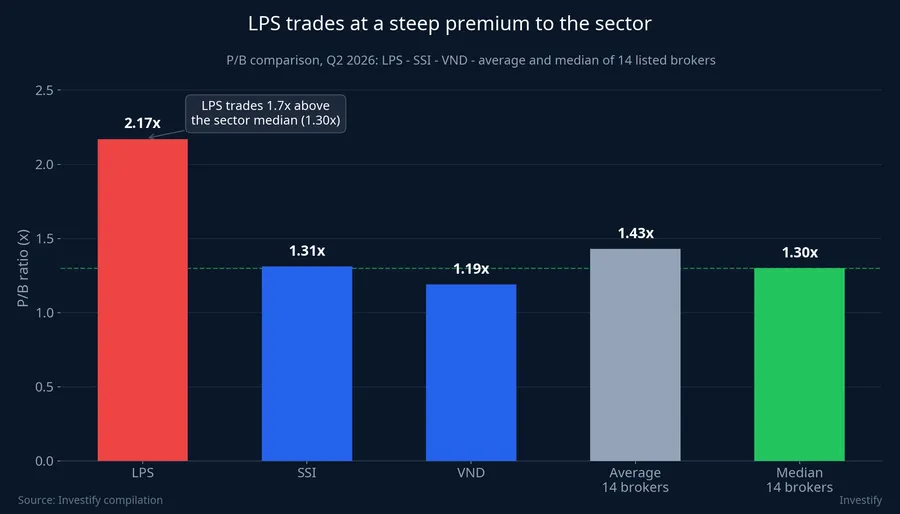
At the August 24 close and a book value of VND 12,716 per share, LPS is trading around 2.17x P/B and roughly 45.6x P/E. The 14 listed brokerages have an average P/B of 1.43x and a median of 1.30x for Q2 2026, with SSI at 1.31x and VND at 1.19x. Buyers of LPS are paying more than twice book value, against a sector clustered near 1.3x.
The composition of that profit explains why the premium is hard to sustain. In the first half of 2026, LPS posted revenue of VND 2,717 billion, of which gains on financial assets at fair value through profit or loss (FVTPL) made up VND 1,557 billion, while brokerage revenue was just VND 93 billion. That's the profit of a proprietary trading book in a rising market, not a steady stream of client fees, and it reverses when the market does.
To be clear, the underlying business performed well. In Q2 2026, LPS posted after-tax profit of nearly VND 503 billion, 2.4 times year-over-year, its first quarter above the VND 500 billion mark; six-month cumulative profit reached nearly VND 575 billion, 42% of its full-year VND 1,700 billion target.Tuổi Trẻ The issue isn't the company's fundamentals. It's that the price has run ahead of the sustainable portion of that profit.
Who owns the stock
LPS's ownership structure is unusual for a brokerage its size. Per its listing prospectus, LPS has five major shareholders, all individuals, holding 52.77% of charter capital; including related parties, that rises to 61.72%.Tuổi Trẻ LPBank itself, despite lending its name to the company, does not appear on the major-shareholder list. The two largest shareholders are Nguyễn Ngọc Mỹ Anh, Assistant to the CEO at Sacombank, and Nguyễn Xuân Thái, a Board Member at LPS itself and concurrently Assistant to the Board at Sacombank, each holding 13.49% of the company. Both are children of Nguyễn Đức Thụy (known as "bầu Thụy"), Standing Vice Chairman of Sacombank's Board and former Chairman of LPBank's Board from December 2022 to December 2025, who directly owns 4.45% of LPS. Combined, the three family members hold 31.43% of the company.
LPS's free float sits at 37.66%, roughly 530 million shares. That sounds large, but matched volume on August 24 was only 2.3 million shares, just 0.16% of charter capital. A very small volume of selling, relative to the company's size, was enough to push the price down the full band, a hallmark of a stock without an established liquidity base yet. Decree 155/2020 requires insiders and related major shareholders to commit to holding 100% of their shares for the first six months after listing and 50% for the following six months,Vietstock so for LPS, the major shareholder group cannot sell yet; that first six-month mark falls in mid-February 2027.

Three other explanations for the floor-price session
The causal story here isn't closed. At least three other explanations are equally plausible alongside the valuation gap.
Profit-taking after the debut rally. Buyers from August 18 at the VND 31,800 level are now down 13.4%, and those who bought at the VND 35,200 intraday peak are down 21.7%. Stop-loss and profit-taking pressure is real, but the available data can't separate how much came from which group.
Broader pressure across the wider group. On the same August 24 session, LPB (Loc Phat Bank) fell 1.80% and was the single biggest drag on VN-Index, at 1.92 points. Two related tickers under pressure on the same day could be coincidence, or it could reflect shared sentiment toward the group. The available data isn't enough to say which.
Money rotating within the sector. SSI matched 32.45 million shares on August 24, VIX matched nearly 63 million, while LPS matched just 2.3 million. That scale gap is too large to argue that money left LPS and flowed into SSI; it more likely reflects two entirely different pools of investors.
Of these three explanations, the data leans most toward the stock-specific story: no adverse corporate event occurred in the August 18-24 window, the broader market still rose 1.17%, and selling volume quadrupled at a stock that had just listed. This reads as supply pressure specific to a newly listed name, compounded by its valuation gap to the sector, rather than a reaction to any particular piece of bad news.
What to watch
For a newly listed stock, the debut reference price isn't an anchor of value. It's simply the level the underwriter and the company agreed on before the first trading session. The real anchor is book value and revenue composition, and on both of those measures LPS is currently priced well above the sector.
The standard practice for freshly listed stocks is to wait for at least one full quarterly report after listing before judging where the price settles. For LPS specifically, the figure worth watching is the share of revenue coming from brokerage fees and margin lending in Q3 2026. If those two lines expand, a P/B above 2x has more grounds to hold. If profit still leans mainly on proprietary trading, the gap to the sector's 1.3x median will likely keep pulling the price down.
The shorter lesson sits right in the August 24 session itself: picking the right sector with money flowing into it is not the same as picking the right stock within that sector. Same sector, same session, and the gap between the best performer and the one that hit the floor was already more than 9 percentage points.