

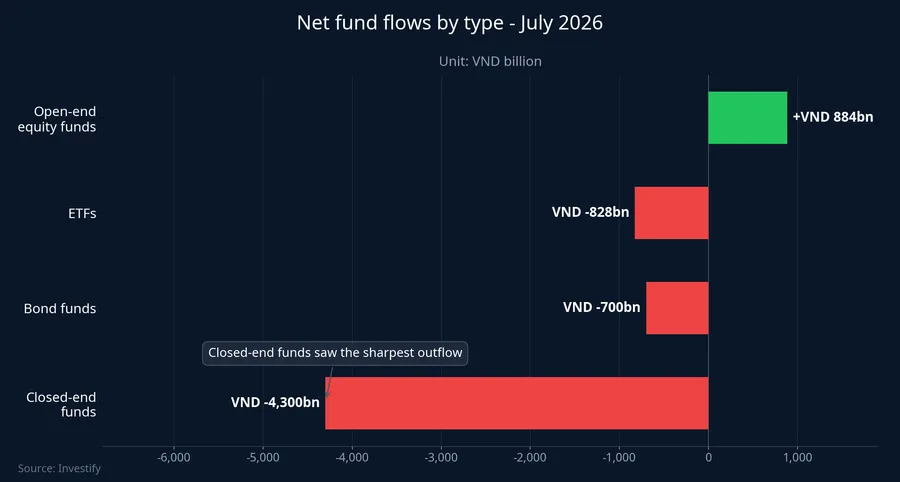
The July 2026 fund-flow data opens with a number that invites the wrong conclusion. Per FiinGroup analysis published by Thời báo Tài chính Việt Nam on August 24, Vietnam's equity funds saw net outflows of over VND 4,200 billion in July, up 13.8% from June.Thời báo Tài chính Việt Nam Read in isolation, a new investor could easily conclude that money is fleeing equity funds altogether.
Break down that number and the story changes. The outflow pressure sits almost entirely in closed-end funds, at over VND 4,300 billion, 13.2 times June's level. The foreign fund VEIL alone accounts for 96.7% of that, close to VND 4,200 billion. This is not a pessimistic sell decision.Thời báo Tài chính Việt Nam VEIL is paying out under a certificate buyback program it announced to shareholders back in late 2025: a scheduled outlay, not a reaction to July's market swings.
Strip VEIL out of the calculation and equity funds saw net outflows of just over VND 91 billion. Within that remainder, the money splits into two opposite directions: open-end equity funds pulled cash in, while foreign ETFs saw it pulled out.
Open-end equity funds: cash arrived the same month the market fell
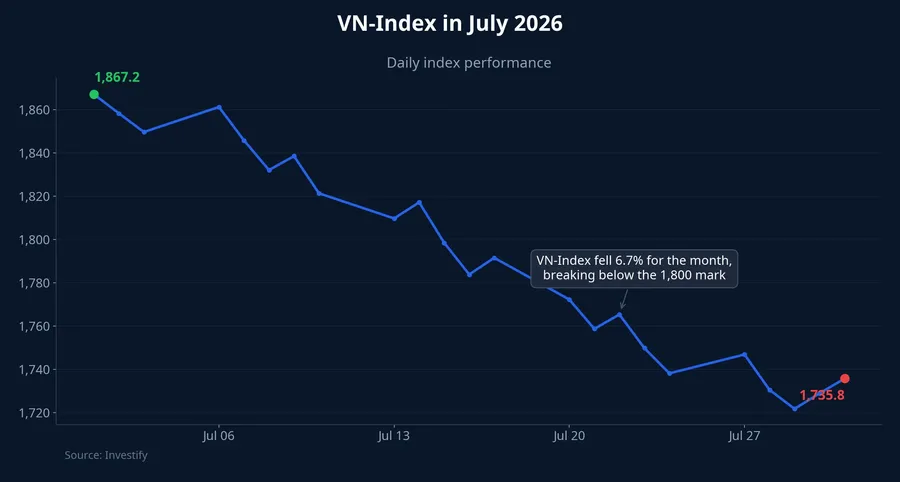
Open-end equity funds took in net inflows of over VND 884 billion in July, reversing two straight months of outflows.Thời báo Tài chính Việt Nam What stands out is the backdrop: that same month, the VN-Index fell 6.7%, from 1,860.01 points at the end of June to 1,735.78 at the end of July, and 77.6% of listed stocks lost ground. The cash arrived exactly when the board was flashing red.
The inflows concentrated in a handful of foreign-managed funds: VNEFUND, LVF, and PRINCIPAL VNEQ-A. DCDS, meanwhile, logged its second straight month of net inflows.
At least three explanations are equally plausible here, and the published data cannot separate them. First, investors may be actively buying the dip. Second, pre-set periodic purchase orders — the dollar-cost-averaging many retail investors use with open-end funds — execute automatically regardless of market direction. Third, there may simply be money shifting within the same fund manager: Dragon Capital saw heavy outflows from its bond fund DCIP in the same month its equity fund DCDS took in net inflows. That third explanation cannot account for the full VND 884 billion, but it is a reminder that "new money entering the market" and "money moving between funds" are two different things.
The detail that matters more for anyone who just put money in is that most of it has not been used to buy stocks yet. In July, 25 of 36 open-end equity funds increased their cash holdings, up from 16 of 36 in June.Thời báo Tài chính Việt Nam DCDS alone raised its cash weighting from 11.2% to 27.4%, took in over VND 119 billion in net inflows, and increased its bank deposits 3.1 times over the prior month.
This is precisely what distinguishes actively managed open-end funds from other channels. Buyers of open-end fund certificates hand both the stock-picking decision and the timing decision to the manager. When the manager chooses to hold cash, the money just deposited sits in a bank account, not in equities. In exchange, the fund keeps room to buy if prices fall further.
ETFs: the seller sits overseas
The same month, ETFs saw outflows of over VND 828 billion, up 103% from June.Thời báo Tài chính Việt Nam The pressure concentrated in two names: the VanEck Vietnam ETF lost VND 695 billion and the Fubon FTSE Vietnam ETF lost VND 233 billion.
Both are index funds set up by foreign institutions and sold to foreign investors: one raised in the US, the other in Taiwan. When an investor there redeems fund shares, the ETF must sell the corresponding Vietnamese stocks to pay out, exactly in proportion to the index basket. No one sits down to weigh which stock is worth keeping, because that is the nature of an index fund.
The consequence for domestic investors is concrete: selling pressure from ETFs does not reflect any judgment on Vietnamese businesses. It reflects the cash needs and risk appetite of investors in a different market. That is also why domestic open-end fund flows and foreign ETF flows can move in opposite directions in the same month without any contradiction. Two different groups of people are answering two different questions.
On the upside, ETFs are the most transparent vehicle in terms of holdings and typically carry the lowest fees, in exchange for tracking the index exactly, no more and no less. July showed the downside of that mechanism: ETFs tracking the VNDiamond index took a direct hit from the sharp declines in PNJ, TCB, and MWG, because the index basket forces the fund to hold those names.
Bond funds: 11 straight months of outflows, and the savings-account comparison
Bond funds saw net outflows of over VND 700 billion in July, up 20.2% from June. That marks the 11th straight month of outflows, bringing the cumulative total to nearly VND 14,200 billion, with the pressure concentrated in TCBF and DCIP.Thời báo Tài chính Việt Nam
This 11-month streak is not a reaction to any single shock. It is the outcome of a calculation an increasing number of people have already run. The average return of bond funds over the first seven months of the year reached 3.5%, slightly above the 3.2% posted in the same period last year, but nearly identical to the 3.4% average savings rate.Thời báo Tài chính Việt Nam In July alone, the group returned 0.48%, below June's 0.54%.
Once the yield premium over a savings account shrinks to roughly 0.1 percentage point, the comparison becomes simple. Bank deposits are insured up to VND 125 million per person per bank and the rate is known in advance, while bond funds still carry the issuer's credit risk and the certificate's value still moves with the interest-rate environment. A margin that thin is not enough compensation for the added risk. That makes 11 straight months of outflows a rational decision, not a panic.
This also flips a familiar assumption on its head: bond funds will become attractive again once savings rates fall, or once the yield spread between corporate bonds and deposits widens back out. That is the signal worth watching. It has not shown up yet.
What the flow table does not tell you
A flow table tells you where money went in, not whether that money made or lost value. July's performance numbers were considerably worse than the inflow figures alone would suggest.
Every single one of the 91 equity funds tracked lost money in July, with an average return of -7.4%, a steeper decline than the VN-Index's -6.7%.Thời báo Tài chính Việt Nam Over the first seven months of the year, the average equity fund return was -8.9%, versus just -2.7% for the VN-Index: a sharp reversal from the same period in 2025, when this fund group was up 12.2%. 71 of 74 funds posted negative returns, with VNDAF among the very few holding a positive result, at 1.2%.
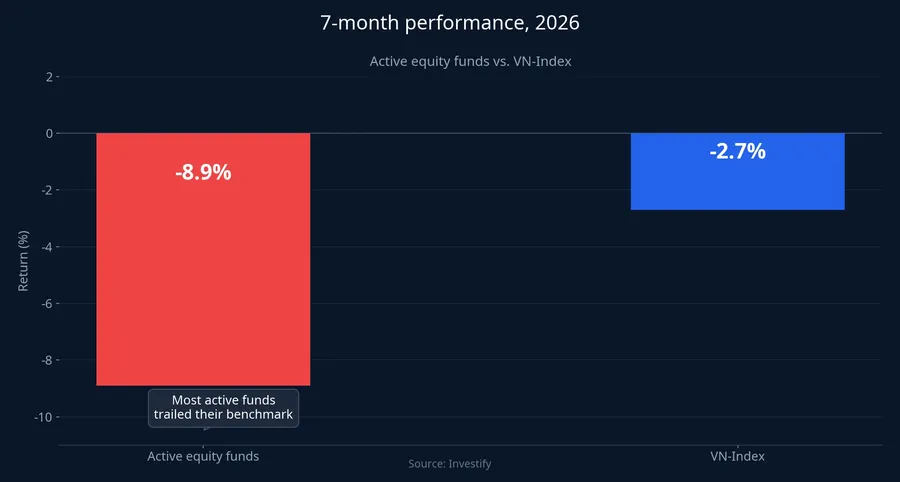
In other words, over the first seven months of the year, most active equity funds underperformed the very index an investor could buy through a low-fee ETF. FiinGroup attributes this to index gains concentrating in a handful of very large-cap stocks, while most funds' broader portfolios performed less well.Thời báo Tài chính Việt Nam For the same reason, total industry NAV has fallen VND 53,100 billion from its August 2025 peak, a 17.7% decline, even as the VN-Index rose 3.1% over the same period.
The industry's current scale: total NAV across Vietnam's investment funds stood at roughly VND 247,800 billion at the end of July, down VND 26,900 billion from the end of June, a 9.8% drop.Thời báo Tài chính Việt Nam
Which fund type fits
These three fund categories are not three quality tiers of the same product. They sell three different things, and July made that clear.

Open-end equity funds sell the manager's judgment: both stock selection and the timing of holding cash. That suits investors who lack the time to watch the board and who accept that results can diverge from the index in either direction. Based on seven-month data, that divergence is currently skewed unfavorably for most funds, so fund selection should weigh multi-year performance more heavily than a single quarter's ranking.
ETFs sell the index itself, at low cost, with holdings disclosed daily. That suits investors who want results that track the market closely and who handle their own entry and exit timing. In exchange, the fund has no discretion to avoid steep decliners within the basket, as VNDiamond showed in July.
Bond funds sell relative stability compared with equities. With a seven-month yield only about 0.1 percentage point above savings rates, this channel only really makes sense once that spread widens. The default benchmark for money parked under a year remains the term deposit.
August's data will be the next test. The VN-Index has recovered to 1,788.78 points as of the August 24 session, 3.1% above end-of-July levels but still below the 1,867.21 points where July began. If open-end equity funds keep drawing net inflows during this recovery month, July's flows were deliberate deployment. If the money reverses the moment prices rise, most of that VND 884 billion was simply automated periodic buy orders running on schedule. Those two scenarios say very different things about how mature Vietnam's domestic capital has become through the fund channel.