
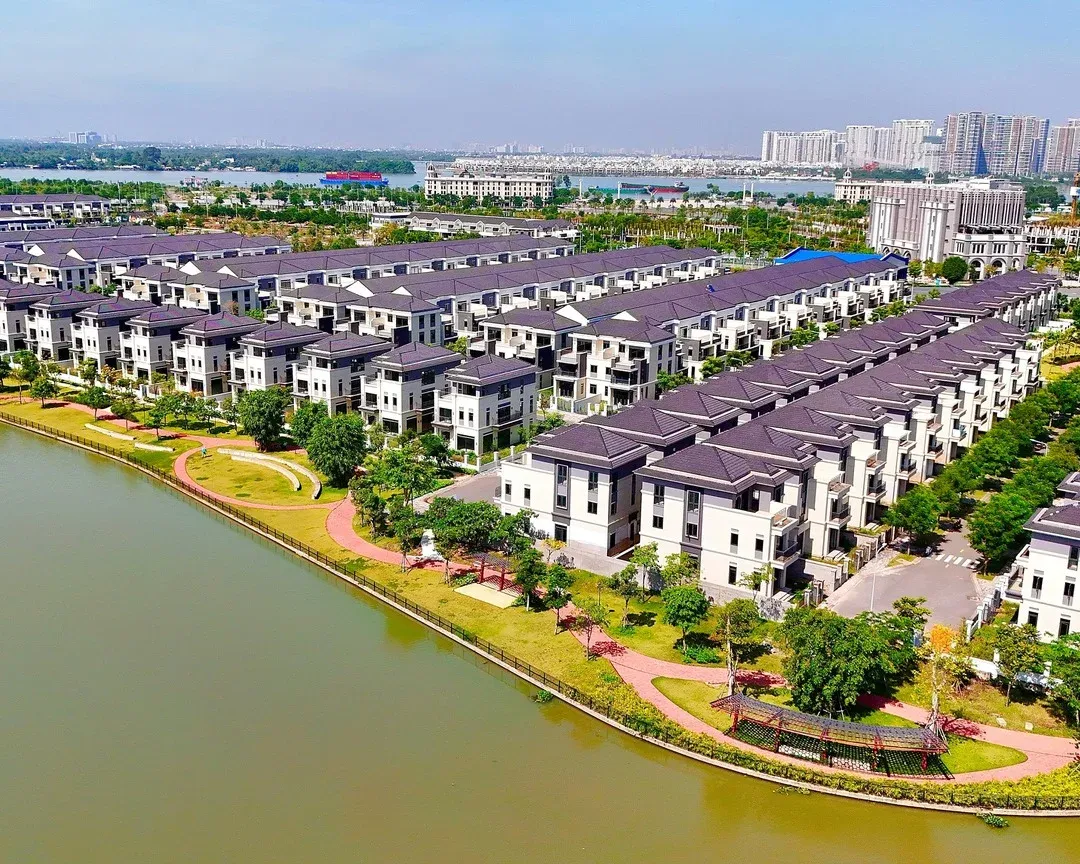

This week's biggest Novaland (NVL) headline is that bondholders agreed to extend nine bond tranches worth over VND 13,800 billion in principal.Người Quan Sát For a developer that has been asking creditors for extensions for three straight years, that's not an easy deal to land, and the market's default read is to file it under good news.
Taken at face value, that read holds up: bondholders agreeing to push out maturities means they still believe Novaland can pay. But the same reviewed H1 2026 financial statements that carried the extension news also contain a set of numbers running the other way, and they're worth reading closely before drawing a conclusion.
What got extended and what didn't
The VND 13,800 billion figure has two pieces. The first is eight domestic bond tranches with combined principal of over VND 5,900 billion, where bondholders agreed to push back payment.Người Quan Sát The second is the international convertible bond tranche, with USD 302 million in principal outstanding (roughly VND 7,900 billion), which reached a restructuring agreement after 85.66% of bondholders approved a one-year maturity extension plus a waiver on certain payment obligations the company had missed.Vietstock
Novaland's total bond debt at end-June stood at nearly VND 23,700 billion.Người Quan Sát That means the extended portion covers roughly three-fifths of the total, leaving the rest outside the deal. Within that remainder are two tranches currently overdue, NVLH2123009 and NVLH2232001, with combined outstanding principal of nearly VND 4,000 billion, and on August 23 the company disclosed a new material event covering the principal and interest payment status of NVLH2232001 and NVLH2232002.Vietstock
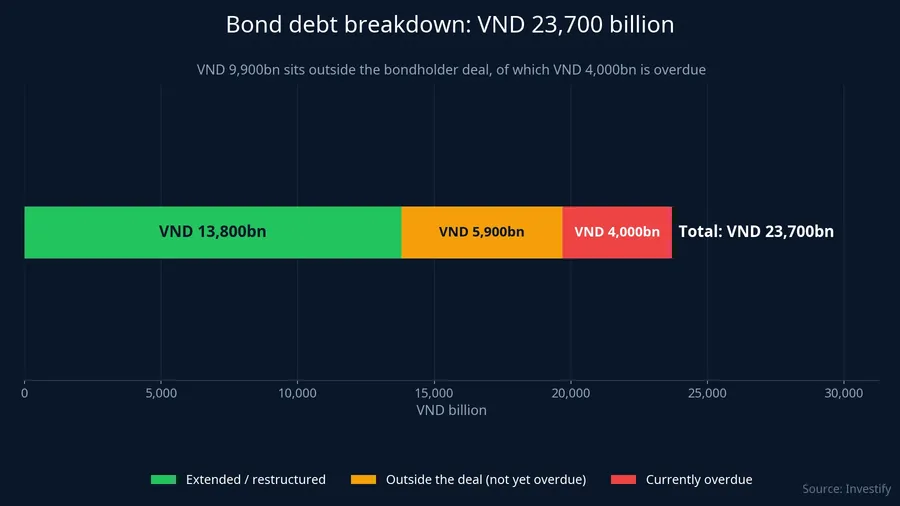
Even within the international tranche that just got restructured, more than USD 7.94 million of interest still has no confirmed funding source.Người Quan Sát That tranche was issued in July 2021 with an original five-year term, maturing on July 16, 2026, before being pushed out another year. In other words, even the part that just got "extended" still carries an unresolved obligation.
Debt hit a record in the very report that carried the extension news
The most notable line in the semi-annual report isn't the bond section, it's total borrowings: nearly VND 72,900 billion, an all-time high, made up of roughly VND 30,500 billion in short-term debt and VND 42,400 billion in long-term debt.Người Quan Sát That's a slight increase from over VND 72,500 billion at the start of the year.
Put the two lines side by side and a move that's gone largely unremarked in the extension coverage becomes visible. Bond debt fell by more than VND 1,000 billion in the first half, while total borrowings edged higher, meaning the bonds that got paid down were replaced by other borrowing. Within that near-VND 72,900 billion, bank loans account for roughly VND 31,300 billion and bonds for nearly VND 23,700 billion, with the remainder made up of loans from institutions and individuals.Fili Total liabilities for the group stand at over VND 193,400 billion, close to three-quarters of total capital.Fili
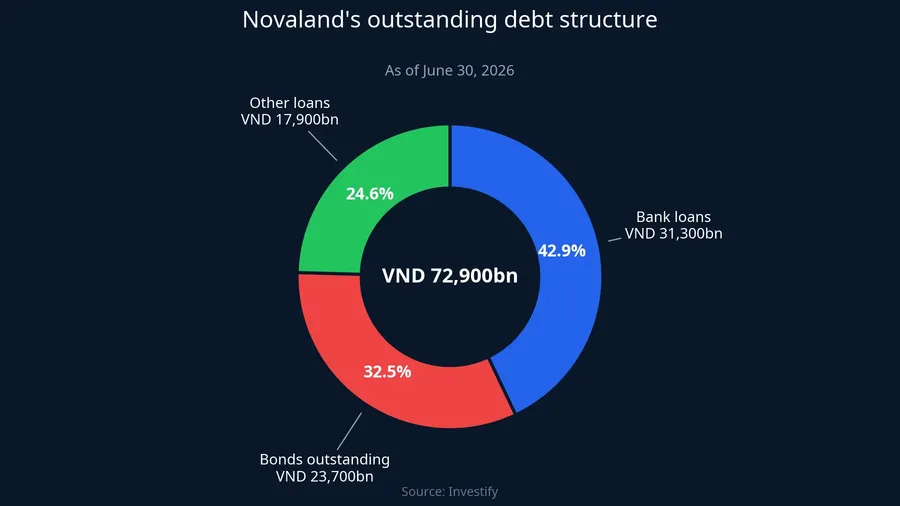
An extension changes the repayment schedule. It doesn't shrink the debt, and over the past six months the debt has actually grown.
Profit is real, but cash is leaving faster than it's coming in
At first glance, H1 results support the optimistic read. Novaland posted net revenue of VND 5,096 billion and consolidated after-tax profit of VND 1,772 billion, a reversal from a VND 666 billion loss in the same period last year and equal to about 96% of the full-year profit target.Fili
Look closer at where that profit came from, though, and most of it didn't come from selling homes. Six-month financial income reached nearly VND 2,600 billion, mostly interest on loans, investment cooperation income, and gains from divesting subsidiaries.Fili On the cash flow statement, net operating cash flow was negative nearly VND 3,600 billion, and interest paid alone came to nearly VND 2,700 billion, more than the after-tax profit reported on the income statement.Fili
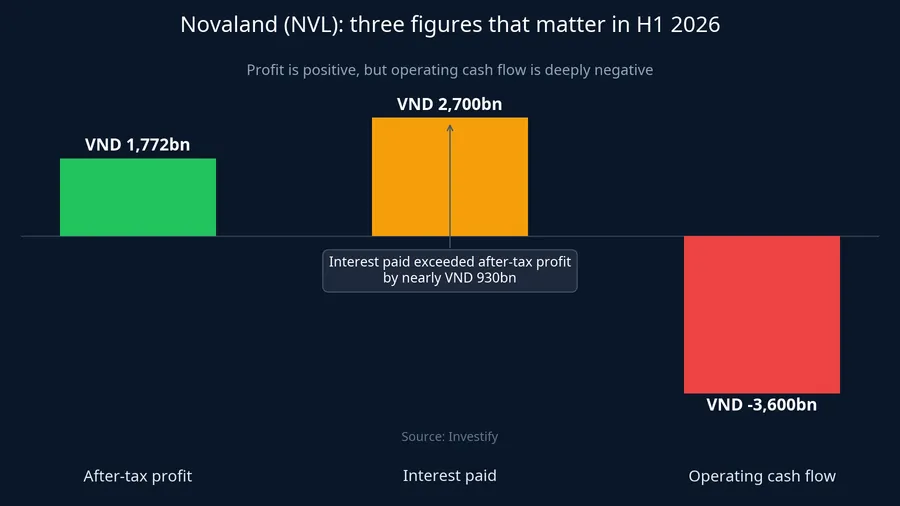
The asset mix explains why cash is slow to come in. Inventory accounts for over VND 157,700 billion, more than 61% of total assets of VND 258,700 billion, mostly capitalized costs at projects under development, and over VND 66,000 billion of that inventory is pledged as collateral for loans.Fili Cash and cash equivalents at the end of Q2 stood at just nearly VND 4,900 billion.Người Quan Sát
The money to clear overdue debt is riding on shareholders
This is the link that rarely shows up in extension coverage. Novaland plans to offer over 800 million shares to existing shareholders at a 3:1 ratio, priced at VND 10,000 per share, raising over VND 8,006 billion.Người Quan Sát Every dong of that is earmarked for debt repayment: VND 5,953 billion for overdue debts and financial obligations at the parent company, VND 1,137.3 billion contributed to No Va Thảo Điền, and VND 916.3 billion to Nova Saigon Royal so the two subsidiaries can pay off their own debts. Disbursement is planned for Q4 2026 through Q1 2027.Người Quan Sát
Put the two pieces together and a fairly clear thread emerges: the extension buys time, but the cash to settle overdue debt is coming from fresh shareholder capital, not from sales proceeds. Credit risk doesn't disappear with an extension deal, it just shifts to a different group to carry.
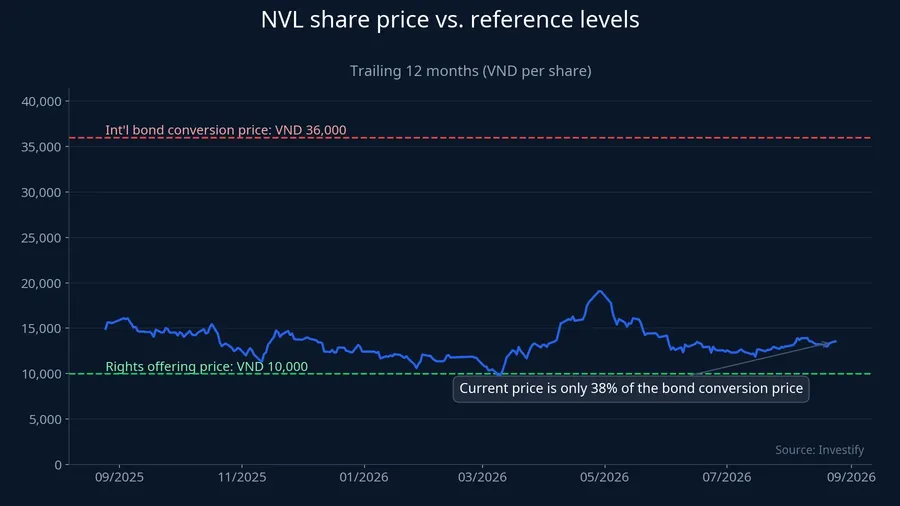
The international bond tranche shows the same dynamic from the other direction. Its conversion price is fixed at VND 36,000 per share, while NVL closed the August 24 session at VND 13,550 per share. At current price levels, almost no bondholder would choose to take shares, so the USD 302 million obligation remains a cash liability, just pushed out to mid-2027.
What could change this picture
This isn't the only way to read the situation. The extension deal has real value: it removes the risk of cross-default spreading across the entire debt structure, and it keeps flagship projects like Aqua City, NovaWorld Hồ Tràm, and NovaWorld Phan Thiết moving toward construction and handover. If the southern real estate market warms up and project legal bottlenecks get cleared, that over-VND 157,700 billion inventory pile could convert to cash much faster than it is now, easing the debt problem without relying on shareholder capital.
The share offering could also succeed in full, given that the VND 10,000 issue price sits roughly a quarter below the market price. What's worth watching is how many shareholders actually put up the cash, since this is a right to buy, not an obligation.
How to read an "extension" headline
For individual investors, most real estate corporate bonds are issued privately and sold only to professional investors, meaning a securities portfolio of at least VND 2 billion maintained for 180 consecutive days. Indirect exposure runs much wider, though, through bond fund certificates, through shares of the issuing companies themselves, and through shares of the banks lending to those same developers.
When an extension headline appears, three lines in that period's report answer a more important question than the headline does: whether total borrowings actually fell or just changed maturity, whether operating cash flow turned positive or interest paid still exceeds cash collected, and where the money for settling debt is expected to come from, sales, asset disposals, or fresh shareholder capital.
For Novaland, the next checkpoint arrives in Q4 2026, when the VND 8,006 billion share offering wraps up and the overdue tranches enter their repayment schedule. Until then, the extension should be read for what it is: good news for short-term liquidity, not yet evidence of repayment capacity.