


12.5% a year sounds like a reward. Stacked against the 6.8% that Agribank, BIDV, Vietcombank and VietinBank all quoted for 12-month deposits on August 21, a real estate bond coupon looks nearly double, and for anyone used to savings accounts that's an easy number to like.CafeF The confidence has some basis too: outstanding real estate business lending had already topped VND 2.5 quadrillion by June 30, 2026, up VND 284,073 billion in the second quarter alone, a 12.71% jump in a single quarter.CafeF
All three numbers check out. There's nothing to argue with there. The problem is the benchmark: buyers are measuring 12.5% against a savings account, when a much closer number sits in the same report that almost nobody reads that far into.
Banks are charging this same sector 12-14% a year
Per a Ministry of Construction report citing State Bank of Vietnam data, real estate lending rates now commonly run 12-14% a year after the promotional period ends, with many loans resetting to a floating 13-15%, and some banks charging as much as 15-16%.CafeF Put the two numbers side by side and the picture flips: the 12.5% bondholders receive is exactly the floor of what banks are already collecting from real estate borrowers.
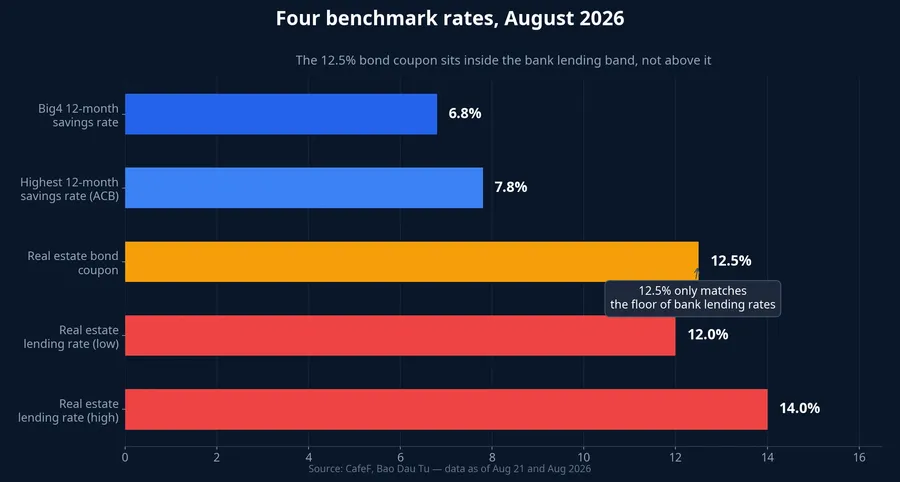
Same sector risk, same project cash flow, but the two sides stand in completely different positions. Banks hold collateral and sit first in the payout order if a project runs into trouble. Buyers of privately placed bonds sit behind them, holding nothing but a paper commitment. The right question isn't "is 12.5% better than a savings account," it's this: why would a bondholder accept more risk than a bank in exchange for a rate that's merely equal to, or even below, what the bank charges from a safer position?

A 3.8-point gap in the same month
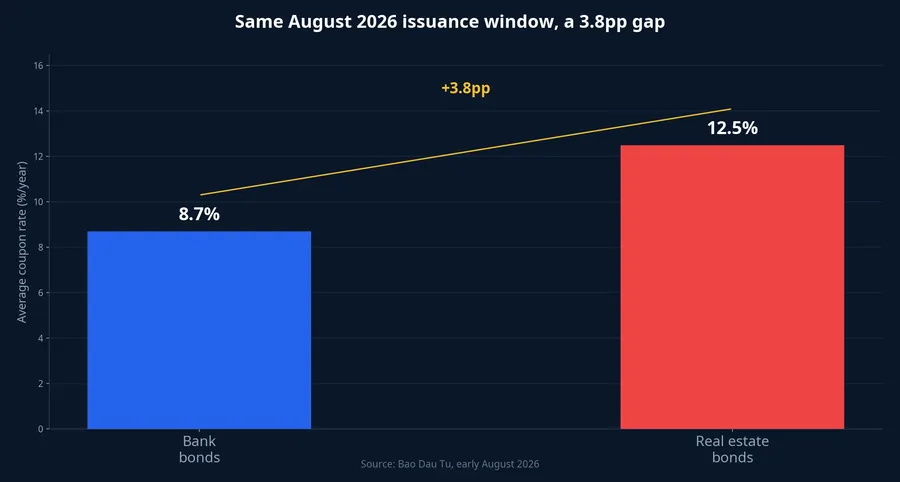
The cleanest test is bond against bond, in the same issuance window. Data compiled in early August shows the average coupon for bank bonds at 8.7% a year, versus 12.5% for real estate bonds.Bao Dau Tu Both groups raised money in the same market at the same time, so a 3.8-point gap can't be explained by the general rate environment. That gap is the credit risk premium the market is pricing into the real estate sector.
One clause in a recent issuance makes the point better than any statistic. Crystal Infrastructure Construction Co. Ltd. raised VND 2,000 billion over a five-year term, with the first two interest periods fixed at 12.5% a year and every period after set at the reference rate plus a 4-point margin, with a floor of 12.5%.CafeF A floor clause like that means the issuer accepted paying at least 12.5% for all five years, even if the broader rate environment falls. Companies only sign terms like that when their other funding doors have narrowed considerably.
The sector-wide trend points the same way: Minh An Investment JSC raised VND 7,500 billion at roughly 10-10.5% a year, and Parkland 53 Co. Ltd. issued VND 7,000 billion with a term of just 12 months at 10% a year. A term that short means the premium isn't coming from locking up capital for the long run.
Three explanations, and only one the data backs
There are at least three plausible explanations for why real estate bond rates are climbing, and no single one should get all the credit. The first is that the broader deposit rate environment is rising: on August 21, ACB led the 12-month segment at 7.8%, and Nguyen Quang Huy, a finance and banking lecturer at Nguyen Trai University, argues that more attractive bond rates are simply a supply-and-demand response.CafeF But that only explains part of it: in the same month, bank-issued bonds paid just 8.7%.
The second is a term premium: a five-year bond demanding more than a 12-month deposit is normal. But the Parkland 53 bond, with a term of exactly 12 months, still paid 10%, so term length doesn't account for most of the gap. The third explanation, and the one the data supports most, is credit risk in the sector itself, and it rests on three fairly clear legs.
Three legs behind the risk story
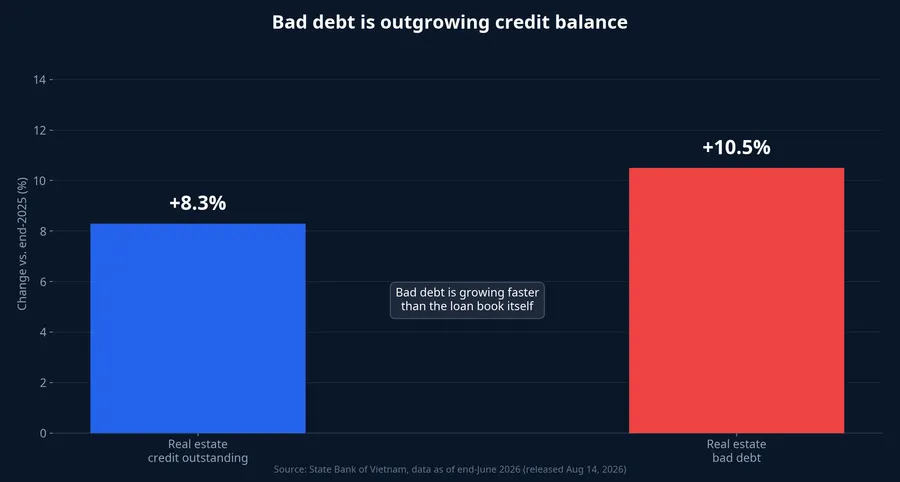
Scale is already highly concentrated. Per State Bank of Vietnam data released on August 14, real estate credit outstanding reached VND 5,146 trillion by end-June 2026, up 8.3% from end-2025 and equal to 25.5% of total credit across the economy.VnEconomy More than one in every four dong banks lend out is tied to real estate, meaning a shock to the sector is a shock to the whole credit system.
Quality is deteriorating faster than the balance is growing. Per the same data, real estate bad debt rose 10.5% from end-2025, faster than the 8.3% growth in credit outstanding. When bad debt outpaces the loan book, the bad-debt ratio climbs, and every lender, bondholders included, ends up demanding a higher price for the next dong.
The repayment schedule is bunching up. VIS Rating estimates roughly VND 99,000 billion in real estate bonds will mature in 2026.CafeF That's the direct driver behind the rush to issue new bonds, and it's also why issuers have little room to negotiate rates. The market is still logging late payments: Construction Business Development Company 3 was late on VND 2,210 billion in principal on June 20, 2026, and Thuan Hoa Ha Giang Hydropower JSC was late on VND 497 billion in interest on February 25, 2026.
The feedback loop bond buyers rarely see
There's a link connecting the 12-14% lending rate to an issuer's ability to repay, and that link is the home buyer. The Ministry of Construction report notes that high interest rates, low loan ceilings and strict income-verification requirements are locking some buyers out of financing, pushing up the number of failed transactions and, through that, weighing on liquidity across the market. What the report doesn't spell out directly is that the cash used to pay 12.5% bond coupons ultimately has to come from that project's own home sales: high funding costs simultaneously push up what a developer must pay to raise new capital and slow down the very cash flow meant to service that interest. Both effects move in the same direction; neither offsets the other.
Policy is tightening from both ends

The State Bank of Vietnam is requiring credit institutions to keep real estate lending growth from outpacing each institution's own overall credit growth in 2026, while targeting system-wide credit growth of roughly 15%, below the 19.1% actually achieved in 2025.
On the legislative side, the National Assembly opened floor discussion on the morning of August 22 on the direction for amending the Law on Real Estate Business. One delegate proposed codifying a ban on market manipulation and price inflation and setting up an early-warning system, describing speculation as the use of financial leverage to distort supply and demand.Tap Chi Kinh Te Tai Chinh The Minister of Construction also spoke at the session about banning land-plot subdivision and sale in Tier 1, 2 and 3 cities.VietNamNet This is still the direction-setting discussion stage, not an issued regulation, but the direction is clear: shrink the share of capital flowing into speculation.
The right benchmark for individual investors
The more accurate picture isn't "real estate bonds pay more than savings, so they're more attractive." It's that the cost of capital across the real estate sector is being repriced upward on every channel at once, and 12.5% is simply the level at which bond buyers are stepping into that same repricing, from a position less safe than a bank's.
The right benchmark for a real estate bond isn't the 6.8-7.8% savings rate; it's the 12-14% banks are already charging that same sector to lend. When an offered yield sits below or merely level with that band, the premium bondholders should be earning for their worse position in the payout order has effectively dropped to zero. For anyone without the means to read an issuance prospectus, project cash flows and collateral filings, the reasonable default for anything under 12 months remains a deposit or a fixed-yield product, where the 7-7.8% top rates among banks have already narrowed the gap with bonds considerably. Worth repeating the legal condition too: privately placed corporate bonds are reserved for professional securities investors, with a portfolio requirement of VND 2 billion held continuously for 180 days.
For anyone still set on participating, the minimum bar is a yield that clearly clears the bank lending band for the same sector, and an issuer that can show sales cash flow sufficient to service its repayment schedule, not just collateral on paper. Two signals worth watching in the months ahead will say more than any advertised rate: whether the 3.8-point gap between real estate and bank bond coupons widens or narrows, and the delinquency rate as most of this year's VND 99,000 billion in maturing bonds moves into year-end repayment.