
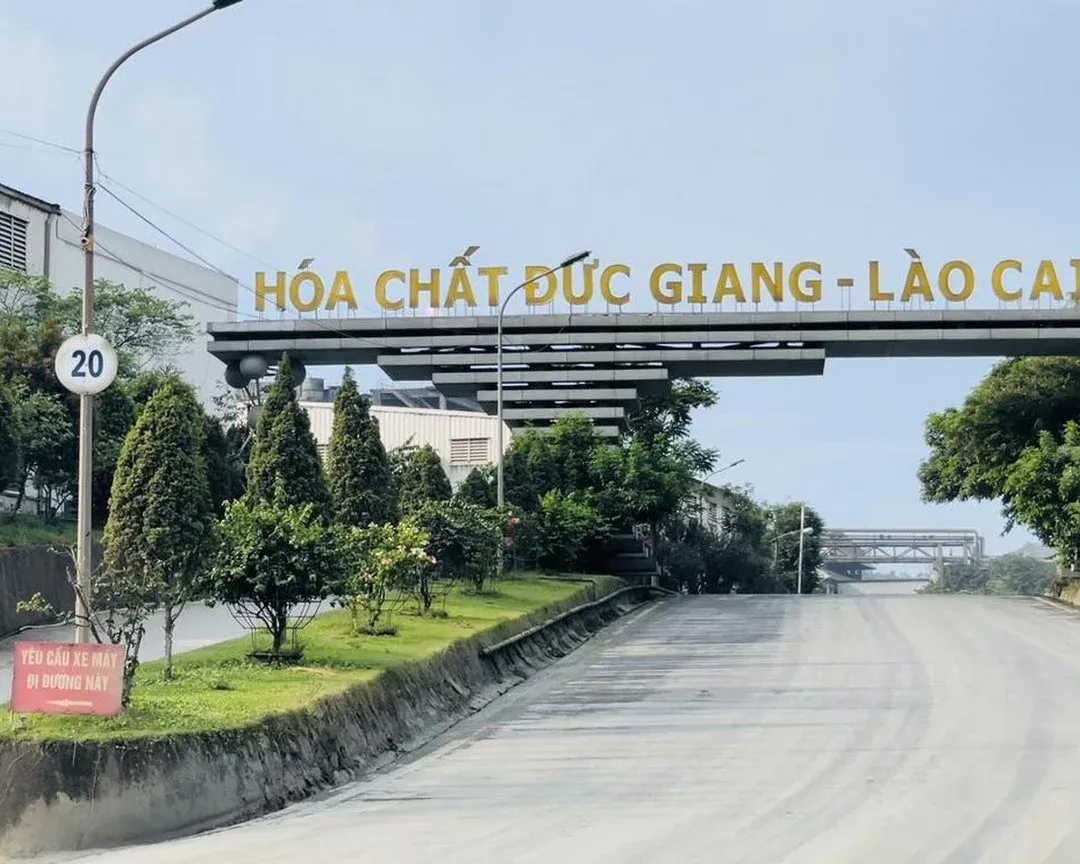

On the afternoon of August 21, the Ho Chi Minh City Stock Exchange (HOSE) announced it would remove DGC, the ticker of Duc Giang Chemicals Group, from its warning list effective August 24, after the company fixed the underlying issue: a delayed annual shareholder meeting.Vietstock The same announcement noted a second fact right alongside it: the stock remains under a trading restriction.
For a reader skimming the headline, those two facts blur into one piece of good news. But a stock's trading status on the exchange is not a single switch. It is stacked from several independent regulatory layers, and each layer has its own unlock condition. DGC just cleared the lightest one. The two heavier layers are untouched.
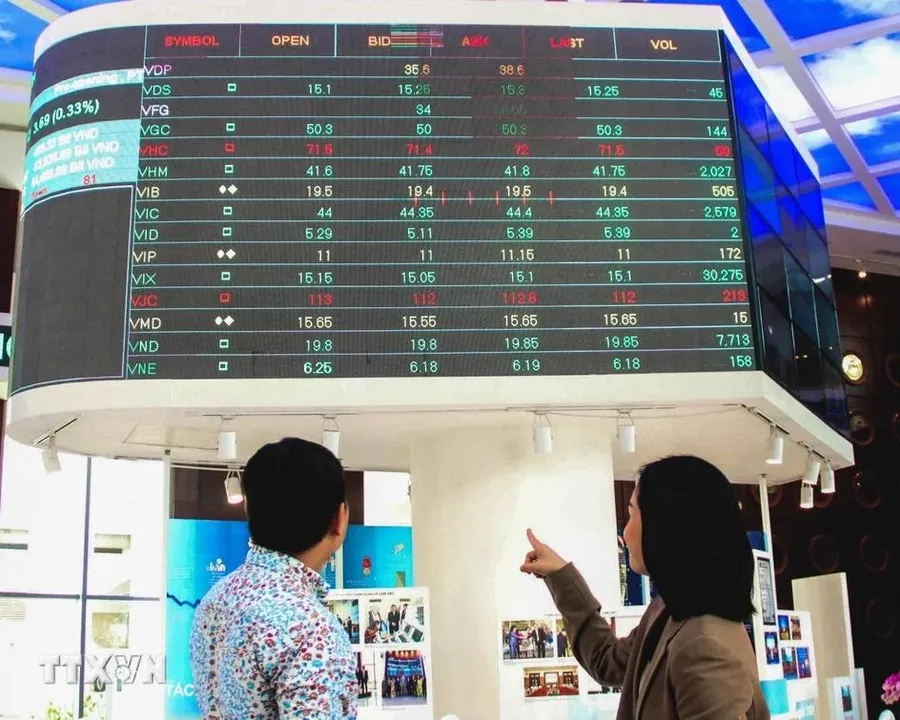
Why "warning lifted means margin restored" is a reasonable assumption
For most HOSE tickers, that assumption is actually correct. In the list of stocks ineligible for margin trading that HOSE published through August 3, 29 of the 57 barred tickers lost margin eligibility purely because they were on the warning list, more than half the total.Vietstock For that group, clearing the warning status automatically clears the reason margin was cut. No further step needed.
The same list has a live example: ticker TIX was removed from the margin-ban list as soon as its warning status was resolved. Investors who have seen cases like TIX and extrapolate the same outcome to DGC aren't reasoning carelessly, they're following the majority pattern. The problem is DGC doesn't belong to that majority.

DGC's margin ban is filed under a different line item
In the same August 3 list, DGC is not among the 29 tickers cut for warning status. It sits in a much smaller group, just four tickers, cut for being under a trading restriction instead, alongside HVN of Vietnam Airlines. That one-line difference decides the entire outcome: DGC's margin ban was never tied to the warning status, so lifting the warning on August 24 does nothing to the actual condition behind the ban. To get margin eligibility back, the stock has to exit the trading-restriction status first, and that runs through an entirely separate door.
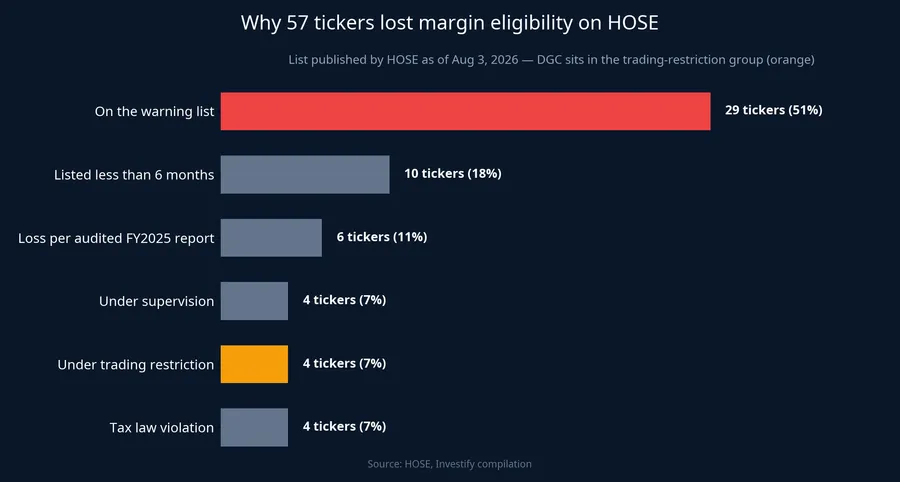
Looking at that chart, DGC doesn't sit in the largest group. It sits in the four-ticker group marked in orange. That is exactly the detail new investors miss when reading a warning-removal notice: the notice only speaks to the layer it addresses, not to whatever else is still stacked on top.
The trading restriction hits order matching directly
HOSE placed DGC under trading restriction from May 26, after the company filed its audited 2025 financial statements more than 45 days past the regulatory deadline, per Decision No. 448/QD-SGDHCM dated May 20.Tuoi Tre HOSE later eased the terms: from May 26, DGC could trade all day but only via periodic call auction for round lots, instead of being confined to the afternoon session as originally announced.DNSE Periodic call auction still means orders wait to be batched before matching, rather than matching continuously the way a normal stock does.
The measurable effect shows up in liquidity. Over the most recent 20 sessions, DGC matched an average of about 538,000 shares per session. Over the 20 sessions before the restriction took effect, that figure was close to 2.94 million shares, roughly 5.5 times higher.
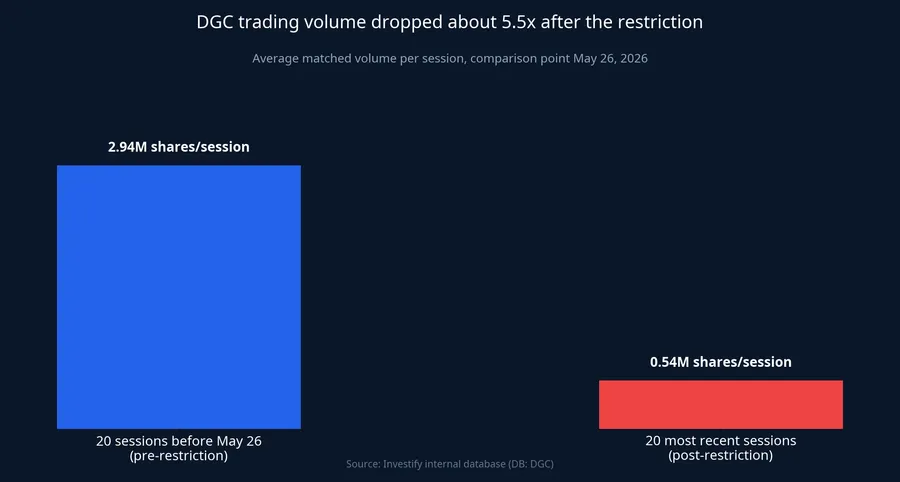
To be precise about attribution: this drop doesn't trace to a single cause. The periodic-auction mechanism itself reduces the number of orders that can match, the margin ban removes leveraged trading activity, and the criminal case that indicted the Chairman and a string of senior executives back in March 2026 pushed some investors away from the ticker entirely.Vietstock These three factors compound each other, and public data isn't granular enough to isolate each one's share of the drop.
The real unlock sits with the auditor, not with HOSE
The delayed shareholder meeting was something the company could fix on its own, and it did: the 2026 annual meeting was finally held on August 13, well past the legal deadline of June 30.Thuong Truong Once the meeting was done, the warning was cleared almost immediately, which is exactly what happened on August 21.
The remaining two layers are not that simple. The root cause is a qualified opinion on DGC's audited 2025 financial statements, which triggered the warning status effective June 30 under Decision No. 544/QD-SGDHCM.Thoi Bao Tai Chinh Viet Nam The qualified item was VND 950.9 billion of inventory on the consolidated balance sheet as of December 31, 2025.
The cause of the qualification is more procedural than a red flag over the numbers themselves: auditor UHY replaced PwC in May 2026, after the 2025 fiscal year had already closed, meaning UHY could not directly observe the year-end inventory count. Alternative procedures weren't sufficient to confirm the figure. But procedural issues still cost time, and not a small amount.
Per the company's stated timeline, resolving this requires two detailed physical counts with UHY: one tied to the mid-year review as of June 30, 2026, and one tied to the full-year audit as of December 31, 2026. In other words, the earliest window for the remaining two layers to clear falls in Q3 2026 or Q1 2027, not August 24. Any investor expecting margin access to reopen within weeks should reset that expectation against this timeline.
The same day, a related ticker lost margin eligibility for a third reason
On August 21, TSB of Tia Sang Battery on the Hanoi Stock Exchange (HNX) was added to the list of tickers ineligible for margin trading, because both its H1 2026 after-tax profit and its undistributed after-tax profit as of June 30, 2026 came in negative per its semi-annual report. TSB is a subsidiary of Duc Giang Chemicals, which has held 51% of the company since early 2023, and TSB had already posted an after-tax loss of VND 1.29 billion as far back as Q1 2026.Nguoi Quan Sat
The point worth noting for new investors: the criterion that cut TSB has nothing to do with warning status or trading restrictions. It's a pure earnings criterion, read straight off the financial statements. Same corporate group, same day, two tickers blocked from margin by two entirely different clauses. That's further evidence that "margin cut" isn't one single reason. It's a set of independent gates.
DGC closed up nearly 4% on August 21, and why that shouldn't be pinned on the notice alone
DGC closed at VND 43,050 per share on August 21, up 3.99%. It's tempting to read that as the market reacting to the warning-removal news, but that explanation has to compete with at least two others. The same session, the VN-Index rose 33.88 points, or 1.95%, with 278 gainers, on the exact day FTSE Russell announced its new emerging-market index composition. DGC itself had already been recovering from around VND 36,000 since late July, well before any warning-removal notice existed. And with matched volume of just 451,600 shares, a near-4% move like this didn't require much capital to produce. The available evidence isn't sufficient to attribute this specific gain to HOSE's notice.
What to read in the next notice
The lesson here isn't specific to DGC. When a stock is announced as cleared from some status, the information that matters is the stated reason, not the headline. Three questions are worth answering before drawing any conclusion: what statuses does the stock currently carry, what reason is recorded for each one, and does the reason just cleared overlap with the reasons behind the remaining statuses.
For DGC right now, the answer is clear. As of August 24, the ticker exits the warning list. The trading restriction and the margin ban both remain in place, because both are anchored to the audit report, not to the shareholder meeting. The dates that actually matter are the mid-year 2026 review report and the full-year 2026 audit report, not August 24.