


On August 21, 2026, FTSE Russell publishes the results of its September semi-annual review of the FTSE GEIS index family, which includes the Vietnam equity basket.Vietstock The result takes effect on September 21, 2026, the same day Vietnam's stock market officially moves from frontier to secondary emerging market status. The bigger picture here involves two separate questions: on April 8, 2026, FTSE Russell already answered "will Vietnam be upgraded at all," while August 21 answers the question that actually moves money: which stocks make the index, and at what weight.
For newer investors, this distinction matters from the outset. Index funds don't pick stocks by conviction; they buy strictly according to a stock's weight in the basket. That means the list published on August 21 is the only basis passive capital will actually allocate against. Any forecast published before it does not count.
The circulating numbers are forecasts, not the list
Ahead of the announcement, every research house had its own number. BSC Research projected 28 Vietnamese stocks entering FTSE GEIS, plus a watchlist of names that could be added if they clear thresholds on remaining foreign room, free-float ratio, and market cap: HDB, SSB, TPB, BSR, FRT, VPX, and PVS.Vietstock Mirae Asset forecast more than 30 stocks would benefit, with nearly VND 40,000 billion in capital from FTSE index-tracking funds.CafeF These aren't three versions of the same list. They are three separate models built on three different assumptions about market-cap and free-float thresholds.
FTSE Russell itself has revised its own reference list before. The April 8 document listed 32 Vietnamese stocks meeting the screening criteria for the FTSE Global All Cap index, based on data through December 31, 2025.CafeF By early May, once updated with data through March 31, 2026, that list had shrunk to 23 names, dropping nine stocks: SAB, DPM, HUT, DIG, EIB, DXG, PDR, FRT, and KDC.Tuổi Trẻ The same update cut Vietnam's estimated weight across several indices: FTSE Emerging fell from 0.227% to 0.192%, FTSE Emerging All Cap from 0.350% to 0.329%, and FTSE All-World from 0.024% to 0.020%.Tuổi Trẻ A lower weight means each index fund has less capital to allocate to Vietnam. A list that looked certain in April had already changed within a single quarter. That is exactly why a forecast should never be read as the official record.
The money doesn't split evenly across the basket
Under BSC Research's model, 28 ETFs and index funds tracking FTSE indices — with roughly USD 1.157 trillion in combined assets under management — could allocate around USD 1.33 billion to Vietnamese stocks.Vietstock What matters for individual investors isn't that total figure: it's how that money gets divided.
By the same model, VIC could draw about USD 459.38 million, nearly 34.6% of total projected flow. VHM ranks second at roughly USD 168.95 million, followed by HPG at USD 78.77 million, VPB at USD 52.52 million, MSN at USD 51.63 million, FPT at USD 48.19 million, and VCB at USD 46.72 million. VIC and VHM together account for about 47.3% of projected flow, and the four largest names combine for more than 57%. At the bottom of the list, projected values taper from around USD 28.63 million for MCH down to USD 9.58 million for EIB.
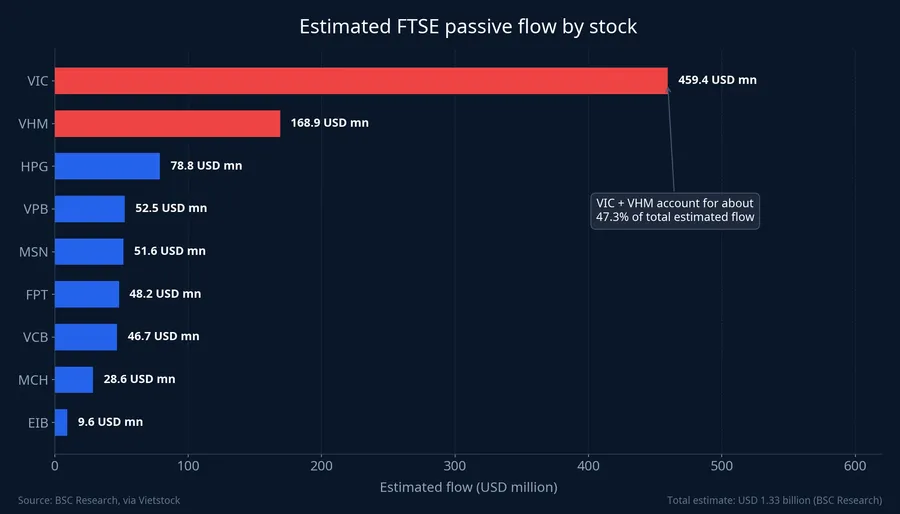
The gap between the top and bottom of the list runs to nearly 48 times. A stock that makes the basket but sits near the bottom receives passive inflows that are tiny relative to its own daily trading value. "Making the FTSE cut" isn't a label with equal value across every name. Market cap, free-float ratio, and remaining foreign room determine how much money actually reaches each stock, not simply whether it appears on the list.
The capital rolls out through September 2027, not in a single session
The rollout for adding Vietnamese stocks to the FTSE indices is split into four tranches to limit any liquidity shock. The first tranche applies a 10% weight starting September 21, 2026. The second adds 20% on March 22, 2027. The third adds 35% on June 21, 2027. The final tranche adds the remaining 35% on September 20, 2027.Vietstock
Using the USD 1.33 billion estimate as a baseline, this September's tranche represents only about one-tenth of the total. Most of the capital gets deployed in 2027. In other words, the upgrade is support that stretches out over more than a year, not a single push concentrated on September 21.
The current foreign-flow backdrop needs to sit alongside that number, because these are two distinct flows, not one. As of the August 20 session, foreign investors had net sold VND 5,434 billion on HOSE over the first 14 sessions of August, with the four most recent sessions each seeing more than VND 800 billion in net selling. Converting at the August 19 exchange rate of VND 26,173.5 per dollar, that half-month of net selling equals roughly USD 208 million, larger than the roughly USD 133 million expected from the September rebalancing tranche under BSC's USD 1.33 billion estimate.
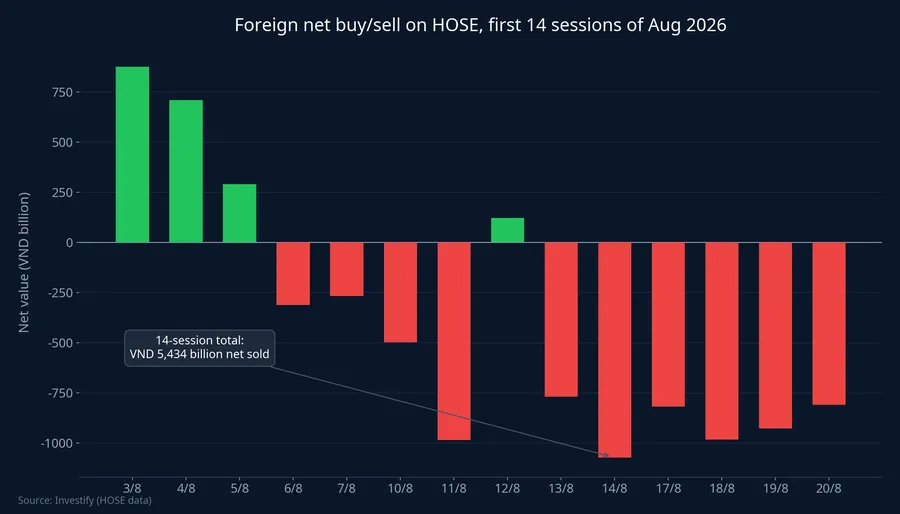
Index-tracking passive flow and actively managed foreign fund flow run on two different logics: one buys at fixed weights inside a basket, the other reacts to macro outlook and real-time valuation. The first doesn't automatically cancel out the second, and investors shouldn't conflate these two stories when reading recent net-selling data.
The market entered the announcement session with the VN-Index closing August 20 at 1,734.24 points, up 7.55 points, or 0.44%, on turnover of 464 million shares. The index remains below the 1,793-point level reached on August 12, following two sharp declines on August 13 and 14.
What to watch on August 21
Read the official list first, commentary second. The binding version is the one FTSE Russell publishes, not any brokerage forecast. For newer investors, this is the single most useful thing to remember: a stock featured in today's analysis can still be absent from tomorrow's list.
Watch the gap between the official list and the forecasts. Divergence tends to cluster among stocks sitting right at the market-cap threshold, the free-float threshold, or close to their foreign-room cap. That's also the group most likely to swing sharply once results are out, in either direction.
Match expectations to the right dates. The list is published on August 21, but index funds only execute purchases around the September 21 effective date, and only at a 10% weight. The month-long gap between the two dates is time during which prices may already price in much of the expectation.
Consider a basket approach rather than picking individual names. For investors interested in the upgrade-driven flow broadly rather than any single company, index-tracking funds are built for exactly that purpose. In exchange, investors accept the basket's actual concentration, including the outsized weight sitting with the top names.
Given a portfolio already loaded with large-cap names, the common pattern in index rebalancing events is for prices to run up ahead of the effective date and cool off afterward. The common defensive standard here is not to chase the announcement by adding weight, but to wait for the price level that emerges once the rebalancing flow has passed through. Right after August 21, the two details worth tracking are how the official stock count compares with the forecast range of 23 to more than 30 names, and whether the concentration at the top of the list matches BSC's model.