
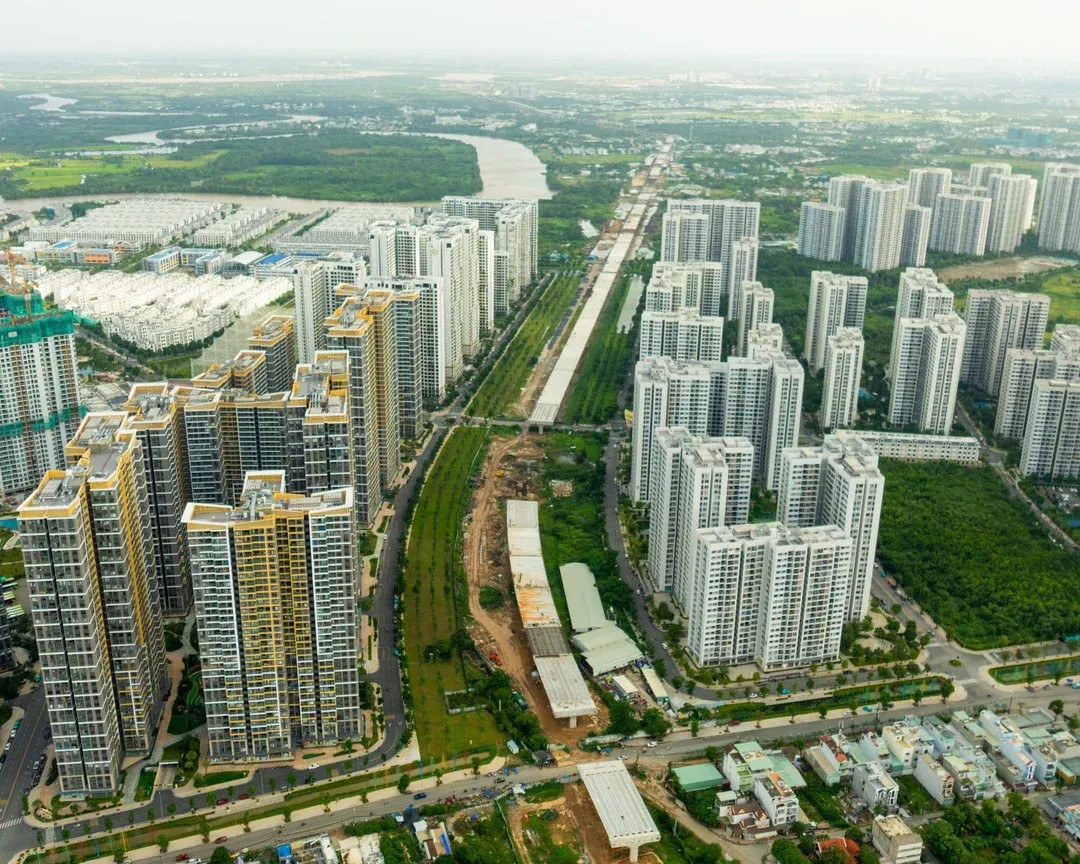

More than 4.1 billion Vinhomes shares will land in the accounts of 34,021 shareholders before September 15, 2026.CafeF By share count, it is the largest stock-dividend issuance in Vietnamese stock market history, doubling Vinhomes' charter capital from over VND 41,074 billion to more than VND 82,148 billion.Thoi Bao Tai Chinh Viet Nam
That scale fueled a widely repeated expectation: the issuance would be a "trigger" that propels the VN-Index higher. Looking at the numbers from the ex-rights session itself, the true story is narrower than the hype suggests.
What the "trigger" thesis was built on
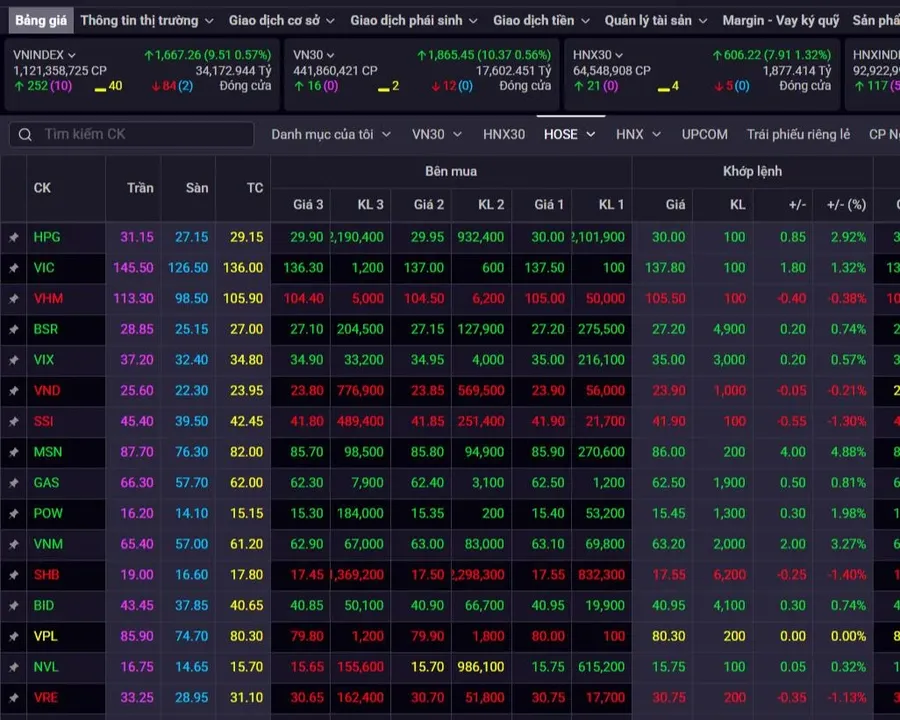
The original call came from an analyst at MB Securities (MBS), cited by Thoi Bao Tai Chinh Viet Nam in early July: a successful issuance would be a "trigger" pushing the VN-Index past its psychological resistance.Thoi Bao Tai Chinh Viet Nam The logic isn't unreasonable. VIC and VHM have been the two biggest index movers since the start of the year, so a major event at VHM could plausibly spill over into sentiment for the whole group.
Two real factors reinforced that expectation. First, halving the per-share price makes a 100-share lot proportionally cheaper: from roughly VND 15.3 million down to roughly VND 7.7 million, based on the VND 153,000 close on August 5, lowering the entry threshold for retail investors. Second, the shares were funded from accumulated after-tax retained earnings through December 31, 2025, meaning the company needed real cumulative profit to make the distribution: a signal about earnings already booked, not a promise about the future.
What the "trigger" argument missed was the pricing and index mechanics.
Session Aug 6 answered the question before it was asked
The ex-rights date for the issuance was August 6, 2026. The prior session, VHM closed at VND 153,000 per share.DNSE On Aug 6, the reference price was halved to exactly VND 76,500, following the standard adjustment formula for a 100% issuance ratio.
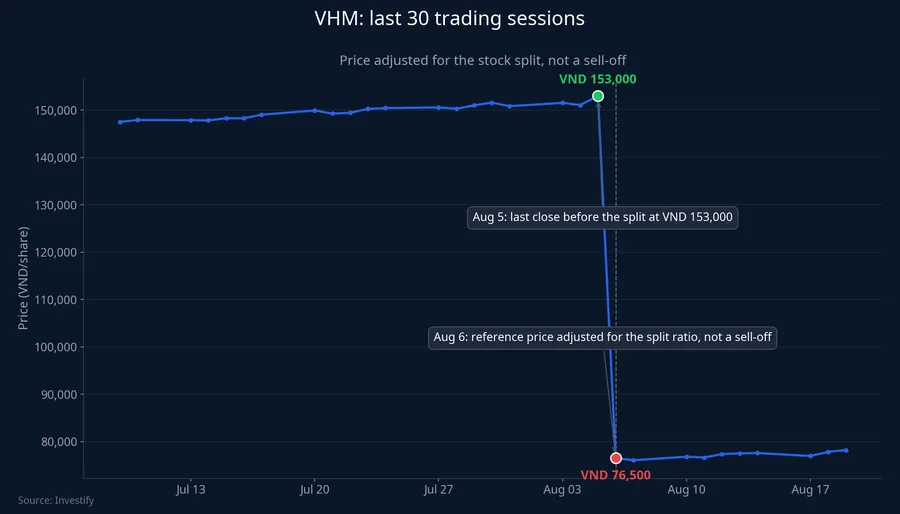
Walk through the arithmetic: an investor holding 1,000 shares at VND 153,000 had VND 153 million. After the adjustment, that investor holds 2,000 shares at VND 76,500, still VND 153 million. Share count doubled; holding value stood still. The "extra" was already subtracted on the Aug 6 session, before the new shares even landed in accounts.
At the index level, the mechanism runs the same way. The VN-Index is capitalization-weighted, and the Ho Chi Minh City Stock Exchange adjusts the free-float divisor every time a constituent's share count changes, on the principle that the index must read the same immediately before and after the adjustment.VnExpress Aug 6 proved exactly that: VHM's price fell 50% while the VN-Index that session slipped only 11.68 points, or 0.66%. If halving the price didn't cost the index any points, doubling the share count doesn't add any points either. The mechanism runs symmetrically in both directions.
Ten sessions later, liquidity tells a different story
From Aug 6 to Aug 19, VHM fell from VND 77,100 to VND 69,100, a 10.4% decline. On the morning of Aug 20, the stock traded around VND 69,700, roughly 9% below the pre-issuance equivalent of VND 76,500.
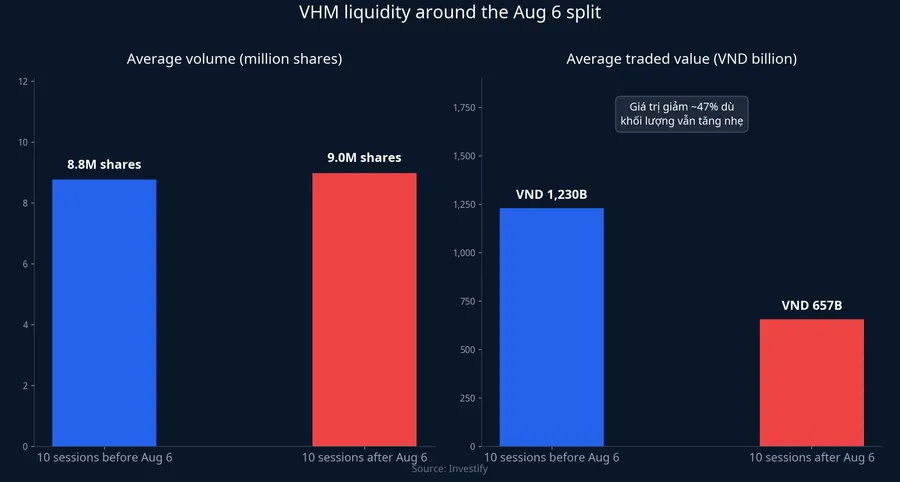
Liquidity tells a two-sided story. By volume, the 10-session average after the ex-rights date reached 8.99 million shares, up 2.5% from 8.77 million in the prior 10 sessions. By value, the flow of actual money contracted sharply: the average fell from roughly VND 1,230 billion to roughly VND 657 billion per session, a 46.6% drop. More shares changed hands, but nearly half as much money actually flowed into the stock.
That 10.4% decline deserves fair context. Over the same window, the VN-Index slipped from 1,764.78 to 1,726.69 points, down 2.16%, including two sharp pullback sessions on Aug 13 and 14, while foreign investors sold net for several consecutive sessions with Vingroup stocks at the center. A broader market pullback and foreign outflows coincided with VHM's decline, so the drop can't be attributed entirely to dilution. What the data does support more confidently is the opposite conclusion: two weeks in, there's no sign the issuance itself is generating any lift for the stock or the index.
The P/E trap for new investors
This is the part most likely to mislead. When share count doubles, every per-share metric gets mechanically halved, even though the company itself is no poorer.

Vinhomes' 2025 net profit attributable to parent shareholders was VND 41,895 billion, equivalent to EPS of roughly VND 10,200 on the old share count. On the 8.215 billion shares outstanding after issuance, that same profit works out to only about VND 5,100 per share.
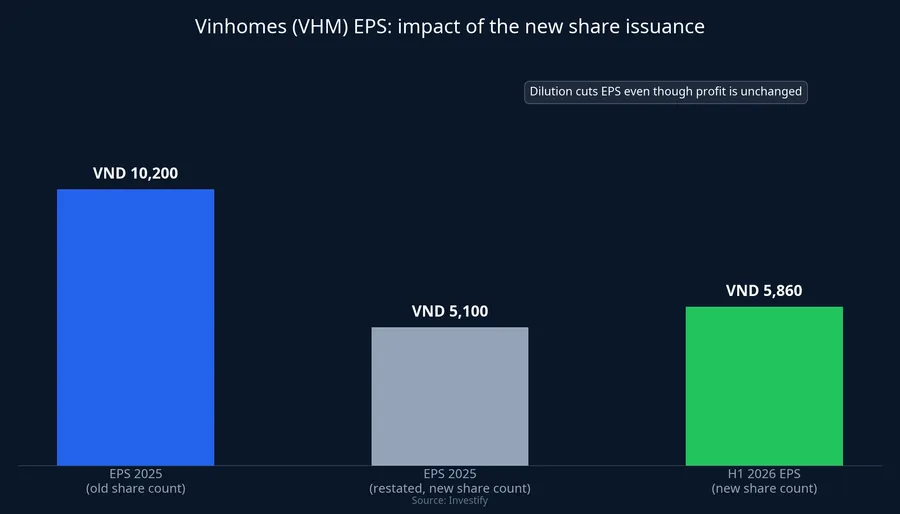
The practical consequence: some screening tools are still dividing the new price by the old per-share earnings, producing a P/E of roughly 3.6x. The properly based figure is roughly 7.2x on trailing-12-month profit, or roughly 13.7x using 2025 profit alone. The gap between 3.6x and 7.2x is wide enough that someone buying because the stock "looks too cheap" could end up paying a price they mistakenly think is half of fair value. The safe rule for this period: check which share count a screening tool is using before trusting the P/E it displays.
What's actually driving VHM: the earnings
In Q2 2026, Vinhomes posted consolidated net revenue of VND 52,722 billion and after-tax profit of VND 26,467 billion, 3.22 times the year-earlier quarter.CafeF For the first half, revenue reached VND 116,565 billion and after-tax profit VND 52,091 billion, hitting 86.8% of the full-year 2026 profit target of VND 60,000 billion after just six months.
This is the part that actually creates new value for shareholders. Specifically, H1 2026 EPS, already calculated on the new share count, still came in at roughly VND 5,860, meaning six months alone exceeded the restated full-year 2025 EPS. When profit grows faster than the dilution rate, dilution gets absorbed; when profit growth stalls, the dilution shows up in full.
One detail worth placing alongside that on the cost-of-capital side: in early August, Vinhomes issued the VHM12615 bond tranche, raising VND 2,000 billion over a 3-year term at a 12.5% annual coupon.CafeF The company is retaining earnings to grow charter capital while still borrowing at double-digit rates, evidence that capital needs for its project pipeline remain large.
What to watch in Q3
Bonus shares don't create additional value for shareholders at the moment they're distributed, and a stock-dividend issuance doesn't automatically add points to the VN-Index. The part of the "trigger" thesis that holds up is narrower than how it circulated: a lower price makes the stock more accessible to retail investors, and a larger float makes orders easier to match. Both are favorable conditions for liquidity, not drivers of price appreciation.
For anyone still holding VHM, a reasonable framework for the coming weeks covers three things: read every metric on the basis of 8.215 billion shares, not 4.107 billion; track average traded value per session rather than volume, since that's the real measure of money actually returning, with a level above VND 1,000 billion per session worth watching; and wait for Q3 results, which will answer whether profit holds the pace set in the first half.
If Q3 sustains that earnings momentum and money flow returns by value, VHM's valuation story will stand on its own without needing the word "trigger." If it doesn't, a doubled share count in the account is still just a doubled share count.