


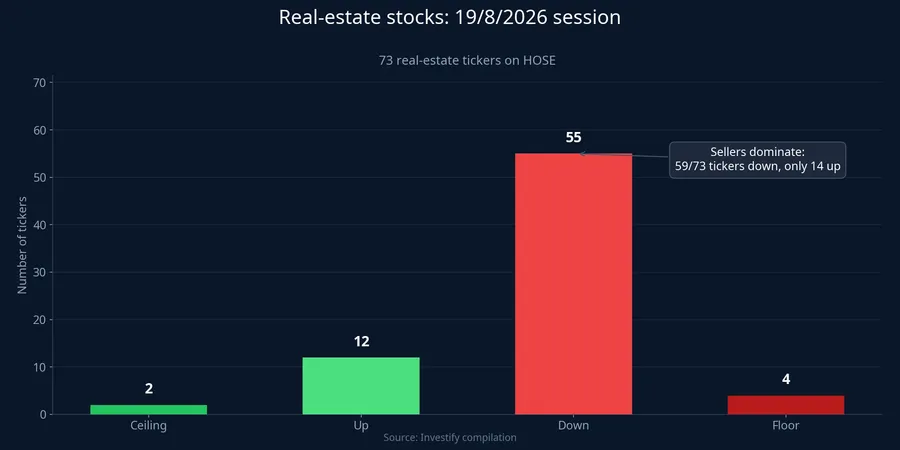
At first glance, the Aug 19 session looked unremarkable for Vietnam's real-estate stocks. The sector index closed at 138.90 points, down 0.34%, milder than the broader VN-Index, which lost 5.33 points to 1,726.69.Dân Việt Look at the ticker board instead, and that same number tells a very different story.
In the same session, the sector recorded 2 tickers at the ceiling, 12 up, 55 down, and 4 at the floor.Dân Việt That puts 59 of 73 tickers in the red, nearly four times the number that gained. A near-flat index and a board full of red — both numbers are accurate, and the gap between them comes down to how the sector index is actually calculated.

A weighted average, not an equal vote
The first thing to understand about a sector index: it is weighted by market cap, not by the number of tickers. The bigger the company, the more its price move decides the closing number, while small companies barely register no matter how far they fall.
In Vietnam's real-estate sector, that weight gap is large enough to decide the outcome almost by itself. On Aug 19, VIC closed unchanged at its reference price of VND 200,000, with a market cap of VND 1,541 trillion. VHM eased just 0.14% to VND 69,100, while VRE fell 1.23%.
To put that weight in perspective: combine the market caps of the next 14 largest listed real-estate companies — BCM, NVL, KBC, KDH, VPI, VGC, IDC, DXG, SIP, PDR, NLG, TCH, DIG, and CEO — and the total is still only about VND 240 trillion, less than one-sixth of VIC's market cap alone.
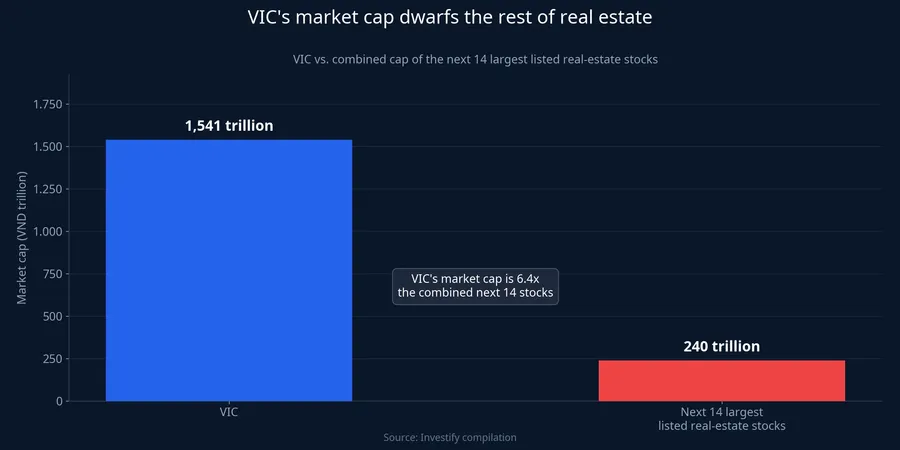
The mechanics are simple. When the heaviest stock in the group stands still, dozens of mid- and small-cap names falling 1-2% only drag the sector index down by a few tenths of a percent. The 0.34% figure isn't wrong; it's just answering a different question than the one most investors think it is. It describes the market cap of the whole sector, not the portfolio of anyone holding mid- and small-cap real-estate names.
What the money flow reveals that the index hides
If the sector index can't show what's actually happening, money flow can. On Aug 19, roughly VND 966 billion flowed into declining tickers, more than four times the VND 234.1 billion that went into gainers.Dân Việt In other words, most of the session's money was selling pressure on losing tickers, not buying interest in winning ones.
Another VND 1,095 billion sat in stocks that closed unchanged.Dân Việt VIC alone matched 5.25 million shares at VND 200,000, for an estimated trading value of about VND 1,050 billion. Nearly all of that "unchanged" money changed hands in a single stock. That stock is exactly what kept the sector index out of deep red.
The pressure on VIC didn't come only from domestic investors. On HOSE, foreign investors were net sellers of more than VND 710 billion, with VIC the single most heavily net-sold ticker on the entire market at roughly VND 136 billion.CafeF A flat price doesn't mean nothing happened at this stock. It means domestic buying absorbed just enough of that selling to hold the reference price.
Below the surface, every ticker tells its own story
The common 1-2% decline spread across the group looks like shared aftershock: BCM fell 2.82%, DIG fell 1.89%, KDH and TCH each fell 1.69%, CEO fell 1.68%, NVL fell 1.52%.Dân Việt But a handful of extreme cases break away from that baseline entirely.
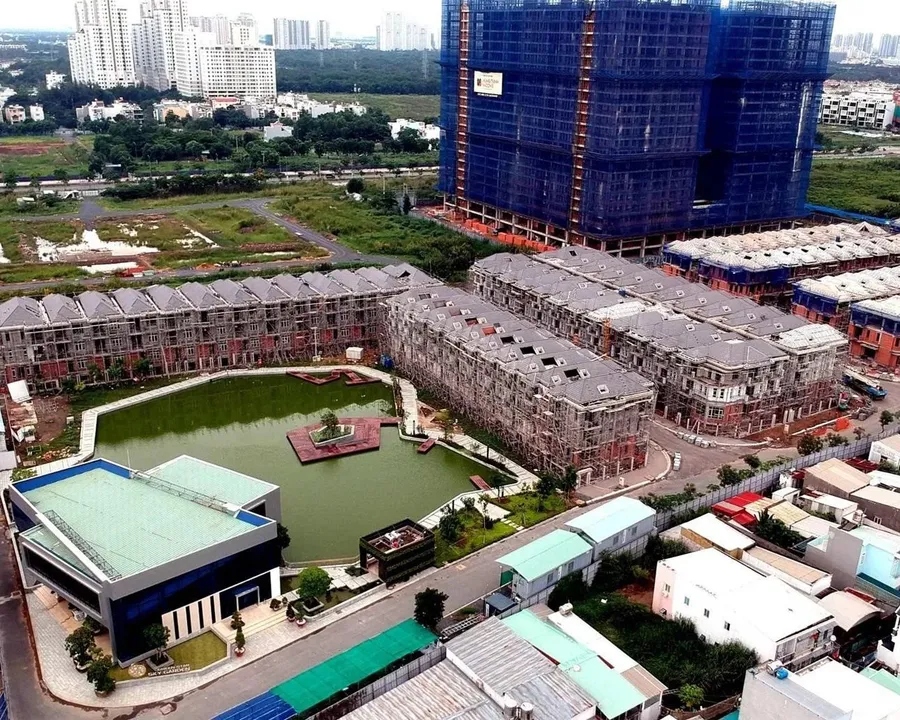
NTL dropped 6.74% to VND 12,450, close to HOSE's daily floor, on 3.87 million shares traded. That volume is more than 14 times the stock's average over the prior 11 sessions, when liquidity typically ran around 270,000 shares a day. This looks like a concentrated sell-off packed into a single session, at a company with a market cap of roughly VND 1.5 trillion. The sector index barely blinked.
NVL carries a pressure that's easy to name. Per a resolution published on July 20, the company plans to issue 800.7 million shares at VND 10,000 to existing shareholders at a 3:1 ratio, raising more than VND 8,006 billion to repay debt.CafeF That issue price sits well below the Aug 19 closing price of VND 13,000, so dilution pressure will hang over the stock until the offering is complete.
On the other side, domestic money still found a place to sit. VPI rose 0.97% to VND 62,700, its third gain in four sessions. CLI rose 2.93% to VND 28,100, its second straight gain. Both show that the selectivity in this group cuts both ways.
Don't blame it all on company-specific stories
It would be premature to conclude that this entire divergence comes from company fundamentals alone. At least two other explanations coexist, and the Aug 19 data isn't enough to fully separate them.
The first is thin liquidity. Matched-order value on HOSE on Aug 19 came to only about VND 10,000 billion, below recent weeks' levels.CafeF When the order book is thin, a sell order worth just a few billion dong can push a small-cap stock's price a long way, widening the range without any fresh news.
The second is a pre-existing correction. VNREAL had already fallen from 3,132.52 points on Aug 12 to 2,940.12, a decline of about 6.1% over six sessions, including two consecutive drops of 2.95% and 3.33% on Aug 13 and 14.
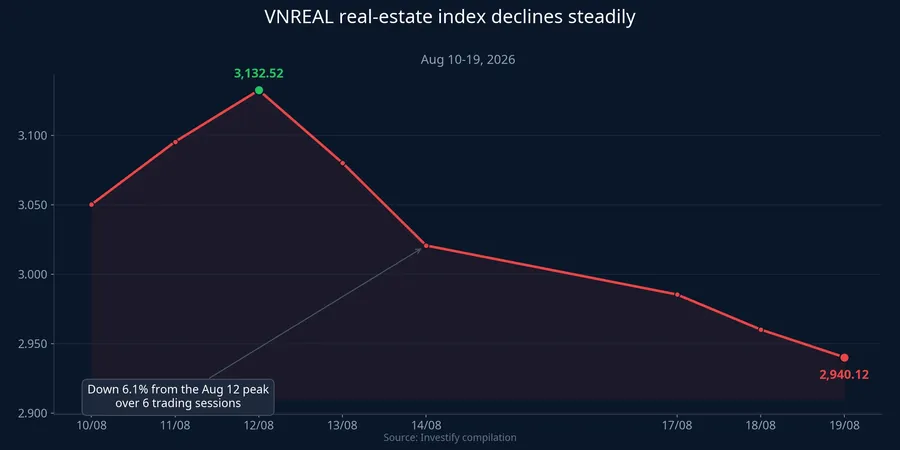
After a slide like that, selective money flow that prioritizes exiting weaker names is a market-wide reaction, not necessarily a fresh verdict on any single company. The Aug 19 data leans toward a combined reading: the 1-2% declines across most stocks reflect shared aftershock and a thin order book, while extreme moves like NTL's are genuinely stock-specific, since the volume spike showed up only in that one name rather than across the group.
How investors should read the sector index
A sector index answers the question "did the sector's total market cap rise or fall today." It does not answer "how did the stock I'm holding do today." For portfolios weighted toward mid- and small-cap names, three sharper gauges are worth tracking alongside the sector index: market breadth, which shows how many tickers rose versus fell; the money-flow ratio, which shows whether cash is flowing into losers or winners; and the weight of the leading ticker, which shows whether the index reflects the whole sector or just a few of its largest names.
For Aug 19, all three point to something the 0.34% figure doesn't say: sellers still had the upper hand in real estate, and VIC's outsized market cap was simply masking the true range of the session.
Signals worth watching in coming sessions: whether foreign net selling in VIC and VHM cools off, and whether HOSE's matched-order value returns above VND 10,000 billion. If liquidity stays thin, the gap between the sector index and the ticker board underneath it is likely to persist, and reading the sector number alone as a signal for the whole group will keep leading to the wrong conclusion.