
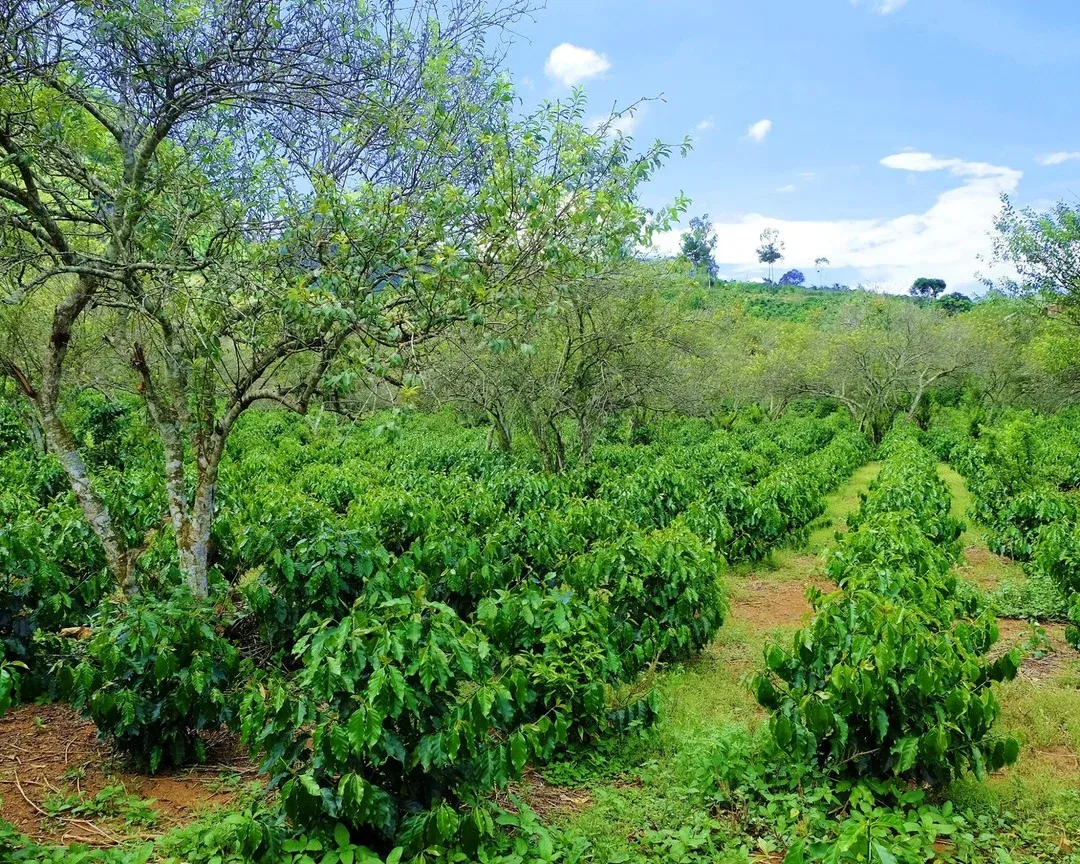

On the afternoon of August 18, 2026, Hoang Anh Gia Lai (HAGL) held an investor briefing for the IPO of Hoang Anh Gia Lai International Investment JSC (HGI), the subsidiary that runs its plantation business. HGI plans to offer 18.8 million shares at VND 60,600 each, raising up to roughly VND 1,139 billion, before listing on UPCoM in Q3–Q4 this year.Thanh Nien That's just one of three funding legs HAGL is counting on for its biggest ambition since emerging from its debt-heavy years: 20,000 hectares of coffee by 2028.
Look at the numbers and the three-year capital program for coffee alone already equals most of the company's current market value. That's why this deserves more scrutiny than a routine capital-raise headline.
The 20,000-hectare map, and the money behind it
HAGL's target is 20,000 hectares of coffee by 2028, with ambitions to become the single largest coffee-plantation operator in the world.VnExpress The variety mix skews premium: 15,000 hectares of Arabica on the Paksong plateau (Champasak, Laos), 4,000 hectares of Robusta, and 1,000 hectares of Liberica. At full capacity, output is projected at roughly 565,000 tonnes of fresh cherries a year, equal to more than 106,285 tonnes of green coffee beans, with target revenue of nearly VND 19,000 billion.
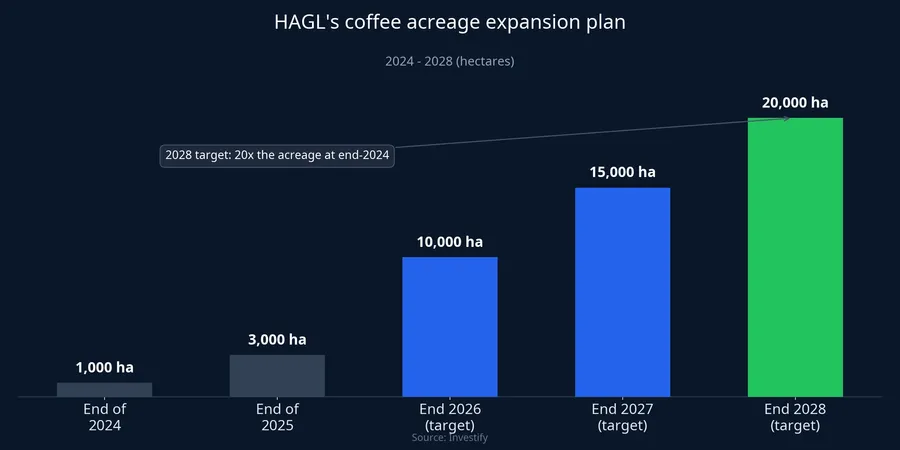
The price tag: total capital need for 2026–2028 is approximately VND 14,220 billion, with 2026 alone requiring about VND 5,420 billion for planting 7,000 new hectares, phase-1 of a soluble-coffee plant, and four wet-processing plants.CafeF That figure is worth setting next to another one: on August 19, HAG closed at VND 14,000 a share, down 1.06%, putting market cap at roughly VND 17,700 billion. In other words, the three-year capital program for coffee alone is equivalent to about 80% of the value the market currently assigns to the entire company.
Why Arabica
The choice of variety isn't arbitrary. At the August 18 close, the September Arabica contract on the New York exchange stood at 345.10 US cents/lb, up 2.07% and a six-week high.VOVDan Tri The same session, the September Robusta contract on the London exchange stood at USD 3,670/tonne, up 1.35%. Converted to the same unit, that Arabica price works out to roughly USD 7,610/tonne, 2.07 times Robusta. HAGL (HAG) Chairman Doan Nguyen Duc has cited a similar ratio in the domestic market: Arabica around VND 200,000/kg versus Robusta at VND 98,000–100,000/kg.CafeF
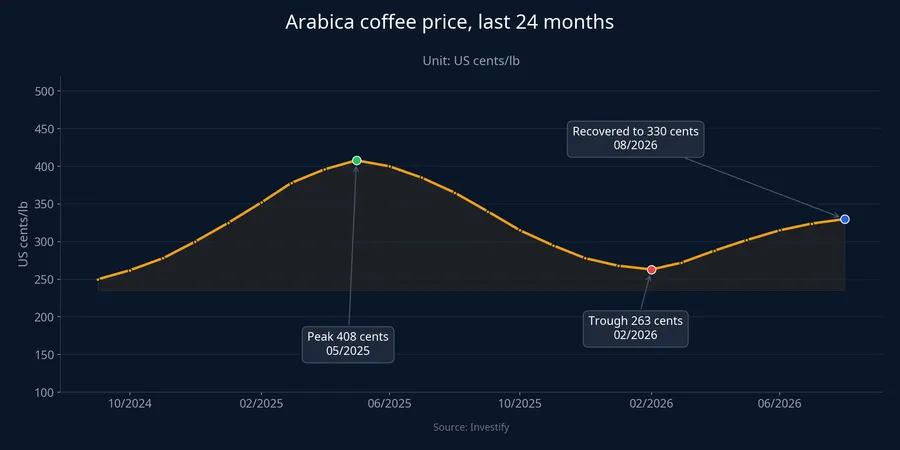
The entire profit case for the new plantations rests on that roughly 2x ratio, but the ratio isn't a constant. Over the past 24 months, Arabica has moved from around 250 US cents/lb to a peak near 408, down to a trough around 263, then back up to around 330 (Investify data), swinging with droughts in Vietnam or bumper harvests in Brazil. Brazil's National Supply Company (Conab) forecasts the country's 2026 crop will hit a record 66.2 million bags, with Arabica alone up 23.2% to 44.1 million bags. That supply could weigh on Arabica prices in coming seasons.Yahoo Finance
Three years between spending the capital and the first harvest
This is where investors skim past the fine print: coffee trees don't pay back immediately. HAGL's stated timeline: 3,000 hectares by end-2025Nong Nghiep Moi Truong; 7,000 new hectares planted in 2026 to complete the first 10,000 hectares by October 2026VietnamFinance; then 5,000 more hectares each year in 2027–2028. Commercial coffee revenue is projected to begin in October 2027, with large-scale harvests only from 2028.
Set against the biology of the crop, that October 2027 milestone is a tight schedule. Standard agronomy references note that newly planted Arabica trees typically bear their first fruit after 3–4 years and only reach stable commercial yield after 5–7 years, depending on variety, altitude and care.Roast and Post Acreage planted in 2025 will be only about two and a half years old by October 2027, so even if the first harvest arrives on schedule, that year's output can't represent the target capacity of 106,285 tonnes. Most of the acreage planted this year and over the next two years will sit outside any revenue report until after 2028: HAGL is spending at 2026 coffee prices but will be selling at 2029-and-beyond coffee prices.
Three funding legs, and the thinnest one
HAGL has laid out three funding sources: roughly VND 2,000 billion in retained earnings from 2026, roughly VND 1,500 billion from the HGI IPO, and roughly VND 2,000 billion in bonds combined with medium-term loans.Tuoi Tre The third leg is already done: in April 2026, the company raised VND 2,000 billion in bonds guaranteed by OCB, channeled into plantations in Gia Lai, Savannakhet and Stung Treng.Mekong ASEAN The second leg is underway, but the actual offering size tops out at VND 1,139 billion, about VND 360 billion below the VND 1,500 billion figure in March's plan.
The first leg is where it pays to look closely. In H1 2026, HAGL posted net profit after tax of VND 2,298.7 billion, up 161.3% year-on-year, but net revenue was nearly flat at VND 3,707.1 billion and gross profit fell 11.9% to VND 1,277.9 billion. The gap came from financial income: in Q2 alone, the company was granted a waiver of over VND 784 billion in interest on its HAGLBOND16.26 bond, under an April 30, 2026 resolution from the Members' Council of Vietnam Debt and Asset Trading Corporation (DATC).Doanh Nghiep Thuong Hieu
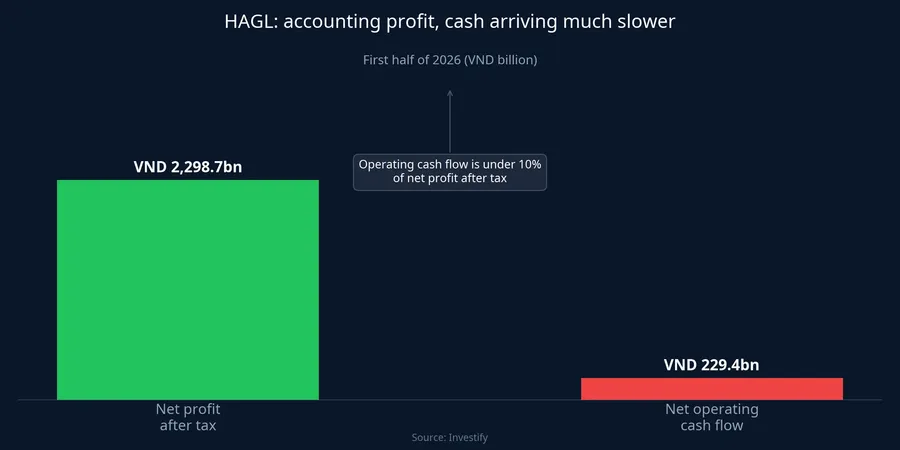
The interest waiver dresses up the income statement but doesn't bring cash into the account. Net operating cash flow for H1 was only VND 229.4 billion, under 10% of pre-tax profit for the same period. Retained earnings is equity growth on paper; the money to pay for seedlings, fertilizer and processing plants has to come from real cash flow.
On the debt side, the picture has clearly improved. As of June 30, 2026, total borrowings stood at VND 8,655.2 billion against equity of VND 17,343.8 billion, a ratio of 0.50x, down from 0.90x a year earlier; cash rose to VND 1,243.5 billion from VND 193.7 billion in the same period last year. But that 0.50x also means the company's commitment to keep borrowings under 50% of equity is now sitting right at the line, with the heaviest stretch of the capital program still ahead.
The current cash-flow pillar is thinning
While coffee isn't yet producing a harvest, bananas and durians still have to carry the cash flow. In Q2 2026, fruit revenue came in at nearly VND 1,382 billion, about 72% of sales revenue, but down more than 31% year-on-year as both price and volume declined.VietnamFinance Two curves are moving in opposite directions: current revenue is shrinking right as capital spending needs peak, which makes the HGI IPO and planting progress the two key variables to watch, not this week's coffee price.
The stock hasn't reacted to the profit
Over the last ten sessions, HAG has traded in a tight VND 14,000–14,150 range, with volume mostly under 2.6 million shares a session, despite the company just reporting record first-half profit (Investify data).
There are at least two ways to read that, and the data isn't enough yet to rule either out. First, the market may already be discounting the profit that came from the interest waiver, since it's a one-off item that won't repeat. Second, investors may be waiting for execution proof — completed new planting acreage and sustainably positive operating cash flow — before re-rating the coffee story. The upcoming HGI IPO adds another variable around ownership structure in the plantation business.
A watch-list for investors
For an investment whose revenue only arrives after 2027, near-term signals matter more than any three-year coffee-price forecast. The evidence isn't yet enough to lean firmly bullish or cautious, which is why this watch-list matters more than a buy-or-sell call:
- Actual 2026 planting acreage versus the 7,000-hectare plan and the October 2026 target of completing 10,000 hectares. This is the most direct gauge of execution capability.
- HGI IPO results: both the pricing and the actual proceeds raised versus the VND 1,139 billion maximum offering.
- Quarterly net operating cash flow, stripped of financial reversals, to see whether the "retained earnings" funding leg has real cash behind it.
- Banana and durian revenue in coming quarters, the only cash source carrying the business through the pre-coffee years.
- The Arabica-Robusta spread as Brazil's 2026 crop reaches the market, to see how much of that 2x assumption holds up.
This is a textbook case of an agricultural growth story: capital goes out years ahead, revenue comes later, and commodity prices can fully reverse during the wait. The right lens isn't reading coffee-price headlines session by session, but tracking planting progress and cash-flow quality quarter by quarter. The Q3 2026 report, with the 10,000-hectare milestone due, will be the first real checkpoint for this entire story.