

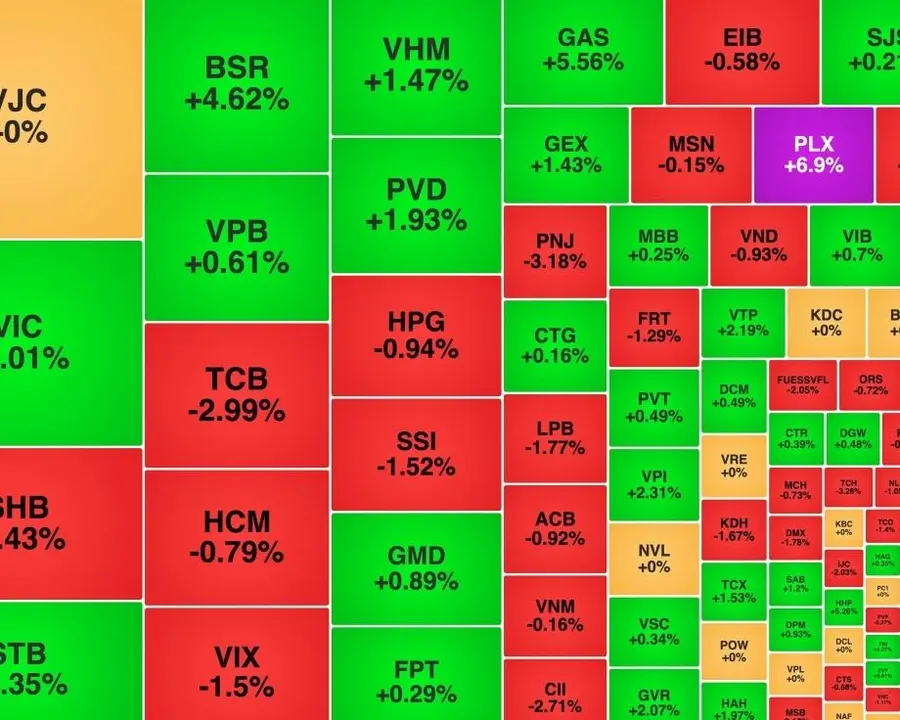
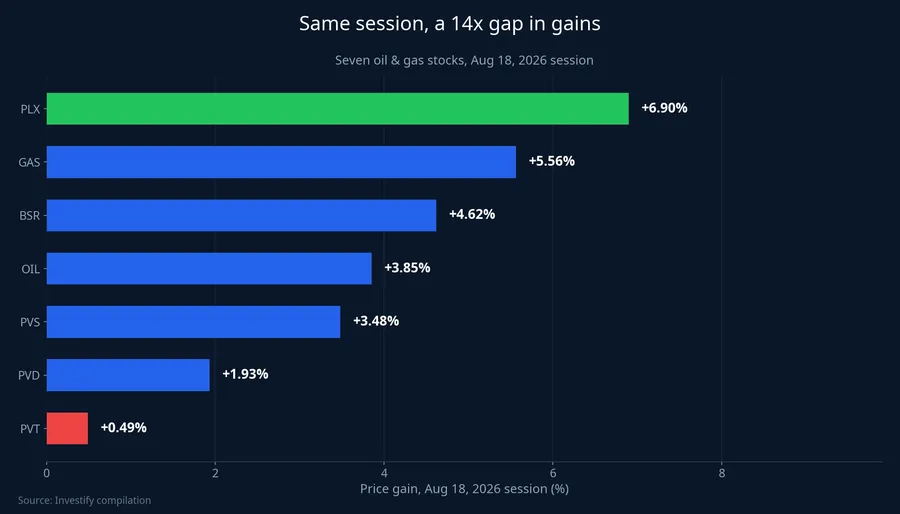
In the August 18, 2026 session, all seven major oil and gas stocks on Vietnam's exchange closed green. On the board, that looked like rare sector-wide consensus. But look at the magnitude and the picture changes completely: PLX rose 6.90% to VND 37,950Mekong ASEAN, while PVT edged up just 0.49% to VND 20,400. A 14x gap, in the same sector, the same session, on the same oil-price headline.
The lesson here: the market doesn't buy "oil and gas stocks" as a block. It prices each company's profit mechanism separately.
Oil did rise, but the real jump came the night before
Brent crude closed the August 18 session at $91.10 a barrel, its third straight gain. But the day's own move was a modest 0.26%. The real jump had already happened one session earlier: on August 17, Brent rose 2.65% to $90.87, after US-Iran peace talks stalled and a temporary ceasefire expired.VOV An Iranian official signaled tighter control over shipping through the Strait of Hormuz: just 5 cargo ships passed through in the two days of August 15-16, versus 31 the previous weekend.Thanh Nien

By the time Vietnamese investors opened the August 18 session, the oil-price news was already sitting on the table from the night before, a shared backdrop for all seven stocks. If oil were the only driver, the price reaction should have been roughly uniform. It wasn't.
The money flow was real, but badly skewed
A common read when a stock rallies on news is "price up, but the money hasn't followed." The August 18 numbers don't support that read. Combined trading value across the seven stocks reached roughly VND 1,434 billion, 206% of the 10-session average; combined volume hit 45.68 million shares, 184-192% of the recent average. That's real capital, not a rally running on thin demand.
But that capital didn't spread evenly. GAS volume ran at 247.7% of its 10-session average, trading value at 270.2%, and the price rose 5.56% to VND 83,500. BSR posted the group's highest trading value at VND 559.7 billion, with the price up 4.62% to VND 27,200. PVT, by contrast, saw volume at just 122.7% of average and its price barely moved. PVD rose 1.93% to VND 18,500, but most of its trading value (roughly VND 318 billion of VND 398 billion) came from negotiated block trades, not matched-order buying.
Capital concentrated in three leading names, GAS, BSR, and PLX, rather than spreading evenly across the sector: the market was selecting, not buying the sector label.
Three other stories hit this group, not just one
At least three separate stories touched the oil and gas group in the August 18 session, and they didn't hit the same set of stocks. This is the part new investors most often miss.
The first is oil prices, affecting the whole sector but through different channels. The second is a planned divestment by PetroVietnam: the group plans to sell 2-5% of its stakes in GAS and BSR to meet public-float requirements for listed companies, with valuation expected to wrap up by December 2026 at the latest.Nguoi Quan Sat That news only touches GAS and BSR directly, the exact two names with the session's strongest liquidity.
The third is company-specific news. PLX hit its ceiling right after Petrolimex announced plans to sell its entire treasury share holding.Vietbao That's a capital-structure event specific to PLX, unrelated to oil-driven margins. On top of that, the market is also pricing in an amended Petroleum Law expected to take effect by the end of 2026, covering investment incentives, offshore energy, and carbon capture; that's a policy expectation, not a law already in force.
Attributing the entire rally to oil prices, when three or four separate stories are actually at play, leads to the wrong conclusion about which stock is worth holding.
Each company sits at a different point on the value chain
Rising oil prices don't automatically help every company with "oil and gas" in its name; that's the most important framework for new investors here.
BSR benefits the fastest and the most. A refiner's profit depends on its crack spread, the gap between the price of refined products sold and the crude bought, plus gains from revaluing inventory. When Brent rises, both channels move in the same direction. BSR's gross margin swung from negative 4.6% in Q3 2024 to 20.7% in Q1 2026, then held at 14.7% in Q2 2026. Net profit reached VND 8,265 billion in Q1 2026 and VND 7,461 billion in Q2 2026.
GAS benefits directly, but with a steadier margin. GAS prices its gas and LPG off fuel oil prices on a short adjustment cycle. Its gross margin rose from 11.9% in Q1 2026 to 18.0% in Q2 2026, with net profit of VND 6,021 billion in Q2, up 25.2% year-on-year. That price-linked mechanism means profit reacts quickly in both directions, including when oil reverses.
PLX and OIL benefit only partially, and only temporarily. Fuel distributors sell at a base price set by regulators, adjusted for contributions to and drawdowns from the price stabilization fund, which caps their margin: PLX's gross margin runs a narrow 3.8-6.7% per quarter, with net margin typically around 0.3-2.2%. OIL is thinner still, posting a net loss in Q2 2026 despite strong revenue growth. The real benefit for this group is inventory gain: PLX held VND 20,179 billion in inventory in Q2 2026, about 23% of total assets, so when world prices rise between price-setting periods, cheaply bought stock sells at a higher price, though that gain narrows as the regulated price catches up with the world price. PLX's stabilization fund balance had fallen to just VND 928 billion as of early April 2026, while OIL's fund was negative by more than VND 1,700 billion.

PVD, PVS, and PVT benefit with a long lag. Revenue for the technical services and shipping group is locked in under long-term contracts signed well in advance. Higher oil prices only prompt field operators to raise exploration and production capex after a period of observation, before that eventually converts into new contract awards, a lag that can run from a few quarters to over a year. That explains why PVT barely moved in a session when the whole sector rallied: today's $91 oil hasn't shown up in its financial statements yet.
The reversal risk is stratified in the same order
The transmission mechanism cuts both ways: whichever stock benefits fastest when oil rises is also the one most exposed when oil turns, and this isn't a theoretical risk.
The US Energy Information Administration (EIA) forecasts average Q3 2026 Brent at around $85 a barrel, below the August 18 close of $91.10, even after the EIA itself raised that forecast by $11 a barrel from its July report due to prolonged Hormuz tensions.Stockbiz Its full-year 2026 forecast is $86.81 a barrel, falling to around $69 in 2027 as inventories rebuild and output normalizes.
On the domestic side, Tap Chi Kinh Te Tai Chinh cited MBS as expecting refining margins to cool toward year-end, keeping a neutral rating on BSR.Tap Chi Kinh Te Tai Chinh MBS's target price for BSR is VND 29,500, only about 8.5% above the August 18 close; for a stock that had just gained 4.62% in a single session, the analyst's own estimate leaves fairly little room left to run.
The fact that the EIA itself raised its Q3 forecast by $11 in just one month shows these figures are a base case that can shift, not a locked-in price.
A three-layer framework for reading a sector rally
When a whole sector rallies on one piece of macro news, a reasonable check runs in three layers. The first is separating the news: how many distinct stories are touching the sector in that session, and which stocks does each one actually hit? In the August 18 session, the divestment news only touched GAS and BSR, while the treasury-share story only touched PLX.
The second is checking the profit mechanism: where does the company sit on the value chain, and through which channel does the oil price actually flow into its financial statements, selling price, refining spread, inventory gain, or service contracts? The shorter that channel, the faster and more real the impact. The third is checking durability: how long does that benefit channel last if oil goes flat or falls? Inventory gains disappear once the regulated price catches up with the world price, refining margins narrow once supply stabilizes, while contracts already signed keep running regardless of oil.
Given the current forecast curve, with major institutions' base case sitting below the current trading price, the usual degree of caution favors watching the quality of matched-order liquidity in the leading names rather than adding to positions on price momentum alone. The signals worth tracking in coming sessions are fairly clear: if matched-order liquidity in GAS, BSR, and PLX holds at an elevated level, the rally has a capital-flow basis behind it; if liquidity drops quickly while price stays elevated, most of the expectation has already been priced in.