

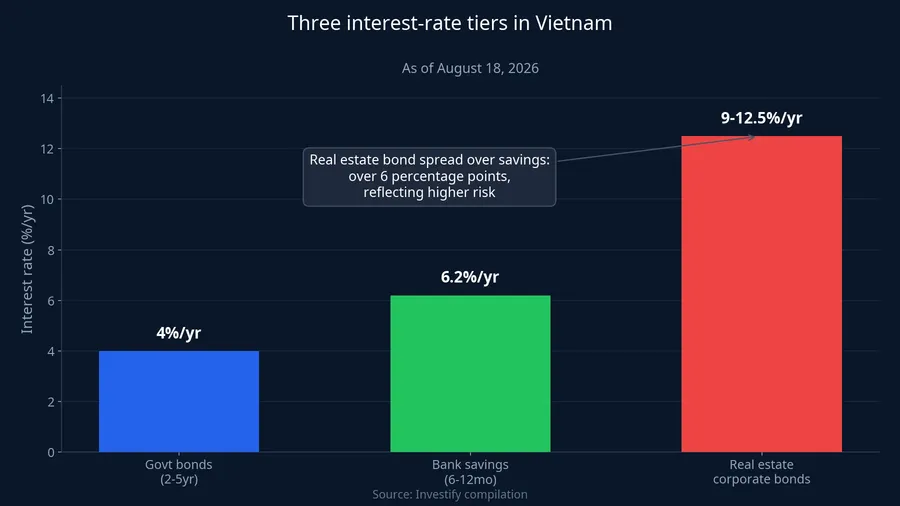
In early August 2026, banks and real estate developers issued new bonds at 9-12.5% a year.Báo Đầu tư On the same day, August 18, 2026, online savings rates for 6-12 month terms sat around 5-7% a year, with a median of 6.2%, while 2-5 year government bond yields were just 3.95-4.18%.
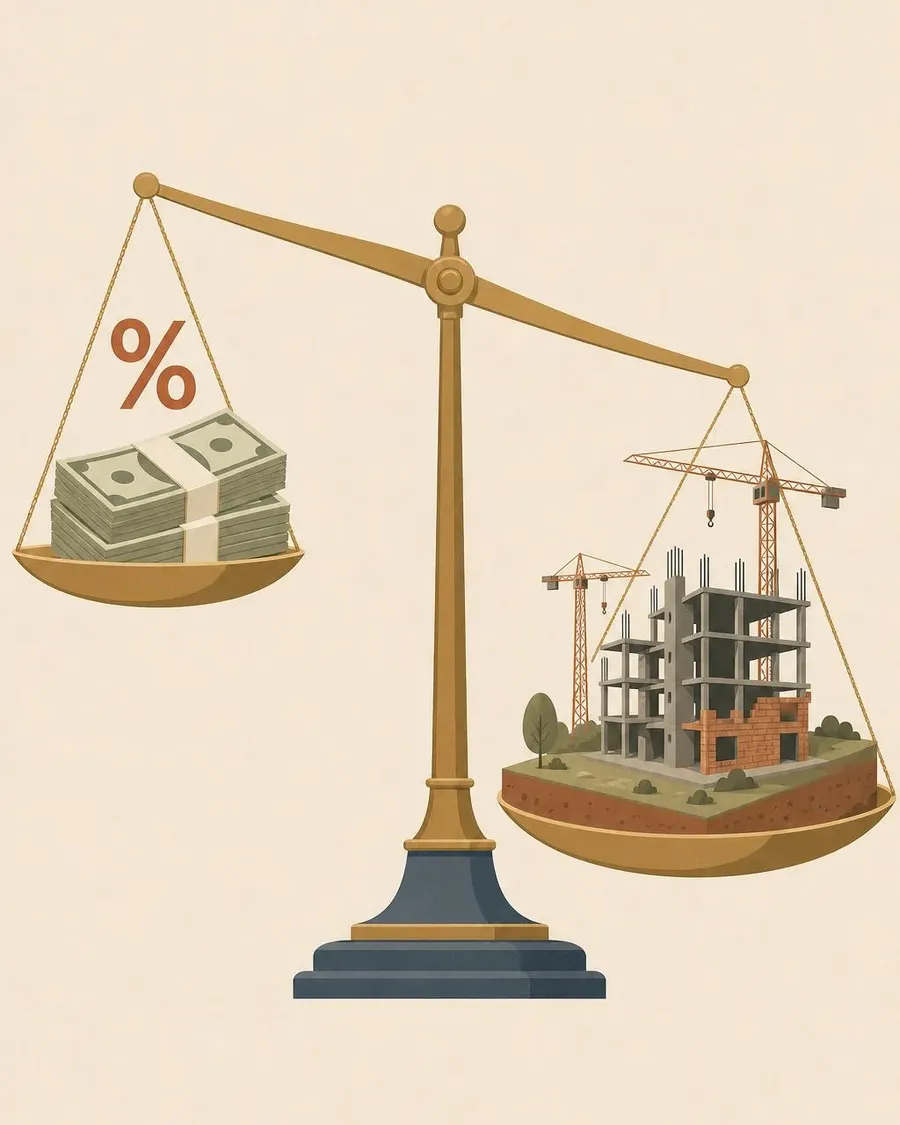
Lined up together, these three rates form a fairly clear ladder. Government bonds pay the least because the borrower is the state treasury. Bank deposits pay a bit more and come with deposit insurance up to a cap. Real estate corporate bonds pay more than both, roughly 5 percentage points above government bonds of similar maturity. That spread isn't a reward for investors willing to explore a new channel. It's the market's wage for shouldering the risk that a company fails to repay on time. One case playing out this very week shows exactly how that wage gets priced.
Same debt, cost of capital up 1.5 points in two years
In August 2024, Kinhbac City Development Holding Corporation (KBC) issued the KBCH2426001 bond: VND 1,000 billion, 24-month term, fixed coupon of 10.5% a year, secured, with proceeds earmarked for restructuring debt at two related companies.Tin Nhanh Chung Khoan
That note matures on August 28, 2026, with roughly VND 997 billion still outstanding.Người Quan Sát To cover the principal, KBC plans to issue a new private placement of VND 1,000 billion on August 18, 2026: a 3-year term, fixed coupon of 12% for the first year, secured by shares of Hung Yen Investment and Development Group JSC (a KBC subsidiary) worth at least 300% of the issuance value, again for debt restructuring.Báo Mới
Two years, the same company, the same VND 1,000 billion size, and the first-year coupon has climbed from 10.5% to 12%. That 1.5-point gap is the market repricing this issuer's own risk: for buyers, 12% sounds attractive next to 6.2% on a savings account; for the company, it means roughly VND 15 billion more in annual financing cost for what is essentially the same old debt.
The balance sheet says where repayment cash will come from
The question that matters for bondholders isn't the coupon rate. It's what source of cash will actually cover the principal at maturity. KBC's Q2 2026 report answers that question fairly directly.
Net profit after tax for Q2 2026 came in at VND 34 billion, down 91% year-on-year, with the portion attributable to parent-company shareholders at just VND 16 billion.Người Quan Sát For the first half, net revenue fell 46% to VND 1,925 billion and net profit after tax dropped 79% to VND 269 billion — just 9% of the full-year profit plan — a shortfall the company attributes to delayed revenue recognition on industrial-park land handovers.Vietstock
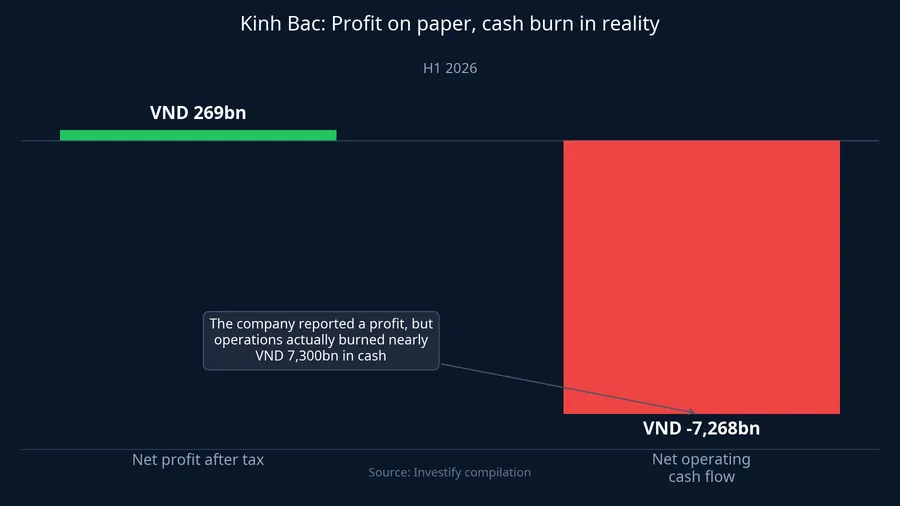
More important than the profit figure is actual cash flow. Net operating cash flow for H1 2026 was negative VND 7,268 billion, the second straight year of a deep first-half shortfall. Core operations are burning cash, not generating it. Cash and equivalents at end-Q2 stood at VND 5,522 billion, down 34% from the start of the year, while actual interest paid rose from VND 184 billion to VND 637 billion.
On the asset side, inventory reached VND 33,357 billion, up 23% and about 45% of total assets, with the Trang Cat urban project alone accounting for VND 17,832 billion.Người Quan Sát That's land bank and unfinished projects: assets that only turn into cash once handed over. On the liabilities side, total liabilities rose almost 10% to VND 47,106 billion, about 64% of total capital, of which roughly VND 32,677 billion is short- and long-term borrowing.
Put together, the causal chain is fairly clear: handover revenue hasn't arrived, operating cash flow is negative, the cash cushion is thinning, so the roughly VND 997 billion principal due at month-end has to rely on a new bond. This is refinancing, not deleveraging — the obligation just gets pushed out to 2029 at a higher price.
It's worth stating the uncertainty here too: the company still holds a large land bank, its book current ratio remains above 4x, and if the industrial-park handover cycle picks up in the second half, cash flow could improve quickly. The current picture is about refinancing risk, not a verdict on principal loss.
2026 is the peak maturity year for real estate bonds
KBC's case isn't an outlier. Around VND 263,000 billion of corporate bonds are due within the next 12 months, and real estate issuers alone owe about VND 141,000 billion in 2026, up 81% from 2025, according to S&I Ratings.Báo Đầu tưCafeF
On actual repayment track record, the Hanoi Stock Exchange has published a list of 54 companies late on bond principal or interest payments,VietTimes and estimates put roughly 90 companies behind on principal or interest for privately placed bonds, with outstanding balances above VND 200,000 billion, mostly real estate firms.Thuong Truong Big names aren't exempt either: Novaland owed more than VND 1,270 billion in principal and interest across two bonds due February 12, 2026, but had paid back just over VND 12 billion.Người Đưa Tin A recognizable brand name doesn't substitute for reading the balance sheet.
Four questions worth answering before committing capital
What a financial report doesn't say outright is who is actually carrying the risk behind each coupon number. These four questions help fill that gap.
Is operating cash flow positive. Accounting profit and real cash are two different things. KBC is the case in point: H1 profit was still a positive VND 269 billion while operating cash flow was negative VND 7,268 billion. Interest and principal get paid in cash, not in booked profit.
Where will principal repayment actually come from. Every offering document states its intended use of proceeds. If the stated purpose is debt restructuring and the plan for repaying principal at maturity is simply issuing the next bond, buyers are lending against the issuer's ability to keep borrowing, not against project cash flow.
Can operating income cover interest. The common metric is EBIT divided by interest expense, with a safety threshold typically seen as 2-3x or higher. When operating profit can't cover interest expense, a company is forced to rely on asset sales or fresh borrowing to get by.
What exactly is the collateral, and how is it valued. A secured bond beats an unsecured one, but the collateral itself needs scrutiny. Land-use rights on a legally complete project are worlds apart from shares in an unlisted subsidiary, since that equity's value depends directly on a project that's already struggling. A 300% collateral ratio sounds generous, but real protection hinges on whether that collateral can actually be liquidated.

Legal safeguards are a necessary condition, not a sufficient one
Since June 5, 2026, the legal framework for privately placed corporate bonds has been Decree 200/2026/ND-CP, replacing Decrees 153/2020, 65/2022 and 08/2023, and preserving the same principle: companies borrow, repay, and bear responsibility on their own.Chinh Phu Portal
Individuals who want to buy private-placement bonds still need to qualify as professional securities investors — holding a listed securities portfolio worth at least VND 2 billion on average over at least 180 consecutive days, or reporting taxable income of at least VND 1 billion in the most recent year — and securities firms are responsible for verifying that status before a purchase.LuatVietnam
That eligibility bar filters by asset size, not by bond quality — qualifying legally is not the same as the bond itself being safe.
How to rank three channels under today's rate landscape
For money that needs absolute safety and might be needed within 12 months, 6-12 month bank savings at 6-7% a year remain the standard defensive choice, backed by deposit insurance up to VND 125 million per person per bank. For money that can tolerate moderate risk, government bonds and open-end bond funds accept entry from a few hundred thousand dong, trading lower yield for diversification across many issuers instead of concentration in one company.
Privately placed real estate corporate bonds at 9-12.5% a year sit at the far end of that risk ladder. That coupon only makes sense for capital an investor can genuinely afford to see delayed, and only after the four questions above have clear answers from the issuer's own financial statements.
The nearest checkpoint for testing this whole framework is August 28, 2026. Whether KBC succeeds in raising its new bond, and whether the roughly VND 997 billion principal gets repaid on time, will show what price the market is still willing to pay to refinance industrial-park developers.