


PLX's 23.3 million treasury shares are not a number to read simply as a bullish or bearish headline. They change the denominator. Once treasury shares are sold, shares that had been held by the company return to investors, regain voting rights and enter the outstanding-share count. The immediate change is therefore to ownership per share and EPS, not to Petrolimex's operating profit.
Petrolimex has registered to sell 23,285,846 treasury shares through order matching on HOSE. Its August 8 adjustment retained that scale, with the stated aims of meeting public-company requirements, strengthening financial capacity and balancing long-term funding sources.VnEconomy For a new investor, the useful sequence is straightforward: establish how many shares are actually sold, calculate the change in outstanding shares, then assess what the proceeds do for the business.
Treasury shares are not newly issued shares
Think of treasury shares as stock the company has repurchased and holds itself. They remain within the total number of issued shares, but while held by the company they do not receive dividends or carry voting rights. They are also excluded from the outstanding-share count used for per-share measures.
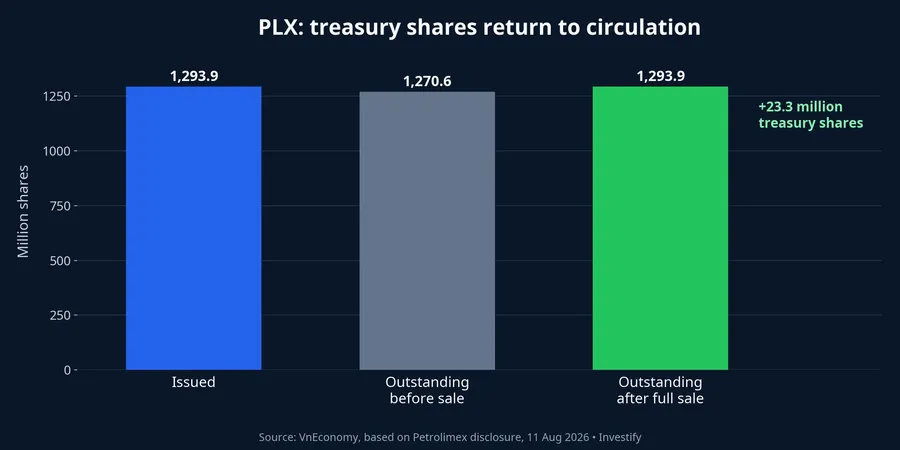
That is why selling treasury shares is different from issuing new stock. A new issuance raises the total number of issued shares. In PLX's case, the issued total remains 1,293,878,081 shares; the proposed transaction shifts 23,285,846 shares from treasury status to outstanding status. It sounds technical, but the distinction is central to understanding dilution.
Before the transaction, PLX had 1,270,592,235 outstanding shares. If every treasury share is sold, the count returns to 1,293,878,081. That is an approximately 1.83% mechanical increase in outstanding shares.VnEconomy It says nothing by itself about the company's operating outlook.

A larger denominator reduces the relative stake
Imagine holding 1,000 shares in a pie divided into 1,270.6 million pieces. If the pie becomes 1,293.9 million pieces and you still own 1,000 shares, your absolute holding has not changed. Your percentage ownership is lower because the total number of voting shares has increased.
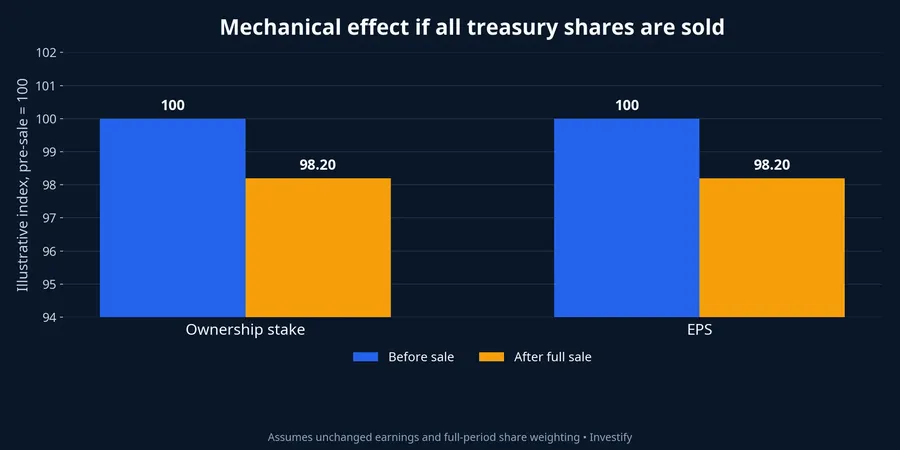
If all treasury shares are sold, the relative ownership percentage of a shareholder who does not buy additional shares falls by roughly 1.80% from its pre-transaction level. No shares are removed from that shareholder's account. The effect comes entirely from the larger denominator. The final outcome depends on how many shares are actually sold, because a registration to sell is not the same thing as a fully completed transaction.
Order matching also does not reveal who will buy the shares. The stock might be dispersed among many investors or accumulated by a smaller set of buyers. Only the transaction result and subsequent ownership disclosures can show how the voting structure has actually changed. It would be premature to infer the shareholder structure from the registration notice alone.
EPS depends on when the sale is completed
EPS is profit attributable to ordinary shareholders divided by weighted-average outstanding shares. If profit is unchanged, all 23.3 million shares are sold and they are counted for a full reporting period, EPS per share would decline mechanically by about 1.80%. The same profit would be divided among more shares.
That is a teaching illustration, not an EPS forecast for PLX. Financial statements use a weighted average. If the sale closes late in the reporting period, the newly outstanding shares enter the denominator for only part of that period, reducing the near-term EPS effect relative to the full-period illustration.
The numerator need not stay fixed either. Sale proceeds can add financial flexibility and generate future income if deployed effectively. Profit could then offset part, or more, of the effect from the higher share count. If the funds do not yet create a corresponding economic benefit, investors will have observed a larger denominator without an improvement in earnings per share.
Cash proceeds are not operating profit
Another common mistake is to treat cash received from treasury-share sales as new revenue or profit. The cash balance does rise by the number of shares sold times the realised price. Accounting-wise, however, the transaction is primarily within equity: the treasury-share cost is removed from the contra-equity balance, while any difference between sale proceeds and cost is recognised within equity under the applicable rules.
Put simply, cash arriving in the account does not automatically become profit from fuel distribution or other operations. The more useful question is whether the funds will be retained to improve liquidity, used as working capital, or invested in a purpose capable of earning more than its cost of capital. The stated plan is to strengthen financial capacity and balance long-term funding, but effectiveness can only be assessed after the company reports the transaction result and subsequent financial statements.VnEconomy
Float and market price are a separate question
Selling through order matching may increase the freely tradable float. Over time, that could support liquidity if the market absorbs the additional supply. In the short term, however, the price will also reflect order timing, offsetting demand, the minimum price the company accepts and sentiment in each trading session.
In the morning session of August 18, PLX traded at VND 37,950, up 6.90%, while the VN-Index gained 0.42%. Brent crude stood at USD 90.93 per barrel. Those figures appearing together do not establish one cause for PLX's move. The price could reflect expectations around the treasury-share transaction, oil prices, operating expectations, flows into energy names and the market's broader direction.
Because there is no evidence separating the contribution of each factor, the disciplined reading is that the intraday gain was a market reaction, not proof that fundamental value rose by the same amount. Actual shares sold, the average sale price and the pace of execution remain unknown variables.
This distinction matters because a stock-price move and a capital-structure change work on different clocks. The market can reprice an expectation immediately, while the weighted-average share count appears only through the accounting period and the benefit of new cash depends on later management decisions. A one-session chart therefore cannot settle the question that the financial statements are designed to answer.
What to check after the notice
The thesis is clear: PLX is preparing to increase its outstanding share count; the first effects are mechanical changes to ownership stakes and EPS, while long-term value depends on what the proceeds accomplish. That does not make the transaction inherently positive or negative for shareholders today.
Investors can follow three disclosures in sequence. First, the transaction result: how many shares were sold and when completion occurred. Second, the weighted-average outstanding-share count in the next reporting period, which measures the actual EPS effect. Third, the financial statements and cash-flow notes, which show where the proceeds sit and whether they create additional economic benefit.
This is a case for waiting for evidence. The denominator has a clear direction of travel, but there is not yet enough evidence to conclude where value per share will go. The transaction report and the next reporting period will complete the arithmetic.