


Through the August 18 session, foreign investors had sold net for four straight sessions on HOSE.Dân trí In just over a month, on September 21, Vietnamese equities will formally enter FTSE Russell's secondary emerging-market index. Plenty of retail investors are asking the obvious question: if the upgrade is all but certain, why is foreign money still heading out the door?
That is not a paradox. It is two events with very different odds being collapsed into a single argument. Whether the upgrade happens is close to certain. Whether upgrade day automatically triggers a wave of foreign capital is an entirely separate question.
The popular belief has real grounding
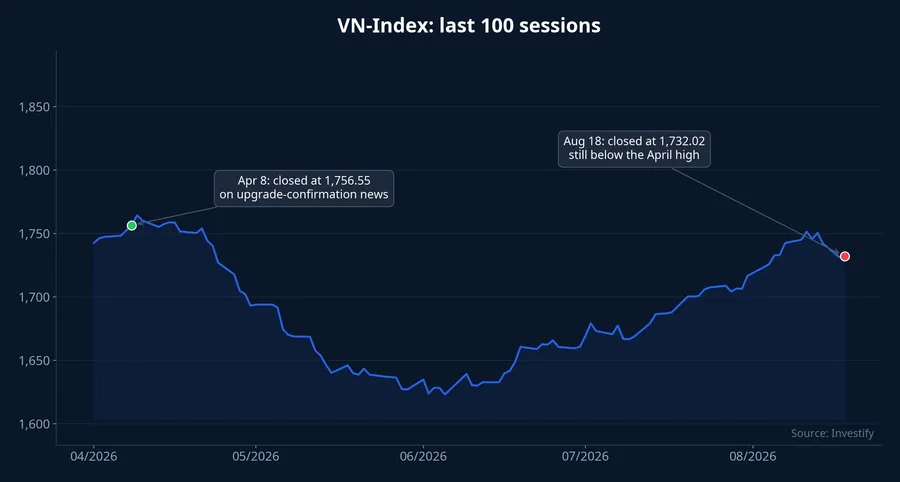
The expectation that "upgrade means foreign capital floods in" isn't wishful thinking: it has a concrete price precedent. Right after FTSE Russell confirmed Vietnam's reclassification from frontier to secondary emerging market, the VN-Index jumped 79.01 points, or 4.71%, to close at 1,756.55 on April 8, with 297 gainers against just 25 losers. That was a genuinely strong price reaction, exactly the kind markets deliver on upgrade news.
The scale of money has a concrete figure attached too. Per a roundup of expert views published by Dân trí on August 18, Võ Văn Huy, Senior Client Director at DNSE Securities, estimates passive index-tracking capital at around $1.5 billion, potentially rising to roughly $6 billion once active funds and broader reallocation effects are included.Dân trí For a market where average daily trading value in July was only about VND 19,300 billion, well below the VND 28,000 billion average for the first seven months of the year, a few billion dollars is a genuinely large sum. The bullish belief is grounded in real numbers.
The actual flow data tells a different story
The problem is timing: upgrade money hasn't arrived, while the money that's been leaving has been leaving for a long time. From March 9 to August 18, foreign investors sold a net VND 93,152.8 billion on HOSE, roughly $3.65 billion, with net selling in 98 of 114 sessions.
Selling pressure has concentrated precisely in the stocks upgrade flows are expected to buy. In August, the three most heavily sold names were TCB at VND 1,047.72 billion, VHM at VND 816.64 billion, and VPB at VND 743.37 billion. Year-to-date, VHM has seen VND 20,306.6 billion in net outflows and FPT VND 15,910.7 billion, far ahead of the rest of the market.
The most conclusive number sits in the index itself: the VN-Index closed August 18 at 1,732.02, still below the 1,756.55 close from the upgrade-confirmation session in April. The entire gain from that euphoric session has been given back, even as upgrade day is now less than four months away.
The disbursement schedule explains most of the gap
Passive capital doesn't arrive all at once. Per Huy, Vietnam's inclusion in global indices rolls out in multiple tranches starting September 2026 and extending into 2027, with only around 10% expected to be allocated in September 2026.Dân trí
Put the two figures side by side and the ratio is obvious. That first tranche, roughly 10% of $1.5 billion, is about $150 million. At an exchange rate around VND 26,000 per dollar, that's approximately VND 3,900 billion, or just about 4% of the VND 93,152.8 billion foreign investors have already pulled from HOSE since March.
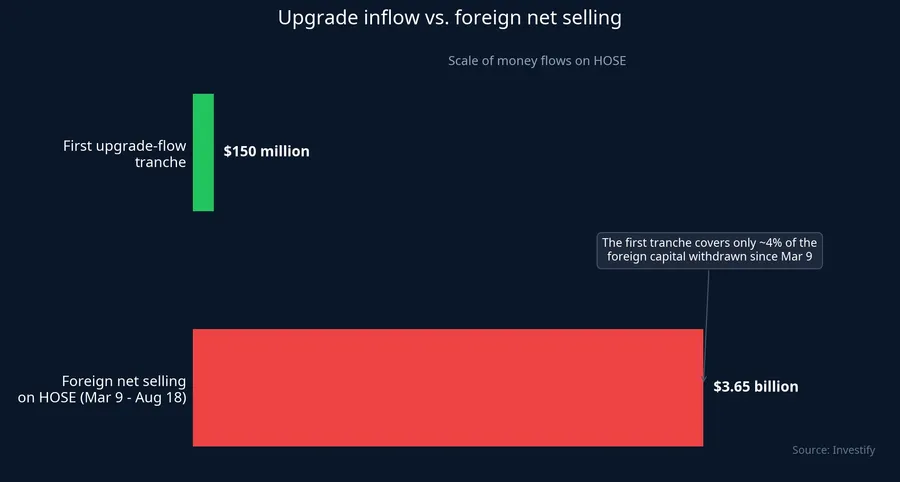
In other words, the first upgrade tranche is only enough to offset roughly half a month of net selling at the current pace. Most of the passive flow lands in later rebalancing windows, and active money has no fixed schedule at all: each fund decides its own timing.
Where global equity money is actually flowing this year
This is the layer most domestic analysis hasn't reached: the money that could otherwise buy Vietnamese equities is busy elsewhere on the global capital map.
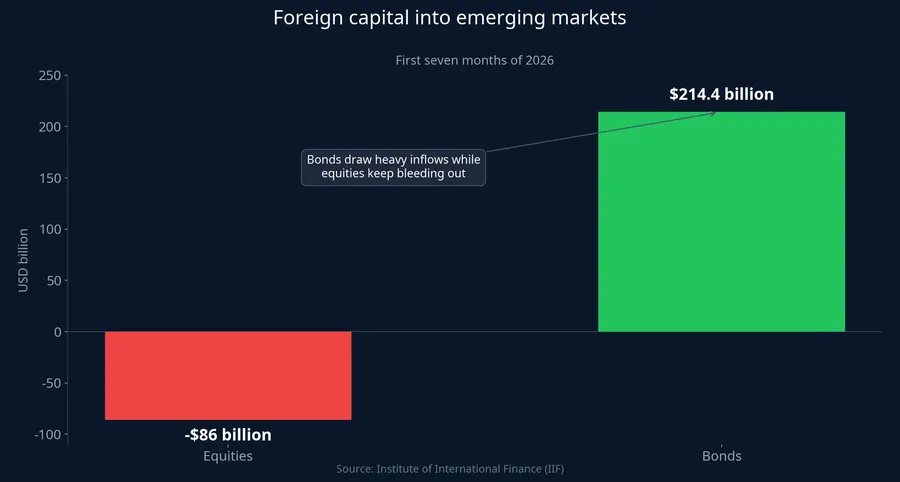
Per Institute of International Finance (IIF) data published August 11, emerging-market equities saw $86 billion in net outflows over the first seven months of 2026, nearly 10 times the $9 billion outflow in the same period of 2025. Over the same window, emerging-market bonds pulled in $214.4 billion.Yahoo Finance That picture flips the read entirely: global capital isn't abandoning emerging markets. It's coming back, just into bonds, buying yield rather than growth.
The money earmarked for equities is piling up somewhere else: the semiconductor supply chain riding the AI investment wave. US semiconductor ETFs have kept pulling in heavy capital throughout 2026 despite cycle-peak warnings, and that money is flowing into names listed in the US, Japan, South Korea, Taiwan, and Europe, markets with actual chipmakers sitting inside the supply chain.
HOSE has almost no company that sits directly in that chain. Vietnam has industrial parks, IT services, and digital infrastructure, but no listed chip manufacturer that an AI-themed fund is obligated to buy. When this year's allocation standard for global equity funds revolves around semiconductor exposure, Vietnam's market sits outside the selection basket, regardless of whether its classification is frontier or emerging.

Other explanations and how much weight they carry
Foreign net selling shouldn't be pinned on a single cause. At least three other explanations coexist, each carrying its own weight.
The first is the exchange rate, usually the first culprit people reach for, but August data doesn't strongly support it: USD/VND stood at 26,063.5 on August 14, down from 26,284.5 on August 3. The dong firmed while foreign investors kept selling, so the exchange rate is unlikely to be the main driver of August's selling specifically.
The second is profit-taking after a rally. The VN-Index ran from 1,669.01 on July 27 to 1,793.18 on August 12, then fell 1.54% and 2.07% over the August 13 and 14 sessions. Some foreign selling landed right in that window, so profit realization is a real factor, though it doesn't explain the full five-and-a-half-month selling streak.
The third is thin domestic liquidity. With average trading value in July at only about VND 19,300 billion per session, selling a large block of large-cap stock hits price harder, and that dynamic itself makes foreign funds more cautious about re-entering.
Weighing all three, the evidence leans toward global capital allocation as the underlying driver, with the exchange rate and profit-taking acting as secondary variables within short-term swings. Net selling that stays steady for five and a half months, across shifting exchange-rate states and different price cycles, looks more like a long-term portfolio allocation decision than a reaction to any single domestic variable.
A more accurate picture, and what to watch next
The upgrade is close to certain. The foreign inflow wave is not. These are two events with different odds and need to be read separately, not folded into one argument.
September 21 should be understood as a scheduled index rebalancing event, with an estimated size and a phased disbursement, not a single-session demand shock. The most predictable part of the event, the price reaction to confirmation news, already happened in April and has largely been given back by the market.
For retail investors, a more useful framework is to watch two confirming signals rather than the event date itself. First, a foreign net-buying streak that runs across multiple consecutive sessions. A single net-buying day has popped up sporadically since March without reversing the trend. Second, average trading value returning to the VND 28,000 billion range per session, the level seen in the first seven months of the year, which would signal broad money coming back rather than just a few large-cap names being marked up.
The risk to watch also has a clear name: if the rollout of the new trading system and the removal of pre-funding requirements slips behind schedule, later disbursement tranches could get pushed into the next review cycle, forcing the expectations already priced in to adjust once again.
The upgrade opens the door for foreign capital. It doesn't decide when that money walks through it. This year, global equity capital is queued up at a different door, and what's worth watching over the coming weeks is whether the selling streak breaks first, or passive capital starts disbursing first.