

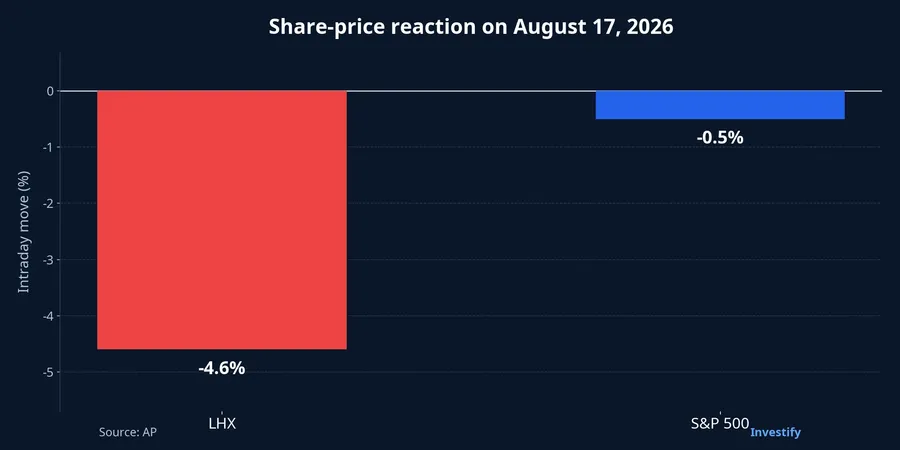
L3Harris Technologies has replaced its chief executive with immediate effect after its board completed an investigation into conduct inconsistent with the company’s Code of Conduct. LHX fell 4.6% on August 17, compared with a 0.5% decline in the S&P 500 that day.AP That is a meaningful market reaction. It is not, by itself, proof that the business has deteriorated.
The distinction matters. A surprise leadership exit can create a governance discount before it changes a customer relationship, a production schedule, or a cash-flow forecast. For investors, the immediate task is to separate what the company has actually disclosed from the risks that still need to be tested in future reporting.
A leadership change outside the normal timetable
Christopher Kubasik, former Chairman and Chief Executive Officer of L3Harris Technologies (LHX), has left his positions. Samir Mehta, Chief Executive Officer of L3Harris Technologies (LHX), was appointed immediately and joined the board. L3Harris said its board acted after an investigation, assisted by independent counsel, found conduct inconsistent with the values set out in its Code of Conduct.
The company did not disclose the underlying conduct. That omission sets an important analytical boundary. Filling it with a more elaborate narrative would be speculation, and speculation is often what keeps an initial sell-off alive. The disclosed matter is serious because it concerns the person at the top of the organisation, but it is not evidence that defence customers, contracts, or financial controls have been impaired.
L3Harris said the conduct was unrelated to financial reporting, controls, customer relationships, and operational performance. This is a statement about the scope of the matter at the time of disclosure, not a guarantee that every governance consequence has already been resolved. Both ideas can be true: investors should not invent an operating crisis, and they should not treat an abrupt CEO change as mere housekeeping.L3Harris

What the share-price move is discounting
LHX’s 4.6% fall was far larger than the S&P 500’s 0.5% decline. The gap suggests that investors demanded a larger risk premium for L3Harris after the announcement. It does not establish a fall in revenue, free cash flow, or delivery capability; intraday prices usually react to uncertainty faster than operating data can.
Several explanations are plausible. Investors may be reassessing board oversight and reputational risk. Some holders may simply be reducing exposure until they can judge the new leadership team. Broad market weakness also formed part of the day’s backdrop. The evidence supports the first two explanations more strongly, but it does not let us assign a precise portion of the decline to any one of them.
That is why it would be a mistake to read the 4.6% move as proof that customers are leaving. It would be equally wrong to dismiss it. The market has issued a reasonable request: show that the operating system remains steady after a change at the highest level.
For a retail investor, this distinction is practical. Governance news can move a share immediately because it changes the confidence investors place in management and oversight. Operating data move a company’s long-term case when they alter orders, margins, cash generation, or its ability to deliver. Those are related questions, but they are not interchangeable, particularly on the day a management announcement arrives.
The successor reduces, but does not erase, transition risk
Mehta’s appointment avoids one common source of disruption: bringing in an outsider who must first learn the company. He joined L3Harris in 2023, has more than 25 years of aerospace and defence experience, and most recently led the Space & Mission Systems and Communications & Spectrum Dominance segments. Those businesses account for more than 80% of L3Harris revenue.L3Harris
That background gives him direct familiarity with customers, major programmes, and internal execution pressures. It is a practical continuity advantage, not simply an appealing succession narrative. A leader who already ran most of the operating base should need less time to establish priorities than an external hire.
The risk has nevertheless moved down the organisation. When the executive responsible for the two largest segments becomes CEO, those operating roles must be filled and coordinated quickly. L3Harris has announced new segment leaders. The relevant test now is execution after the announcement: programme milestones, deliveries, and cost control need to retain their rhythm.
Operations have not signalled a reversal
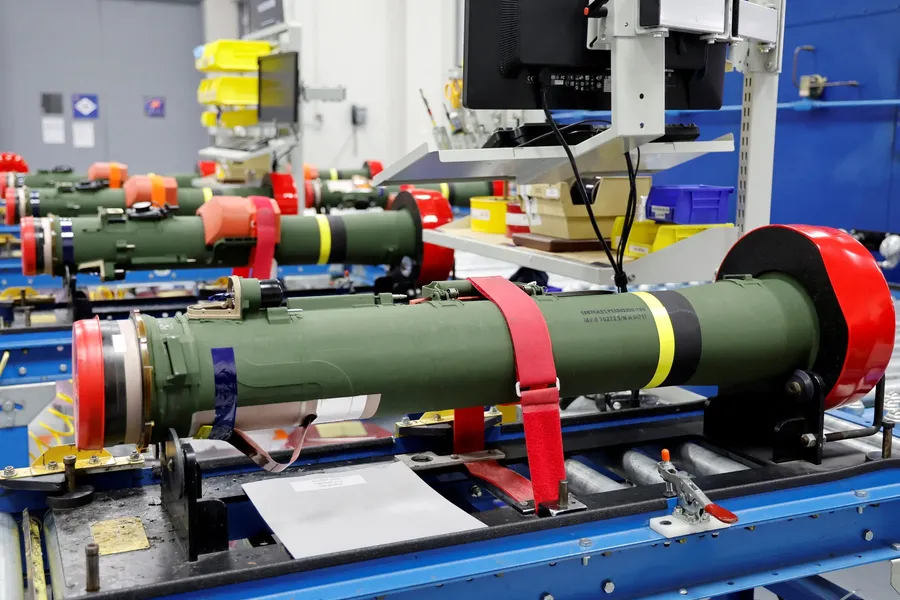
In the same announcement, L3Harris reaffirmed its 2026 consolidated revenue, organic-growth, segment-margin, GAAP EPS, and free-cash-flow guidance. It also said it remains committed to a $3 billion capital buildout to expand solid-rocket-motor production and strengthen the supply chain.L3Harris
This is the part of the disclosure that should not be overlooked. Retaining both annual guidance and a major capacity investment immediately after a CEO transition says that the company has not identified an operational reason to change its priorities. If a core disruption had already been recognised, leaving the full operating outlook intact would be harder to reconcile.
Reaffirmed guidance is still forward-looking rather than completed performance. The company itself identifies competitive conditions, US defence-spending priorities, contract mix, supply chains, debt, and interest rates as relevant risks. The available information therefore supports a narrower conclusion: there is no disclosed evidence of operating weakness today. It does not prove that the transition will have no effect.
The next reporting cycle is the real test
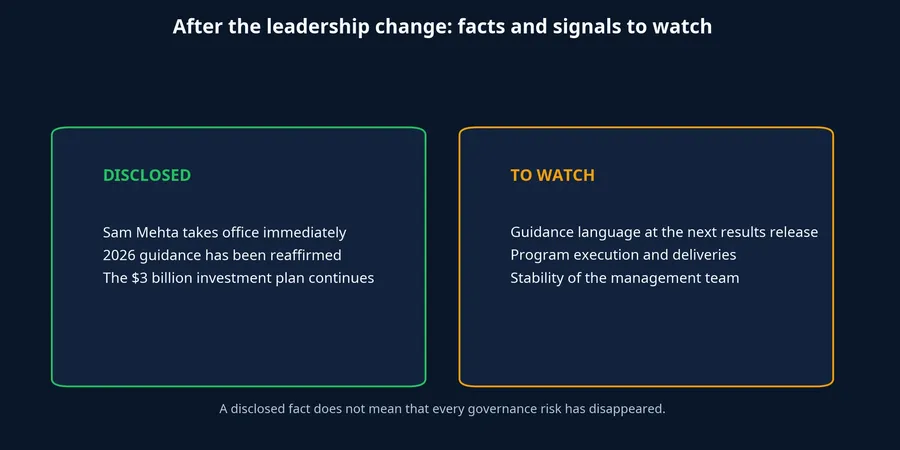
The first test will be management’s language at the next results release. If L3Harris retains its outlook and does not add warnings about customers, controls, or programme execution, the case that this has remained contained within governance will strengthen. A guidance revision or an expanded account of the investigation would give the market a reason to reassess the discount.
The second test is organisational stability. Investors do not need an absolute promise that no executive will leave. More useful is evidence that the newly arranged roles have clear decision rights and accountable owners. In a business with long contract cycles, a management gap can appear in schedule slippage before it reaches the income statement.
The final test is disclosure quality. The company has drawn a relatively specific boundary around the matter. Subsequent communications should remain consistent with that boundary and show how board oversight has been reinforced. Transparency cannot erase the event, but it can reduce the time investors are forced to price uncertainty without evidence.
That watch list also keeps the analysis honest. A share-price recovery alone would not prove that governance concerns are behind the company, just as a further decline would not demonstrate an operating failure. The more informative evidence will come from management’s next disclosures and whether the business continues to execute against the commitments it has already made.
The thesis: a governance discount, not an operating verdict
The current evidence supports a clear thesis: LHX’s decline reflects a governance shock and an uncertainty premium, rather than confirmed business deterioration. Mehta’s deep operating familiarity with segments that generate more than 80% of revenue and the company’s reaffirmed 2026 outlook are the two strongest facts supporting that view.L3Harris
The conclusion would change for concrete reasons, not because of another weak trading session: customer disruption, a control issue, programme delays, or a change in financial guidance. Until such evidence appears, the disciplined approach is to monitor execution and disclosure quality rather than let a single-day move tell a story larger than the data can support.