


A financing headline can make a project look fully funded at a glance: banks are involved, a motorway is in the background, and shareholders are offered a new bond. With CII, though, the important task is not to add the headline figures into one impressive “capital package.” It is to identify who owns each flow of money, what stage it has reached, and what has to happen before it produces value for shareholders.
On August 17, CII closed at VND 14,750, up 5.73% on 17,303,400 shares traded, while the VN-Index fell 0.09%. That divergence suggests that the market had a company-specific expectation, but a one-day price move does not prove that a project has generated profit or that a financing round has been completed.
The central point is straightforward: CII has different sources of capital and different obligations. A credit facility or a subscription-rights announcement should not be treated as evidence that all of the money has already reached CII. Once those layers are separated, the picture is less dramatic and much easier to test.
A subscription right is not cash raised
CII's board has approved the distribution of CII426001 convertible bonds to existing shareholders. Under the resolution published on August 14, holders of 10 shares receive the right to buy one bond; the record date is August 27, with registration and payment scheduled from September 10 to October 9, 2026.CII
Put simply, a subscription right is a conditional invitation. Shareholders receive it, then decide whether to subscribe and pay. Only after investors have paid in full and the distribution is completed does it become actual capital available to the company. The maximum size stated in the filing is therefore not the same thing as cash already sitting in CII's account.
That distinction matters particularly for new investors. A phrase such as “a VND 6,720 billion bond offering” can easily become “CII has just received VND 6,720 billion.” They are entirely different claims. The first describes the maximum offering size approved in a resolution; the second describes funds collected. The current filing supports only the first claim.CII

Subscription rights also do not, by themselves, quantify dilution. That calculation needs the conversion terms, the distribution result and the choices made by bondholders. When investors see the phrase “convertible bond,” they should separate two questions: how much cash has the issuer received, and under what terms could the bonds turn into shares? Answering one does not automatically answer the other.
Three flows of capital that should not be added together
CII is connected with the expansion of the HCMC - Trung Luong - My Thuan expressway. The project company borrows in its own name; CII may raise funds through its own instruments; shareholders and bondholders make decisions under the terms of each offering. Those flows are economically related, but they are neither the same pool of money nor recorded at the same time.
Credit extended to the project company is, first of all, that company's access to funding. A facility is not a one-off cash drawdown. Lenders generally require documentation, drawdown conditions and evidence of how funds will be used before each portion reaches the project. Seeing CII's name in a financing arrangement is therefore not sufficient reason to call the entire facility cash held by the parent company.
Debt securities issued by CII are a separate matter. They are financial obligations of the issuer, governed by their own terms for interest, principal and, where applicable, conversion. Shareholder subscription rights are an earlier stage still: they allow participation in a distribution but do not reveal whether all funds will be paid. Combining all three loses the key information: who bears the obligation and when it arises.
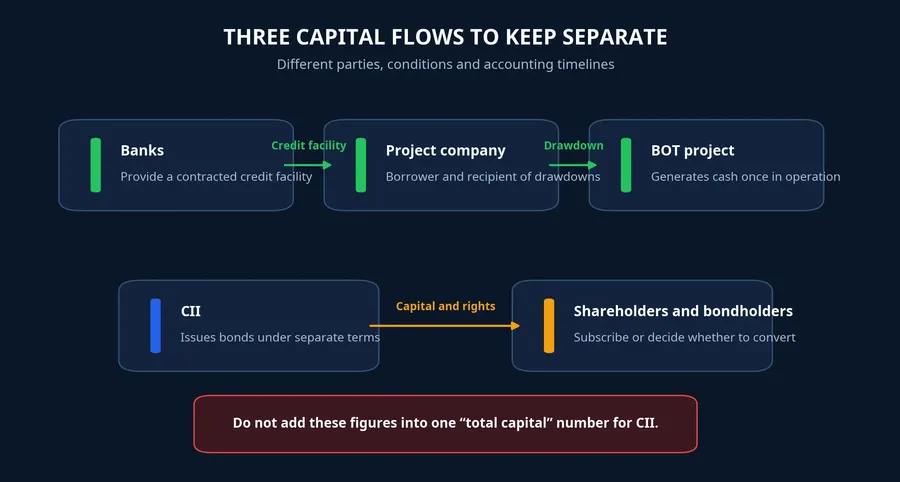
Think of them as three compartments in the same cabinet. One holds project credit, tied to the project company and drawdown conditions. The second holds CII bonds, tied to CII's obligations. The third holds subscription rights, tied to shareholders' decisions to pay. Opening each compartment is the way to avoid treating every number on the labels as available cash.
Project cash flow is the final test
For a BOT project, the ultimate source of debt service is not a signing ceremony or a financing announcement. It is operating cash flow. To reach that point, funds must be drawn, construction completed, the road permitted to operate, and revenue sufficient to cover operating costs and debt service. Each link needs to be followed through documents or actual results.
That does not diminish the importance of financing. A credit facility or an ability to raise funds is an important condition for a project to proceed. It is an input, however, not proof of an output. A project can have a facility but draw down slowly; it can also be built and still require time for traffic and revenue to stabilise.

That is why upcoming financial statements matter more than a single headline. Investors should examine how the project company is reflected in the ownership structure, whether CII has capital commitments or guarantee obligations, and how much cash has actually been paid into the new distribution. Accounting treatment should not be inferred merely from a company's name appearing at a signing ceremony or in an announcement.
Dilution is a mechanism, not a generic warning label
Many investors hear “convertible bond” and immediately conclude that the shares will be diluted. That skips a step. A convertible bond is first a contractual debt obligation; it can become shares only under stated conditions and through the choices set out in the terms. Before conversion, the issuer carries funding costs and repayment obligations. After conversion, debt pressure may ease, but the number of outstanding shares may rise.
This is a trade-off, not an automatically good or bad signal. What investors need to know includes the conversion price, the first conversion date, the maximum shares that may be issued, investor participation and the use of proceeds. CII426001 is currently at the subscription-rights stage. A conclusion on dilution from this series should therefore wait for full conversion terms and the result of the distribution, rather than being inferred from the maximum offering size.CII

A useful note-taking method is to make two columns. “Already happened” includes the board resolution, the record date and the announced payment schedule. “Still to be confirmed” includes actual cash received, the distribution result, the complete conversion terms and implementation progress at the project. Keeping the columns apart prevents expectations from becoming facts merely because the items appear together on a news feed.
Conclusion: Watch actual payments before pricing in expectations
The most reliable conclusion from the available information is not a huge combined funding total. It is the status of each capital flow. CII426001 is a subscription-rights distribution for existing shareholders. Project-company credit, bonds issued by CII and shareholder rights should each be tracked as a separate mechanism.
The thesis follows directly: financing capacity is necessary, but shareholder value becomes clearer only when money is actually paid in, funds are drawn down and the project generates operating cash flow. The next useful signals are the result of CII426001 after the payment window, updates on project funding progress, and relevant disclosures in the financial statements. Those are the milestones that can turn a financing plan into evidence suitable for evaluation.