


One stock can subtract nearly four points from the VN-Index while the market benchmark falls by only 1.62 points. That was the 17 August session: the VN-Index closed at 1,727.46, down 0.09%, while VIC fell 1.20% to VND 198,000 and deducted 3.97 points from the index.VNIndex.ai There is no contradiction here. It is how a market-capitalisation-weighted index works: one large negative contribution can be offset by several positive ones.
For newer investors, the useful lesson is not a prediction for VIC's next session. It is that the VN-Index is neither a proxy for VIC nor a simple verdict that a weak large-cap means the entire market must be weak. Every closing level is the net result of hundreds of stocks, with the largest companies carrying more weight.

A large negative number does not describe the whole session
VIC was the VN-Index's largest source of pressure on 17 August. Its 3.97-point drag was far greater than the index's net 1.62-point decline. Looking only at that comparison could lead an investor to assume the rest of the market was weakening as well. The index calculation, however, does not stop with one stock.
Think of the VN-Index as a very large set of scales. VIC tipped it downward, while GAS, STB, BSR and other stocks tipped it upward. The scales still ended lower, but not by the full weight of VIC alone. Comparing VIC's 3.97-point drag with the VN-Index's 1.62-point fall therefore does not expose a data error; it reveals the offsetting moves inside the benchmark.
Market value explains why VIC's point contribution matters. After the session, its market capitalisation was about VND 1,525.8 trillion. At that size, a 1.20% price move can materially affect the index, whereas a smaller company would need a much sharper move to generate the same point impact.VNIndex.ai
Foreign selling is evidence, not a complete explanation
Foreign investors were estimated to have sold a net VND 602.29 billion on HOSE. VIC alone saw estimated net selling of about 1.2 million shares, or VND 237.81 billion, equivalent to nearly 39.5% of the exchange-wide net selling when the two figures are compared.VNIndex.ai That makes VIC the session's leading net-sold stock and a relevant data point to watch.
It should not, however, be turned into a definitive causal claim. VIC's closing price was formed by all buy and sell orders from domestic and foreign investors. Profit-taking, developments across the Vingroup group and market sentiment after the prior two down sessions are all plausible explanations, but the session data do not allow a precise allocation of each factor's contribution.
The construction of the number also matters. The VND 237.81 billion figure is an estimate based on net volume and the closing price, so it may differ slightly from the official matched value. The accurate description is therefore “estimated net selling,” rather than treating it as HOSE's final figure.VNIndex.ai That small distinction prevents a quick indicator from being overstated.
VIC's price should also be read in context. It declined from VND 215,500 on 12 August to VND 198,000 on 17 August, a fall of about 8.12%.VNIndex.ai The sequence shows pressure accumulating across several sessions, but it does not by itself predict the following day's direction.
Other large caps offset part of VIC's drag
In the other direction, GAS rose 4.08% to VND 79,100 and added 1.55 points to the VN-Index. STB rose 2.63% to VND 74,200 and contributed 0.74 points; BSR gained 2.56% to VND 26,000 and added a further 0.67 points.VNIndex.ai Together, those three stocks supplied 2.96 points of support, offsetting a meaningful portion of VIC's drag.
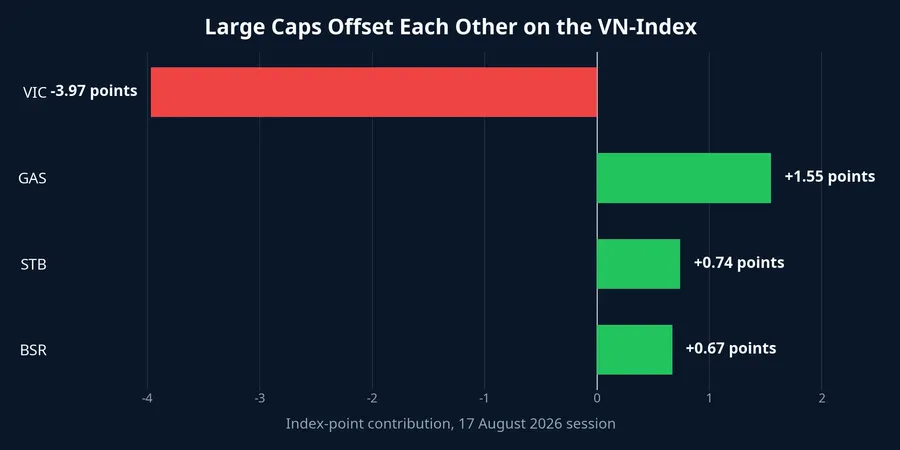
The chart isolates four names to show the mechanism. It does not imply that they alone determined the session. BVH, HDB, MWG, VNM, VRE and other stocks also entered the calculation. On the negative side, LPB deducted 0.94 points, VPB deducted 0.59 points and VCB deducted 0.55 points.VNIndex.ai The closing index is always the sum of many contributions, not a contest between VIC and three gainers.

“Offset” is more accurate than “rescue.” GAS, STB and BSR each had their own price action, and the session data do not establish that they rose in response to VIC. The neutral description preserves what the numbers do show: their moves supported the index on the same day.
Market breadth shows whether pressure is spreading
Index points are the first layer of information, but not the whole picture. HOSE recorded 158 advancing and 161 declining stocks on 17 August, leaving breadth close to even. Trading volume was about 519.22 million shares, and the VN-Index moved between 1,715.91 and 1,735.20 before closing at 1,727.46.VNIndex.ai
Near-even breadth does not mean every stock was fine. It does indicate that selling had not become a market-wide decline. Consider two sessions with a modestly lower index. In one, a single large-cap falls while advancers and decliners are relatively balanced, so pressure may be concentrated. In the other, decliners dominate but a few heavyweights hold the index up; then the headline number can mask broader weakness.

The 17 August session was closer to the first case: pressure in VIC and several bank stocks was partly offset by energy, insurance and consumer large caps. That is not proof that the market has regained strength. The VN-Index had already lost a combined 64.10 points across 13 and 14 August; one session of near-even breadth only shows that selling did not continue to dominate across the board.VNIndex.ai
What the next session needs to answer
The thesis from 17 August is straightforward: the VN-Index's mild decline reflected offsetting moves among large caps, not the disappearance of VIC's pressure. What could change the picture is a broadening of selling from a few stocks into more sectors, or, on the other hand, the consistent emergence of alternative large-cap support.
In the next session, watch VIC alongside estimated foreign net selling. If VIC remains net sold but its decline narrows, liquidity finds buyers and market breadth does not deteriorate, the pressure is still more likely to be concentrated. If VIC falls further while other pillars turn into drags, the offsetting mechanism will weaken. Those are signals for understanding the market's structure, rather than reacting too quickly to a single end-of-day VN-Index number.