


Nguyễn Đức Tài, Chairman of the Board of Directors of Mobile World Investment Corporation (MWG), completed the purchase of 1 million MWG shares through order matching between July 31 and August 13. This is no longer an intention on paper; it is an executed transaction. That distinction makes the disclosure worth reading closely, although it does not settle where the share price goes next.Nguoi Quan Sat
For newer investors, an insider purchase can seem straightforward: a leader is buying, so the company must be attractive. There is some logic to that view because the buyer is increasing personal exposure with real capital. Yet a stock does not rise simply because a well-informed executive buys more. The relevant questions are the scale of the transaction, the underlying operating performance, and the earnings assumptions embedded in the valuation.
An executed purchase is different from a registration
A registered purchase is an intention. During the permitted trading window, an insider may buy fewer shares than planned, alter the plan, or not complete it because market conditions change. Tài's full purchase of 1 million shares therefore carries more informational weight than the initial filing: the capital has been deployed and the post-transaction holding has been disclosed.Nguoi Quan Sat
After the transaction, Tài held 33.4 million shares, equal to 2.26% of charter capital. Subtracting the additional shares implies a pre-transaction holding of roughly 32.4 million shares. His personal MWG shareholding therefore rose by about 3.1%, while his ownership stake increased by only nearly 0.07 percentage points. Those are different lenses: one measures the increase in his own portfolio, while the other shows that MWG's ownership structure was barely changed.Nguoi Quan Sat
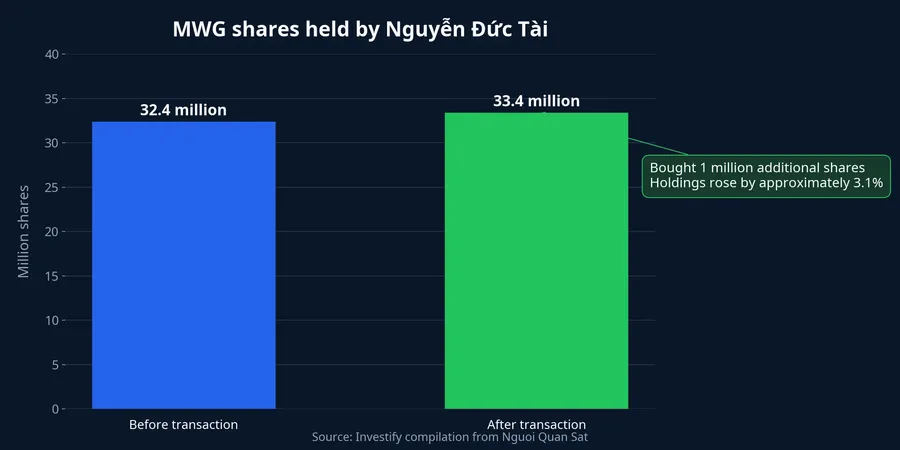
The numbers do not support calling this a change in control or an all-in commitment. Nor should they dismiss a board chairman's decision to increase his exposure at the prevailing market price. Nguoi Quan Sat estimates the transaction at more than VND 70 billion. Since the price of each matched order was not disclosed, that is an estimate rather than a precise settlement value.Nguoi Quan Sat
The insider signal needs operating evidence behind it
The important part of MWG's picture is not only the chairman's action. In the first seven months of the year, the company recorded VND 111,394 billion in net revenue, up 29% year on year and roughly 60% of its full-year revenue target. That is more independent evidence than an insider transaction because revenue captures sales across the operating system rather than one individual's assessment.Nguoi Quan Sat
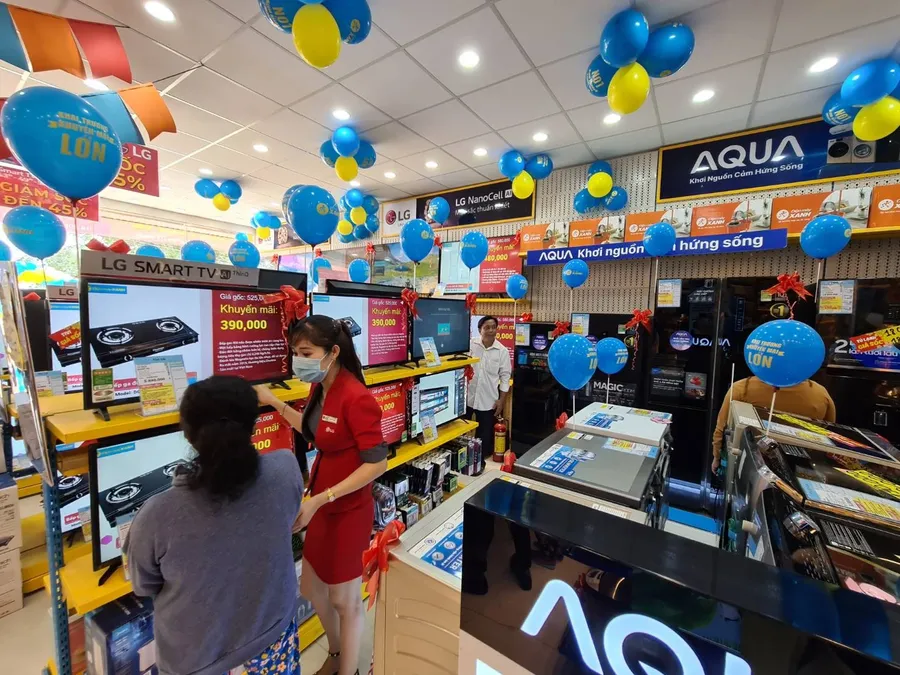
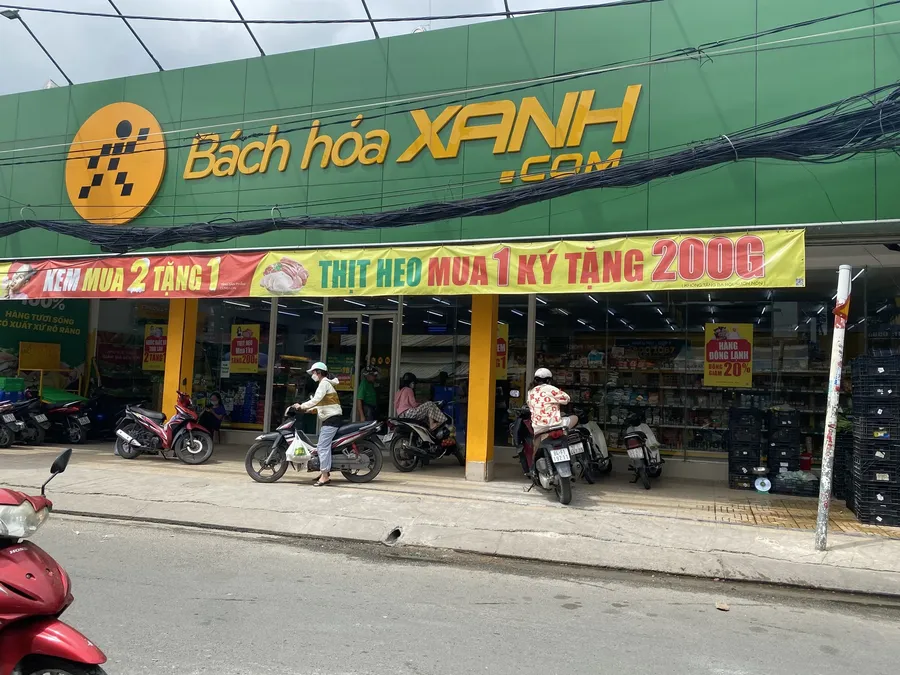
According to figures cited by Nguoi Quan Sat, the Điện Máy Xanh group generated about VND 75,200 billion in seven-month revenue, also up 29% year on year. Bách Hóa Xanh accounted for roughly 30.5% of consolidated revenue, while Thế Giới Di Động and TopZone accounted for about 22.5%. The mix matters: MWG is not just a handset or consumer-electronics story. The quality of growth depends on several chains with different capital needs and margin profiles.Nguoi Quan Sat
Net profit is running ahead of the revenue-plan pace. After six months, MWG reported more than VND 6,100 billion in after-tax profit, around 66% of its VND 9,200 billion full-year plan. The gap may indicate improved margins, a more favourable sales mix, or both. Still, seven-month revenue and six-month profit are different reporting windows; the next financial statements will show whether revenue growth keeps translating into profit and operating cash flow.Nguoi Quan Sat
That timing distinction is more than a technical footnote. A retailer can report rising sales while absorbing inventory, store-opening, or promotional costs that delay the cash benefit. Conversely, a period of stronger margins can make profit advance faster than revenue without guaranteeing the same pace in every subsequent quarter. The useful test is not whether one headline number is good, but whether the relationship between sales, margin, and cash generation remains coherent as the business scales.
For MWG, the separate roles of its retail chains also matter for interpretation. Consumer electronics tend to be more exposed to replacement cycles and discretionary spending, while grocery retail is tied to more recurring daily demand but has its own execution and cost disciplines. A consolidated growth figure is therefore a starting point, not a complete diagnosis. Readers should avoid assigning the same operating quality to every chain just because the group-level total is expanding.
A low P/E is an assumption about the future
Vietcap, as cited by Nguoi Quan Sat, estimates MWG's forward P/E at approximately 9.2x for 2026 and 7.4x for 2027, below its 10-year forward-average P/E of 13.3x. This helps explain the constructive reading of Tài's purchase: if earnings arrive as forecast, the current price may require less than the company's historical valuation range.Nguoi Quan Sat
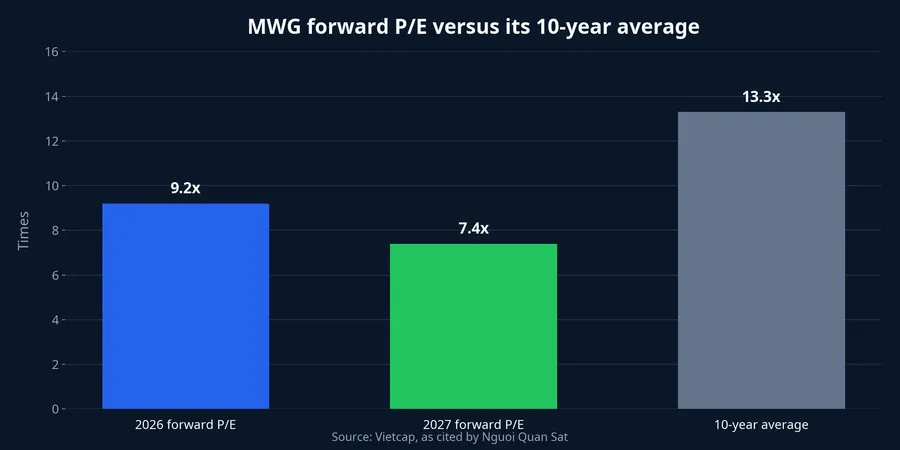
But a forward P/E is not a confirmed bargain. Its denominator is future profit. If earnings fall short of the estimate, the realised P/E will be higher and the impression of cheapness will change. Vietcap's projection of about 18% annual compound EPS growth from 2026 to 2029 should consequently be tested against each reporting period, rather than treated as an achieved outcome.Nguoi Quan Sat
There are plausible reasons for an insider purchase beyond a view that the stock is undervalued. The buyer may be signaling alignment with the business, rebalancing personal assets, or taking a positive view of a recovery phase. Public information is not sufficient to allocate a precise weight to each motive. The strongest evidence is therefore the completed purchase itself, not a claimed explanation of its cause or a target price.
This is also why the purchase should be kept separate from the earnings thesis. The transaction is observable and its scale can be measured. The future earnings path is an analytical projection whose validity depends on execution in the stores, the cost base, and consumer demand. Combining the two too quickly produces a stronger conclusion than the disclosed facts can carry. Keeping them distinct gives the insider action its proper role: useful context, but not a substitute for evidence.
A practical reading frame for newer investors
Start by separating a registration from an executed result. MWG clears that first test. Then put the purchase in the context of the existing holding: 1 million shares represents meaningful capital, but it does not materially alter voting power or control. This prevents both extremes, namely ignoring the signal altogether or treating it as an insider-issued buy recommendation.
Then return to the operating reports. Investors should follow the revenue of the major chains, margins, expansion costs, and operating cash flow. Higher consolidated revenue does not automatically mean every chain is improving in the same way. A fast-growing chain that requires substantial capital can have very different implications from a chain that preserves a healthy margin.
Finally comes valuation. A P/E below the long-term average matters only if EPS follows the projected path. This is where the chairman's purchase and the business data meet: the purchase is a supporting piece of evidence, whereas delivered earnings are the observable input that can shape valuation over time.
The central conclusion is that the MWG signal is stronger because the transaction is complete and is accompanied by revenue and profit growth. It is not, however, a standalone buy signal. The next reports should be assessed for three things: conversion of revenue into profit, contribution from each retail chain, and delivery against the EPS forecast. Those factors can strengthen or weaken the valuation case; 1 million shares cannot substitute for them.