


Calling every artificial-intelligence stock an “AI bubble” can sound prudent, but it is too broad to be useful. A company that rents computing capacity must buy servers before it earns revenue. A semiconductor-equipment supplier depends on its customers’ factory-spending cycle. A software company needs to show that customers will actually pay more for a new feature. They may all sit inside the same technological wave, yet their financial problems are fundamentally different.
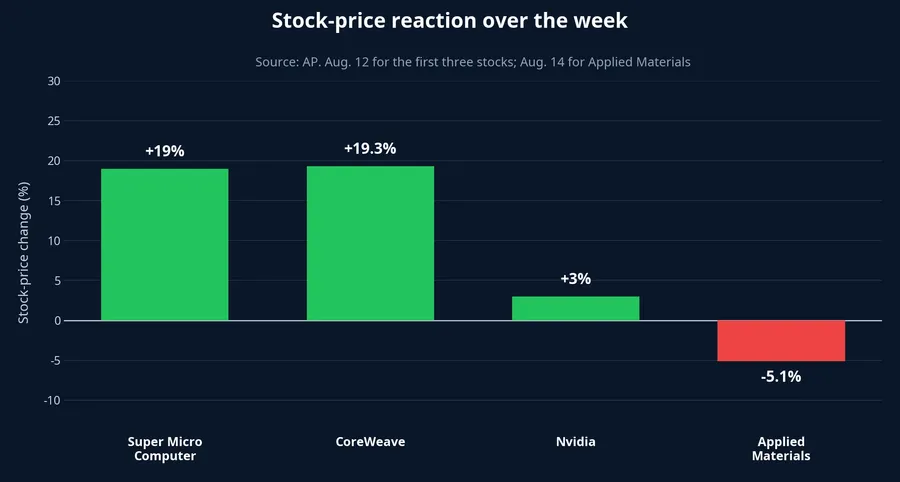
That is why different share-price reactions should not be surprising. In US trading on August 12 and 14, Super Micro Computer rose 19%, CoreWeave gained 19.3% and Nvidia advanced 3%, while Applied Materials fell 5.1% after reporting results above forecasts. Those moves do not, on their own, prove that one business is right and another is wrong. They show that investors are demanding different things from different links in the value chain.APAP

One label cannot describe several business models
Think of the AI value chain as a neighbourhood with different kinds of shops. Some supply power and data-centre capacity, some sell servers and chips, some build models, and others sell applications to end users. Good news for the neighbourhood can attract capital, but each shop has a different revenue model and cost base.
So “Is AI a bubble?” is usually not a precise enough question. A more useful question is: what growth is this company’s price assuming, and how much of that assumption has the financial statements confirmed? If a share price rises on expectations for server demand, investors should look for revenue, margins and cash generation to test that expectation. If those measures do not improve in step, much of the price move may be expectation rather than delivered performance.
One week, different expectations
The important lesson in those price moves is not to force one cause onto all four companies. Super Micro Computer, CoreWeave and Nvidia rose on August 12 as earnings reports reinforced expectations of continuing demand for computing infrastructure. Two sessions later, Applied Materials fell 5.1% even though its revenue and profit exceeded forecasts. The move is a reminder that beating estimates may not be enough when the market has already expected more.APAP
It would be a further, unsupported leap to say that earnings alone caused each move. Over a few sessions, trading positioning, market sentiment and valuation before the results can matter as well. The evidence supports a more careful conclusion: investors are differentiating by a company’s place in the value chain and by the expectations already embedded in its price, rather than buying or selling every business with an AI label together.
For newer investors, this is a small but important change in how to read the news. Do not stop at asking whether a stock belongs to the AI group. Ask what the company sells, when customers pay, and where the company has to spend cash first. Those three questions usually get closer to the real risk than a headline does.
CoreWeave shows that growth and capital pressure can coexist
CoreWeave is a clear example of the two sides of infrastructure growth. Its shares gained 19.3% on August 12, showing a positive market response to expectations for computing-capacity demand.AP For an infrastructure-rental model, though, a price reaction is only the start of analysis: future revenue must be enough to cover the servers, data centres and borrowed capital used to expand.
Put simply, this resembles opening many new shops before the older ones generate enough cash on their own. Revenue can rise quickly, but equipment purchases, data-centre construction and interest costs arrive early too. A gap between operating cash generation and investment is not a verdict on a company because infrastructure models require upfront capital. It is the reason financing capacity belongs beside revenue in an investor’s checklist.
The distinction matters because a fast-growing company can look healthy in a headline and fragile in its financing schedule. Investors do not need to predict the end of the AI cycle to see that difference. They can ask whether new capacity is backed by customer commitments, whether those commitments become billable revenue on schedule, and whether the company can refinance or fund the build-out without steadily worsening its economics.
Each layer needs a different checklist
For data-centre operators and computing-capacity providers, begin with signed contracts and the pace at which those contracts turn into revenue. Then compare cash from operations with spending on servers, facilities and interest. Fast revenue growth is encouraging, but a capital structure can still be vulnerable if debt and capital expenditure rise faster than the business’s capacity to fund itself.
For chipmakers, server vendors and semiconductor-equipment suppliers, orders are an early signal, not the final profit result. Margins, inventories and dependence on a small set of large customers help answer whether growth is durable. Their customers’ investment cycles can also mean that a good report fails to clear the expectations already priced into a stock.

Model developers pose a different problem: many are private, so comparable financial disclosure is thinner. Instead of looking at user numbers alone, consider paid revenue, computing costs, customer retention and the need for additional capital. When direct data are limited, equity investors can assess the exposure through listed customers, suppliers and contractual obligations.
For application companies, the test is closer to everyday business. Does an AI product make customers pay more, stay longer, or improve margins? Repeated mentions of AI in a presentation cannot replace revenue, retention and operating cash flow. A useful comparison is the company’s own numbers before and after the product launch, rather than a comparison with the most exciting AI name in the market.
Separate the price from the business
A practical approach follows three steps. First, identify the growth assumption built into the share price. Next, see whether revenue and profit confirm that assumption. Finally, ask whether cash can finance the required investment or whether the company must rely more heavily on debt and equity issuance.
When price, revenue, margins and cash generation improve together, valuation can still be high, but the operating base is being tested. When revenue rises while cash falls far short of investment needs, the focus shifts to financing. When only the price changes and the business results do not, investors should recognise that most of the story is still expectation.
This framework also keeps an investor from turning a broad technology theme into an all-or-nothing verdict. A supplier can have genuine demand but a demanding valuation. An application company can have a compelling product but no evidence of monetisation yet. A data-centre operator can have contracted growth but face a funding burden. These are separate questions, and the answer may change from one earnings report to the next.
The point is neither that AI cannot create real economic value nor that every AI stock is expensive. The available evidence supports a more differentiated view: valuation frenzies can rotate through individual links in the chain. Rather than treating the entire group as one trade, the next reports should be read for a simpler question: is revenue becoming profit and cash, and is capital demand continuing to outrun a company’s ability to finance itself?