


August 21, 2026 may become the date most often mentioned alongside FTSE Russell. For newer investors, however, the more useful question is what that date actually tells them. FTSE Russell is scheduled to release the list of eligible Vietnamese stocks alongside technical review material. That is official information, but it is not an instruction requiring every index-tracking fund to buy immediately.FTSE Russell
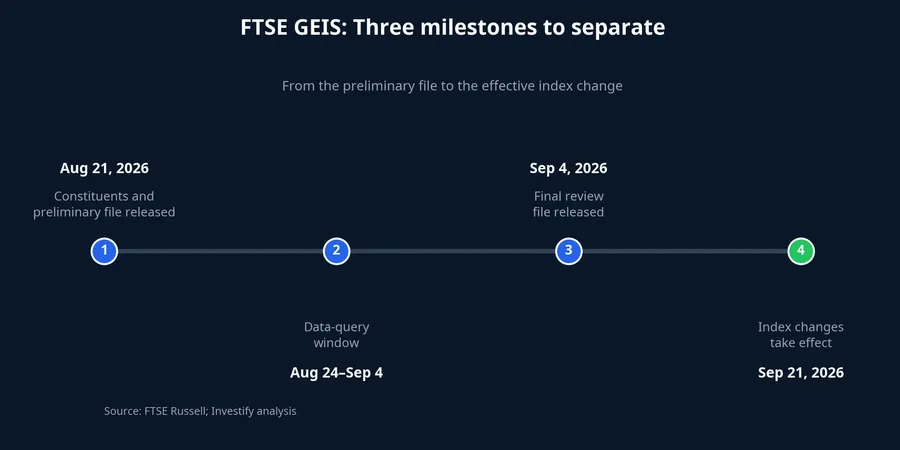
Think of an index review as the process of finalizing a passenger list for a trip. Knowing who is on the list matters, but data confirmation, preparation and departure are separate stages. In FTSE GEIS, August 21, September 4 and September 21 correspond to the preliminary file, the final review file and the effective date for index changes. The central point is simple: follow the status of the review instead of treating a stock name as a promise about its price.
August 21: Official information, not a completed trade
FTSE Russell’s Vietnam reclassification document identifies August 21 as the date for the final list of eligible stocks in the September review. The FTSE GEIS calendar, meanwhile, describes the material issued that day as a preliminary review file, including proposed changes to index constituents, free-float factors and shares in issue.FTSE Russell Those layers are not contradictory. They require readers to separate the announced stock names from technical data that still needs to be checked.
An appearance in the announcement is therefore no longer a brokerage forecast. It still does not reveal exactly how much a fund will buy, which session it will use, or how the market price will respond. Actual orders depend on each fund’s assets under management, the benchmark it follows, its portfolio-construction method and exchange rates when trading occurs.
This is an easy distinction to miss when investors see flow estimates. An estimate can be a useful scenario, but it is not committed cash. A fund that does not replicate the changing index, or that uses optimized sampling rather than holding every constituent at its exact weight, may trade very differently from a figure in a market report.
August 24 to September 4: Checking the data
FTSE Russell has allocated August 24 through September 4 for clients to raise questions about the data displayed in the review file. The final file is scheduled for September 4 and may include revisions from the preliminary version.FTSE Russell That is why August 21 is best read as the start of a verification process, rather than the end of every technical uncertainty.
Once the final file arrives, investors can make a more practical comparison: did weights change, were free-float factors revised, or is there a notice that affects portfolio rebalancing? These details can look modest on paper, yet they matter to funds because an index turns data into target portfolio weights.
A stock adjustment in the file is not a verdict on the quality of the underlying business. The index is testing eligibility under its own methodology, including such factors as size, tradability and free float. It is a test of fit with an index rulebook, not a league table of good and bad companies.
September 21: The index change takes effect
The September review becomes effective in FTSE GEIS from the market open on September 21. On the same date, Vietnam begins its transition from Frontier to Secondary Emerging status under FTSE Russell’s published roadmap.FTSE Russell This is the milestone closest to a benchmark portfolio change, but it still does not create a single day on which every fund must buy.
The reason is how funds operate. An index fund aims to track its benchmark within the limits of its rules and permitted tracking error. One fund may prepare in advance to lower trading costs, split orders to limit price impact, or use other instruments to preserve tracking. Another may concentrate activity nearer the rebalance. Higher volume ahead of the effective date can therefore reflect preparation, anticipatory trading, or both; one session alone cannot identify who is buying or why.
That distinction matters when interpreting a share-price move. A new index constituent may receive incremental rebalancing demand, but valuation, earnings, available liquidity, earlier positioning and offsetting supply also matter. If expectations are already reflected in the price, the effective session may even attract profit-taking from short-term traders. That is a plausible outcome, not a predetermined one.
A phased roadmap changes the reclassification narrative
FTSE Russell’s published roadmap places Vietnam into Secondary Emerging status in four tranches: 10% on September 21, 2026, 20% on March 22, 2027, 35% on June 21, 2027, and 35% on September 20, 2027. The full roadmap totals 100%.FTSE Russell The first tranche is an opening step, not evidence that all capital associated with reclassification must arrive in September.
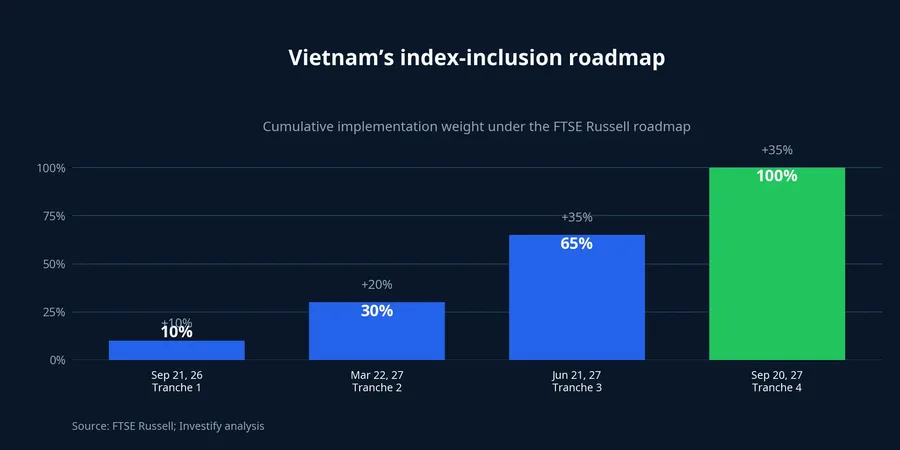
Put simply, a multi-stage process gives the market and funds time to absorb the change. It also weakens the claim that selection guarantees an immediate price increase. Rebalancing flows are worth watching, but they arrive alongside the implementation schedule, the scale of fund assets and each manager’s execution choices.
For fund-certificate holders, this is also a reminder to understand the product they own. An index fund can spare an investor from selecting every stock, but the investor should still know which index the fund tracks, its tracking error and how trading costs can affect NAV. A change in FTSE GEIS does not automatically affect every fund distributed in Vietnam in the same way.
Use a monitoring list instead of reacting quickly
On August 21, first confirm whether information came from FTSE Russell or is only an estimate. Save the preliminary file, the stock names and the accompanying technical fields for comparison. On September 4, focus on the changes between the preliminary and final files, especially weights and data that could affect portfolios.
Around September 21, more useful signals include liquidity in each stock, bid-ask spreads, end-of-session moves and fund portfolio disclosures as they become available. The VN-Index closed at 1,727.46 points on August 17, down 0.09%, but the broad index cannot replace a stock-by-stock liquidity check during a rebalance.
The conclusion is not to ignore FTSE Russell’s list. It is important information for building an orderly watchlist. The evidence does support one clear distinction: the announcement date, the final-file date and the effective date serve different purposes. Separating them helps investors avoid mistaking an index event for a commitment on price direction, and clarifies which signals are still needed to test the expectation.