
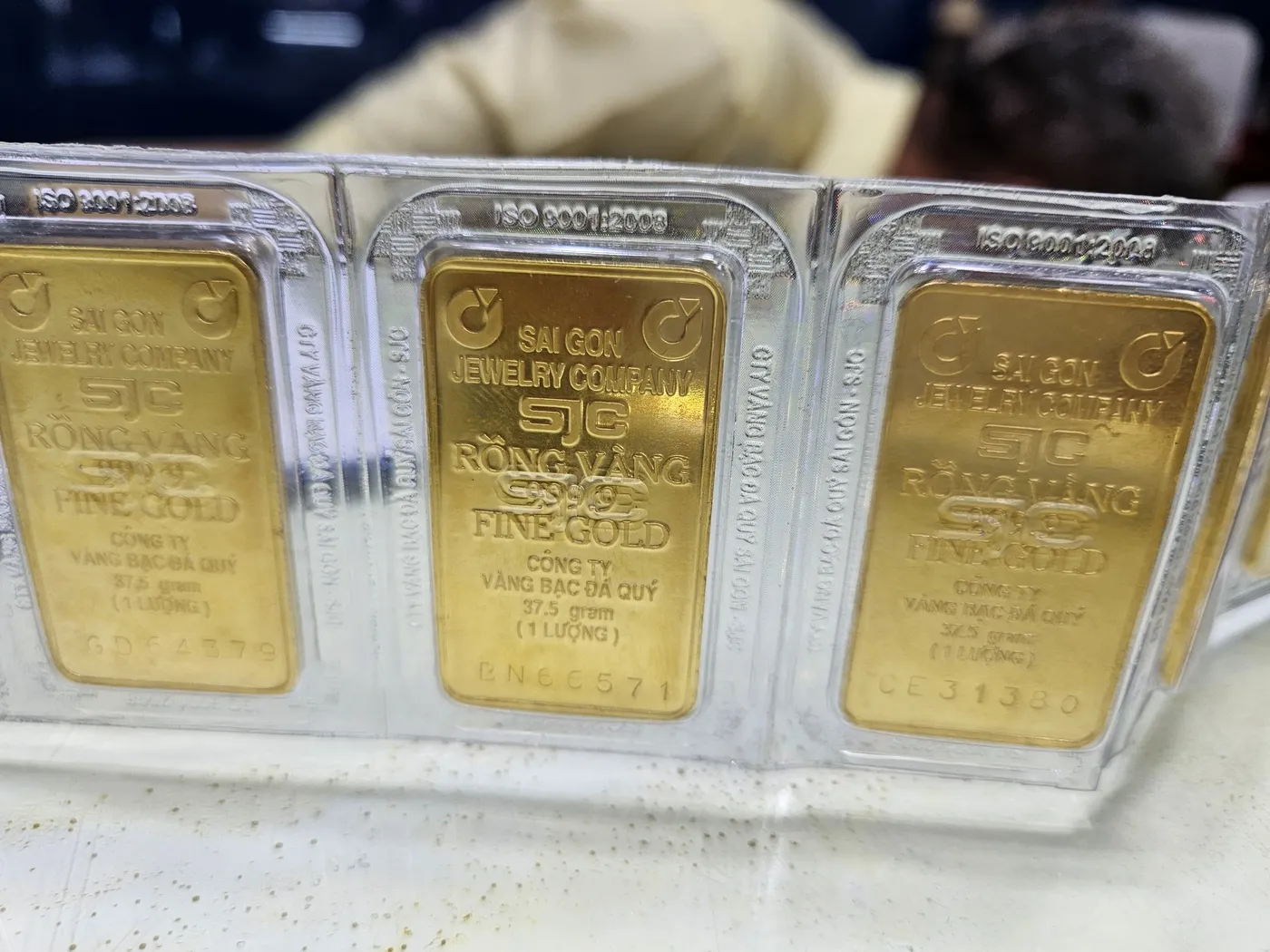

A rise in world gold prices does not automatically become a profit for someone holding SJC gold bars. From mid-July to mid-August 2026, spot gold rose 8.02%, while SJC's selling price fell 3.03%. In a simple illustration, a buyer who purchased one tael at the start of that window and sold it back at the end would have lost about 5.05%.
There is no contradiction here. World gold is the price of the underlying metal. An SJC bar sold in Vietnam also reflects the exchange rate, a domestic premium and the gap between what a dealer charges a buyer and what it will pay to buy the bar back. For an owner, the relevant starting point is therefore not a headline saying gold is up, but the dealer's current bid.
The same metal can follow different price paths
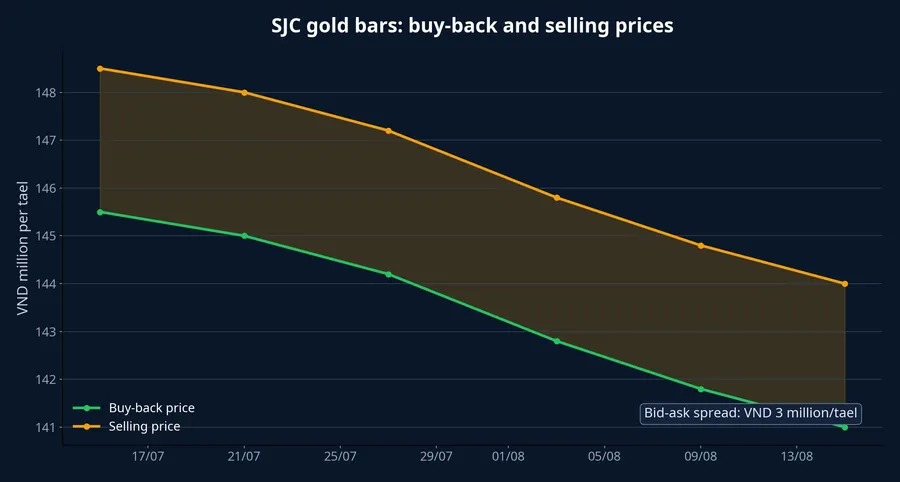
Spot gold was USD 4,054.30 per ounce on July 14 and USD 4,379.54 on August 14, an 8.02% gain. Over the comparable window, SJC's quoted selling price fell from VND 148.5 million per tael on July 15 to VND 144 million on August 15.
The series are offset by a day because their quotation schedules differ. They should not be used to infer an intraday arbitrage trade. They do, however, show that the narrowing of SJC's domestic premium was larger than the increase in converted world gold.
Think of world gold as the base ingredient, not the final receipt. The exchange rate converts that base into Vietnamese dong. The domestic market then determines how much extra a buyer pays for an SJC bar. That final component can move in the opposite direction to the world benchmark.
Converting the world price is the first useful comparison
Under Vietnam's convention, one tael equals 37.5 grams, and one gram equals 0.0321507465 ounce.Official Gazette A practical conversion multiplies the world price per ounce by the USD/VND exchange rate and the weight-conversion factor.
At the start of the period, USD 4,054.30 per ounce and an exchange rate of VND 26,261 per dollar implied roughly VND 128.37 million per tael. By the end, gold had reached USD 4,379.54 per ounce while the exchange rate had eased to VND 26,063.5 per dollar, implying roughly VND 137.62 million per tael.
Converted world gold therefore rose about 7.21%. That was less than the USD gain because the exchange rate declined about 0.75%. The exchange rate softened the rise, but it does not explain why SJC's quoted selling price declined. The larger driver in this comparison was the domestic premium.
The SJC premium was the decisive moving part
On July 15, SJC's VND 148.5 million selling price stood roughly VND 20.13 million per tael, or 15.69%, above converted world gold. By August 15, the premium had narrowed to about VND 6.38 million, or 4.64%. That is a contraction of roughly VND 13.75 million per tael.
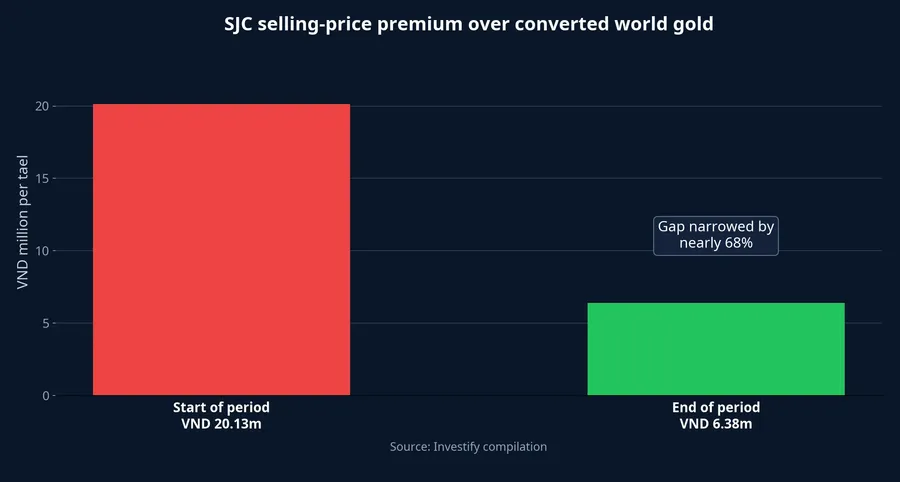
Meanwhile, the converted world-gold component rose by about VND 9.25 million per tael. Because the domestic premium shrank by more than that, the SJC selling price ended the period below where it started. This is why a green world-gold chart can coexist with an SJC holding that has not appreciated.
The premium is not a fixed fee. It reflects supply and demand for gold bars, available inventory, quotation practices and local expectations. Decree 232/2025/ND-CP removed the state's monopoly on gold-bar production while retaining production as a conditional business that requires a State Bank licence.Government News That legal change does not establish policy as the sole cause of one month's premium movement; the available data cannot allocate the effect among the plausible drivers.

The dealer's selling price is not your exit price
This is the detail many newer investors miss. You pay the dealer's selling price when entering. You receive its buy-back price when exiting. The distance between the two is an immediate hurdle before a position can break even, even if the market itself is unchanged.
On July 15, SJC quoted VND 145.5 million to buy and VND 148.5 million to sell a tael, a VND 3 million spread or about 2.02% of the purchase price. On August 15, the corresponding prices were VND 141 million and VND 144 million. The spread remained VND 3 million.

Put that into a transaction. Someone buying at VND 148.5 million on July 15 and selling at the dealer's VND 141 million buy-back price on August 15 receives VND 7.5 million less, a loss of roughly 5.05%. Comparing only SJC's two selling prices gives a 3.03% decline; looking only at world gold in dollars gives an 8.02% increase. Both observations are true, but neither replaces the actual cash result.
The break-even point in this example is a future dealer buy-back price of at least VND 148.5 million per tael. From VND 141 million at the end of the period, that bid would need to rise about 5.32%. “How much has gold recovered?” is therefore incomplete. The better question is: which quote, from whom, and on which side of the trade?
This distinction also keeps comparison honest across products. A headline quote may refer to a selling price, an indicative world benchmark or a different form of gold altogether. Before comparing a past purchase with today's market, match the brand, the weight unit and the dealer's buy-back quote. Without those three matches, a percentage gain can describe a market movement while saying little about the owner's realisable result.
Four numbers to check before calling a gold position profitable
You do not need to forecast every twist in the gold market to understand a holding. First, record the dealer's selling price on the purchase date; that is your cost basis. Then check the current buy-back price for the exact brand and product you own; that is the cash you could realistically receive.
Only then should you examine the drivers. World gold tracks the underlying metal. The exchange rate shows whether that movement expands or contracts in dong terms. The SJC premium shows how much the domestic market adds above the converted price, while the bid-ask spread shows how far the price must move before break-even.
The order matters because it separates measurement from explanation. The buy-back quote answers what the holding is worth today. Converted world gold and the exchange rate help explain the direction of the base value, while the premium and spread explain why the local result differs. That sequence is more useful for a personal balance sheet than treating every international price move as a direct return on a local gold-bar purchase.
The thesis in this data window is straightforward: a rise in world gold is not enough to guarantee a gain for an SJC buyer. The domestic premium and the dealer spread determine the realised result. In the coming weeks, the useful signals are SJC's buy-back quote, its premium to converted gold and how gold-bar supply is reflected in dealer price boards, rather than one international price line alone.