


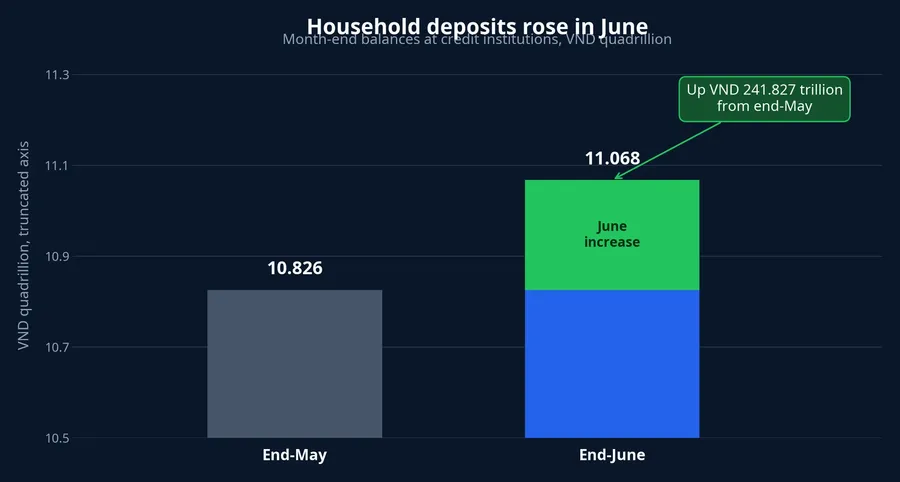
Household deposits at credit institutions reached VND 11.068 quadrillion at the end of June 2026. That was VND 241.827 trillion higher than at the end of May and 7.1% above the end of 2025.Người Quan Sát It is a large enough number to invite an apparently neat conclusion: people must be pulling money out of stocks, mutual funds, or gold and putting it back into banks.
That conclusion goes beyond what the data can establish. A deposit balance is a snapshot taken on a reporting date; a capital flow is the story of an entire period. The snapshot tells us how much sits in an account, but not whether it came from salary income, business receipts, accrued interest, asset sales, or cash waiting to be spent. For a new investor, that distinction matters because it can prevent a portfolio change driven by a headline rather than evidence.
A balance is not a map of money flows
Think of a deposit balance as the amount in your wallet at the end of a day. A fuller wallet does not reveal whether you sold a car, received your salary, got a refund, or simply have not paid a bill yet. To understand the reason, you need the transaction history, not only the final figure.
In financial statistics, this is more than a wording distinction. The International Monetary Fund separates positions at a point in time from transactions and other changes during a period. The difference between opening and closing positions can reflect transactions, valuation changes, and other changes in the scale of assets.IMF It follows that the rise in one balance cannot simply be labelled money withdrawn from another asset class.
June's VND 241.827 trillion increase in deposits has several plausible routes behind it. A household may receive a salary and leave part of it in the account. A business owner may not have spent all recent receipts. Interest may have been added to principal. Funds from a property sale, dividend payment, or a planned expense may also be temporarily parked at a bank on the reporting date.
None of this rules out the possibility that some money left investment assets. It means the available data cannot tell us how much. A claim of asset reallocation needs to see an outflow from asset A, an inflow to asset B, and a sufficiently aligned time window to reduce the role of alternative sources of cash.
Deposits can rise alongside other assets
It is tempting to treat household assets as communicating vessels: if deposits rise, then stocks, funds, or gold must fall by the same amount. Household finances are usually less tidy. Someone can keep a term deposit for emergencies, own long-term shares, and buy fund certificates regularly at the same time.
New income is often the missing variable in popular flow narratives. If income, interest, or business cash receipts grow, deposits can increase without a single share being sold. Conversely, an investor may sell shares in the first week of a month and buy them back before the reporting date. The end-of-month balance captures none of those intermediate steps.
The chart below shows the claim that the published data does support: the end-June deposit balance was higher than at end-May. The green section is the monthly increase. It is not a measure of capital that left the stock market, open-ended funds, or gold.
Even the fact that household deposits account for nearly 63.5% of total deposits by households and economic organisations needs the right interpretation. It shows the banking system's substantial role in holding liquidity across the economy.Người Quan Sát It does not establish that every increase in deposits is caused by investors selling other assets.
Asset prices cannot replace transaction data
June is a useful illustration of the limits of inference. The VN-Index moved from 1,863.49 on May 29 to 1,860.01 on June 30, a decline of roughly 0.19%. In other words, the index was broadly flat during a month when deposit balances increased.
The two developments occurring in the same period neither prove that money stayed in stocks nor confirm a broad withdrawal. Index prices also reflect earnings, valuation changes, the composition of index constituents, and trades by many investor groups. Explaining a price move with one single cause requires evidence that a deposit balance does not provide.

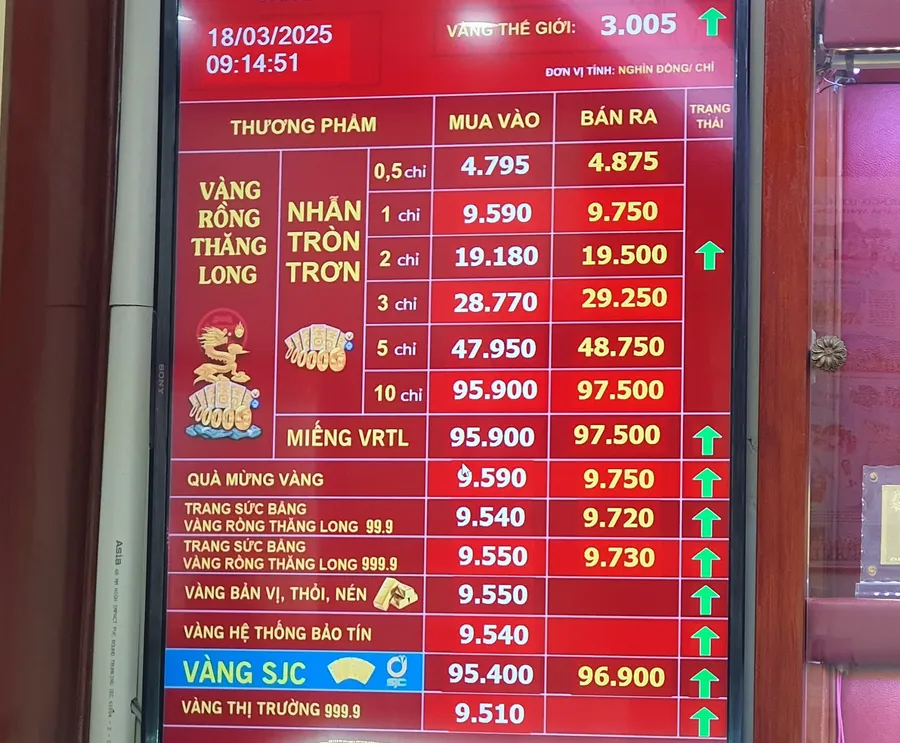
Gold has the same issue. The SJC gold-bar selling price fell from VND 159 million per tael on May 30 to VND 147 million on June 30, a decline of about 7.55%. This price change describes two points in time, not the net volume of gold sold by households. Gold prices may be influenced by global prices, the domestic price gap, supply, and buyer expectations.
Without reliable data on purchase and sale volumes, turning a price line into a capital-flow conclusion is a step too far. The same is true of the reverse claim that falling gold prices prove money flowed into deposits. Both arguments make the same mistake: they substitute price movement for transaction evidence.
Evidence that sits closer to actual flows
Put simply, each market needs its own trail of evidence. For equities, cash balances in securities accounts, net buying or selling by domestic individual investors, and changes in margin lending are more useful than an aggregate deposit balance. New-account figures released by the Vietnam Securities Depository and Clearing Corporation measure participation, not the amount of money deposited into the market.VSDC
For open-ended funds, the relevant figures are fund-certificate issuance and redemptions during the period. They sit closer to flows than total fund assets because total assets also move with the value of securities already held by the fund. The State Securities Commission's reporting framework separately records issuance, redemptions, and investor groups, offering a more suitable basis for tracking capital movements.State Securities Commission
For gold, the most readily available public information is often the quoted buying and selling price. Those boards tell us the transaction spread and the direction of price movement, but not how much households bought or sold. Without volume evidence, the honest conclusion is that the direction of household flows in this market remains unknown.
Conclusion: match the question to the data
The central point is straightforward. Rising household deposits show that households held more liquidity in the banking system on the reporting date. They do not prove that money left stocks, fund certificates, or gold. These are different questions and they require different datasets.
For new investors, the useful response is not to infer an entire flow story from one large number. Watch, over the same period, cash balances at securities firms, net trading by individual investors, fund issuance and redemptions, and any available gold-volume data. When several trails point in the same direction, a conclusion about reallocation has firmer footing. Until then, a deposit record is information about bank liquidity, not a buy-or-sell signal for an entire portfolio.