


SSI will set its shareholder record for the announced dividend on 18 August. Yet the cash dividend is scheduled to begin reaching accounts only from 14 September. That gap is not administrative trivia. It explains why new investors often confuse being entitled to a dividend with having cash available in their account.Người Quan Sát
The easiest way to read a corporate-action timetable is to treat it as a journey with three stops. The ex-rights date determines which trades still carry the entitlement. The record date is when the eligible shareholder list is compiled. The payment date tells you when the company is scheduled to distribute cash. Reading them in that order can prevent both a late purchase and an overly optimistic cash-flow plan.
The distinction is useful beyond this particular ticker. Dividend calendars routinely compress several dates into one short notice, while market feeds often foreground the record date or the percentage being paid. Neither tells the full operational story. An investor who first identifies the ex-rights date, then the record date and finally the payment date is reading the notice in the same sequence in which the entitlement is actually processed.
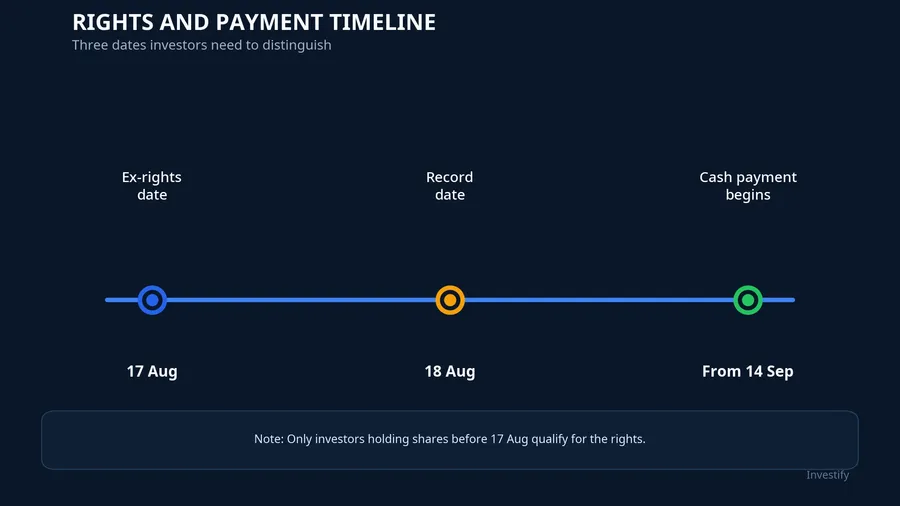
Three dates answer three different questions
For SSI, the ex-rights date is 17 August, the record date is 18 August, and cash payment is scheduled to start from 14 September.Người Quan Sát Someone who notices only 18 August may assume that it is the final day to buy. That is not how the trading mechanism works. The first date to check is 17 August, because shares trade without this distribution's entitlement from that session onward.
VSDC defines the ex-rights date as the business day immediately before the record date. An investor buying on the ex-rights date does not receive the new entitlement, while an investor selling that day retains an entitlement already established earlier.VSDC The record date is therefore not a prompt to buy. It is the date used to compile the register after the entitlement has already separated from trading.
The record date itself is similar to closing a guest list. VSDC compiles the holder list and calculates and allocates entitlements according to the issuer's notice.VSDC It does not mean cash moves that day. The register is set first; distribution follows the timetable announced by the company.
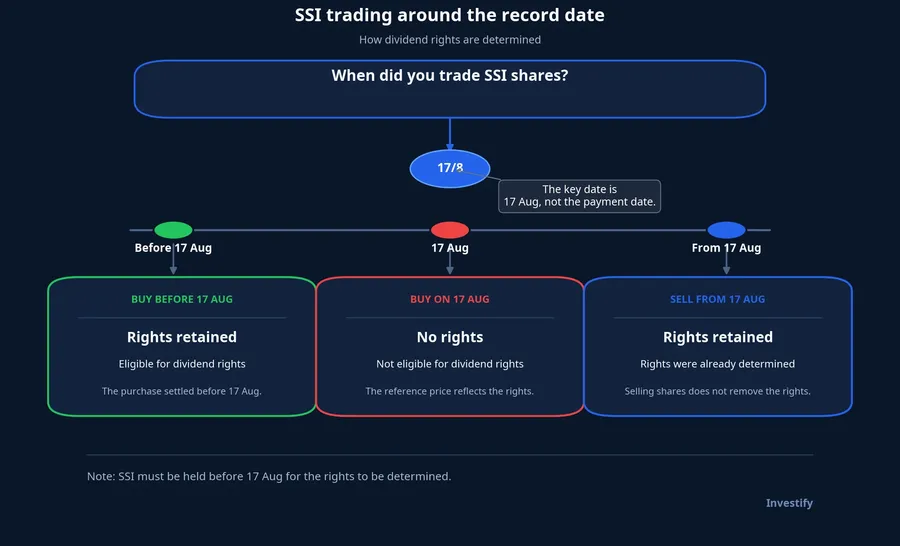
17 August determines the entitlement
For SSI, an investor buying in the 17 August session will not receive this distribution. To qualify, the purchase must be completed before that date. Conversely, someone who held shares before 17 August can sell on the ex-rights date and still retain the dividend entitlement. This is the general rule in VSDC's current guidance, rather than an SSI-specific exception.VSDC
This matters most when a dividend notice appears close to the deadline. A purchase made because “the record date is tomorrow” may no longer include the entitlement if today is already the ex-rights date. Equally, continuing to hold until the record date is not required to keep the entitlement, provided the investor owned the shares before the rights separated.
Reference prices are also normally adjusted when the rights separate. VSDC notes that, on the ex-rights date, a listed share's reference price may fall by an amount corresponding to the dividend value or distribution ratio, subject to exceptions in exchange rules.VSDC Put simply, the entitlement does not create instant value by itself. The investor receives it, while the reference price reflects the fact that it has been separated from the share.
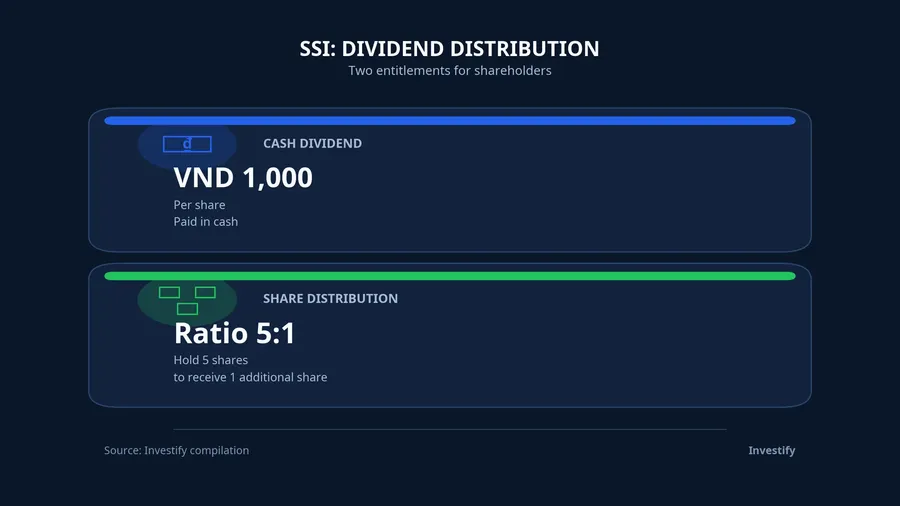
SSI's distribution combines cash and shares
SSI's record date covers two entitlements. The cash dividend is 10% of par value, equal to VND 1,000 per share. SSI also plans to issue more than 500.2 million shares from owners' equity at a 5:1 ratio: an eligible holder of five shares receives one additional share before any fractional-share treatment is applied.Người Quan Sát
Those two items answer different questions. Cash relates directly to the amount scheduled to reach an account. The share distribution changes the number of shares held after allocation. If a holding does not divide evenly by the ratio, the issuer's original notice or the investor's securities firm will state the rounding and fractional-share rules. Do not treat a quick calculation from the 5:1 ratio as the final allocation.
The 10% figure is quoted on par value, not as a 10% investment yield. To understand what the payment means for a portfolio, an investor needs to compare VND 1,000 with the actual purchase price, the number of shares held, tax and post-ex-rights price movement. Additional shares do not automatically raise an investment's total value either, because market prices reflect the rights change and the new issuance in their own way.
Use the payment date for cash-flow planning
SSI is scheduled to begin paying the cash dividend from 14 September, nearly a month after the 18 August record date.MarketTimes This is the date to use when planning for an upcoming expense. Still, “scheduled” should retain its full meaning: it is the timetable announced today, and investors should watch for updates if it changes.
Waiting periods vary by issuer. In the same schedule, Dien May Xanh has an ex-rights date of 18 August and a payment date scheduled for 26 August; Be tong Hoa Cam has an ex-rights date of 19 August but a payment date scheduled for 16 October.FireAnt This comparison does not rank the companies. It simply shows that a dividend rate and the speed of cash delivery are independent variables.
FT1 offers another example. It has the highest cash-dividend rate in this week's schedule, at 44.07% of par value, equal to VND 4,407 per share. Its payment date is still scheduled for 22 September.MarketTimes A high percentage describes the distribution relative to par value. It does not shorten the payment process or replace an assessment of yield against the market price.
How to read a rights notice before acting
When you encounter a dividend notice, follow the mechanism rather than the headline percentage. First, identify the ex-rights date to determine which trades include the entitlement. Then check the record date to understand when the register is set. Finally, review the payment date, the form of entitlement, the distribution ratio and the treatment of fractional shares.
It is also worth opening notices from the issuer, VSDC and the securities firm holding your account. VSDC says investors can find ex-rights and record-date information through the issuer's disclosures, the exchanges, VSDC and their depository member.VSDC That is a more reliable check than relying on a single abbreviated line in a market feed.
SSI's timetable is not primarily a verdict on whether the dividend is attractive. Its practical lesson is the discipline of separating three dates. Rights separate from the share on 17 August, the register is set on 18 August, and cash is scheduled to start from 14 September. For a new investor, recognising that sequence is the foundation for avoiding a mistimed purchase and for not confusing an entitlement with cash already in the account.