


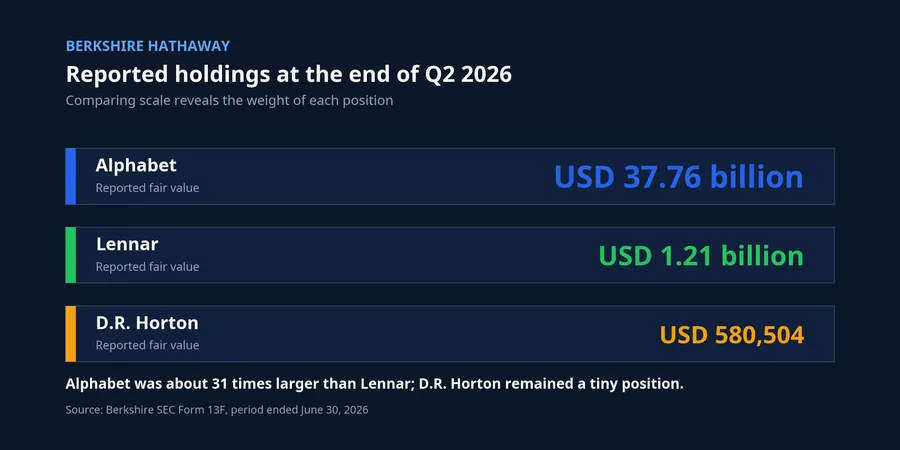
Berkshire Hathaway's second-quarter 13F puts Alphabet, Lennar and D.R. Horton in the same frame. A name-only reading could suggest that the conglomerate is allocating equally to artificial-intelligence infrastructure and U.S. housing. The numbers say otherwise: as of June 30, Alphabet was valued at about USD 37.76 billion, Lennar at about USD 1.21 billion, and the new D.R. Horton position at only USD 580,504.AP
Think of a portfolio as a list of hypotheses, with the capital behind each one revealing how much importance the institution assigns to it. The right starting point is therefore not “Which tickers did Berkshire buy?” It is to measure the weight of each holding and understand how that company turns capital into cash flow. For individual investors, a 13F is most useful as a research map, not as a ready-made order ticket.
Three names, very different capital weights
Berkshire added roughly 48.1 million Alphabet shares during the second quarter, taking its total holding to about 106 million shares. That is large enough to make Alphabet the central item to analyse in the filing, rather than simply another technology name on the list. AP also reported that Berkshire increased its Lennar share count by nearly 30% over the quarter and started a very small D.R. Horton position.AP

The common mistake is to compress those facts into “Berkshire is betting on technology and U.S. homebuilders,” then treat every name as an equal vote. By reported value, Alphabet was about 31 times the size of Lennar. D.R. Horton is so small that it does not, by itself, establish an equally serious commitment; later filings will need to show whether the position is expanded.
That does not make Lennar uninteresting. A position above USD 1 billion merits research, particularly alongside Berkshire's broader housing direction. But portfolio reading requires us to resist moving from “owned” to “held with the same conviction.” In institutional investing, a count of company names is no substitute for capital weight.
This distinction matters particularly for a new investor because headlines tend to flatten a portfolio into a handful of familiar brands. A small new holding can be a test position, a legacy allocation, or a position managed by a different investment team. A large addition deserves a different level of scrutiny, but it still does not reveal the investor's purchase price or intended holding period. Position size is evidence of relevance, not a complete explanation of intent.
Alphabet's clock for earning back capital
Alphabet generates most of its revenue from search advertising, YouTube and cloud services. Its current growth case also runs through computing capacity for artificial intelligence: servers, data centers and software need investment before customer usage can be tested. Alphabet has said it plans to raise USD 80 billion for the computing infrastructure supporting its AI offerings.AP
In simple terms, Alphabet is funding a very large machine before it knows exactly how much additional revenue and profit that machine will produce. If customers use cloud services and new products at sufficient scale, higher revenue can absorb the investment. If use lags, depreciation and operating costs can pressure incremental profit.
That is why it is incomplete to view Alphabet only as a software stock. Investors need to follow cloud growth, the resilience of advertising, and capital-spending discipline together. Those variables are related, but the 13F does not say which one motivated Berkshire's purchase. A share-price move and an institutional purchase occurring in the same quarter are not, on their own, proof of causation.
Homebuilders turn land and projects into cash
Lennar and D.R. Horton run on a more tangible cycle: secure land or land-purchase rights, build, sign contracts and deliver homes. Capital completes its cycle only when a buyer can afford financing, accepts the price and closes. Mortgage rates matter directly because they affect the buyer's monthly payment, and can therefore quickly affect orders, sales incentives and cancellation rates.

When demand slows, homebuilders can cut prices, subsidise mortgage rates or adjust sales releases to sustain transactions. Those choices may move inventory faster, but they commonly involve a margin trade-off. A low P/E for a homebuilder is therefore not automatically evidence of a cheap stock. Current earnings may reflect a favourable part of the cycle rather than a permanently repeatable earnings level.
Set beside Alphabet, the two groups meet interest rates through different doors. For homebuilders, rates enter household budgets via monthly debt service. For Alphabet, rates matter more through the cost of capital and the valuation investors will pay for future cash flows. The same macro variable therefore calls for two different analytical question sets.
Do not place two P/E ratios side by side and stop there
Comparing Alphabet and homebuilders through a single multiple creates a false sense of precision. P/E uses current profit as its denominator, while the quality of that profit depends on where the business sits in its cycle. One business must demonstrate that its AI infrastructure will be used efficiently. The other must demonstrate that housing demand can withstand mortgage rates, pricing and affordability constraints.
A more useful approach is to place each company against its own capital-recovery clock. For Alphabet, track the path from infrastructure spending to usage to revenue. For homebuilders, track the path from land and work in progress to orders and delivery. The shared question is how quickly and reliably capital returns at a profit; a shared appearance in one filing cannot answer it.
That framework also keeps valuation from becoming a shortcut. A lower multiple can reflect a mature or cyclical profit stream, while a higher multiple can reflect expected growth that may or may not arrive. Neither label is a verdict. The investor's job is to ask what assumptions are embedded in each earnings number and which future observations would show those assumptions were wrong.
A 13F is a historical snapshot, not today's portfolio
The filing was submitted on August 14 but reflects positions at the close of June 30, a 45-day lag. Berkshire may have bought more, trimmed, or done nothing in the intervening period; the filing cannot tell us. AP described the release as a quarterly portfolio snapshot disclosed after the quarter ends, not a real-time transaction notice.AP
That delay changes how the data should be used. A 13F does not disclose average purchase price, purchase dates within the quarter, holding horizon, or every part of an institution's balance sheet. Copying a trade after publication can therefore mean buying an asset after the institution's view has changed, or at a price far from the institution's entry point.
The thesis from this filing is straightforward: Berkshire allocated overwhelmingly more capital to Alphabet, increased a meaningful Lennar position, and left D.R. Horton needing more time to establish its significance. The next items to monitor are not an imagined buy order, but whether later filings confirm the pattern, whether Alphabet's infrastructure demand turns into revenue, and how U.S. housing affordability evolves. Those are the signals that could strengthen or weaken the thesis.