


DGC has appointed a new Chief Executive Officer and reduced its legal-representative structure to a single person. That is a necessary act of repair after a series of personnel changes, but it is not a certificate that governance risk has disappeared. For shareholders, the relevant issue is not simply the name of the replacement. It is whether the new organisation can preserve approval authority, accountability and business continuity.
On 13 August, Duc Giang Chemicals Group replaced Luu Bach Dat, former Board member and Chief Executive Officer of DGC, with Pham Duy Tung, Chief Executive Officer and legal representative of DGC. On the same day, the company moved from three legal representatives to one, the Chief Executive Officer.DGC The substance of the decision is therefore not a routine change of seats. Signing authority and legal responsibility are now concentrated in a clearly identified position.
Three risks that should not be confused
The disclosure does not substitute for a final legal conclusion. In material released with its AGM documents, DGC said that several key leaders had been subject to criminal proceedings in connection with environmental, ore-extraction and accounting matters.DGC This procedural status does not mean that an individual has been found guilty, nor does it automatically establish wrongdoing by the entire company.
New investors should separate three layers of risk. The first is an individual's legal exposure, which can only be resolved through the relevant investigation and competent authorities' conclusion. The second is corporate-governance risk: who can sign, approve and supervise, and how the company discloses information while senior personnel are changing. The final layer is business risk, visible in output, margins, cash generation and project delivery.
Combining these layers into one conclusion produces two opposite mistakes. One is to treat a management appointment as proof that every issue is over. The other is to treat an individual's case as proof that the company cannot operate. Both ignore the operational evidence DGC still has to produce after its personnel decisions.
How the organisation has been rebuilt
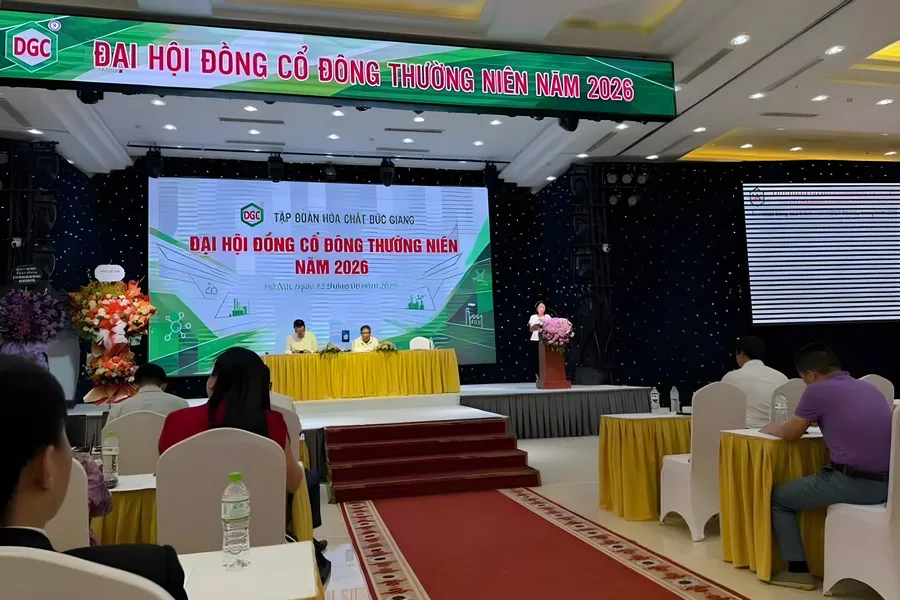
The changes did not occur in a single day. At an extraordinary general meeting on 8 May, DGC added Dao Huu Kha, Chairman of the Board of DGC, Nguyen Quoc Trung, former Board member of DGC, and Pham Duy Tung to its Board; Dao Huu Kha subsequently became Board Chairman.DGC
At the annual meeting, DGC dismissed Dat and Trung from the Board and elected Do Van Dong, Board member of DGC, and Dao Duc Manh, Board member of DGC, for the remainder of the 2024–2029 term. Dat also left the CEO role; Phung Trong Tu, former Deputy Chief Executive Officer of DGC, left the executive team. These decisions were disclosed on 14 August.DGC
Adding directors allows the Board to continue meeting and issuing resolutions. A Board with enough members, however, is not the same thing as an effective control system. Governance risk can only ease when delegation below the CEO, substitute-signing authority and oversight of major transactions are applied consistently in future disclosures.
A clearer owner of authority, and greater reliance on one role
The Board appointed Pham Duy Tung as Chief Executive Officer effective 13 August. With that appointment, he also became DGC's sole legal representative.DGC The new structure makes the executive and legal point of responsibility clearer. That is a practical advantage when a company needs to avoid an authority vacuum after significant personnel changes.
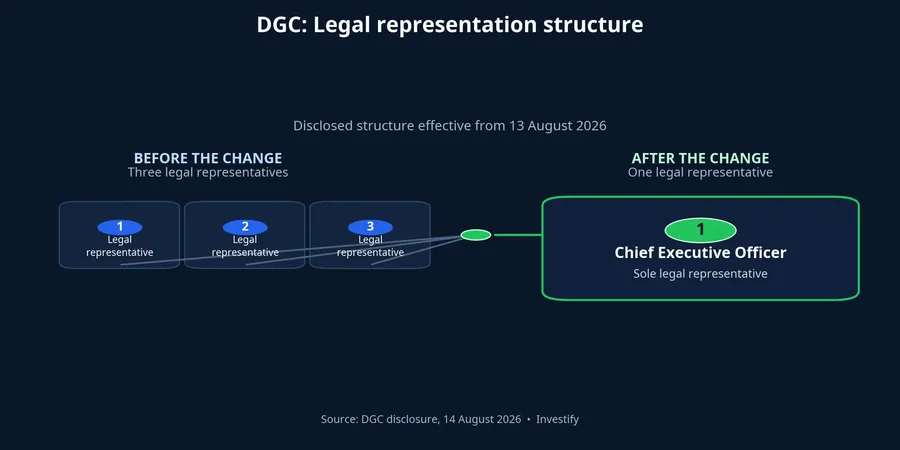
The other side also needs to be named precisely: a single-representative structure raises the company's reliance on the CEO role. That is not inherently negative. Many companies work effectively with one legal representative. In DGC's case, after a recent reshuffle, shareholders should watch whether controls remain sufficiently distributed rather than infer governance quality from the number of representatives alone.
The available disclosures do not establish that the personnel changes will, by themselves, improve or weaken financial performance. Input prices, chemical demand, ore supply, transport costs and project execution can all affect results at the same time. The more defensible reading is that the personnel event is a test of the operating system, not an answer to the earnings outlook.
The 2026 plan provides the practical yardstick
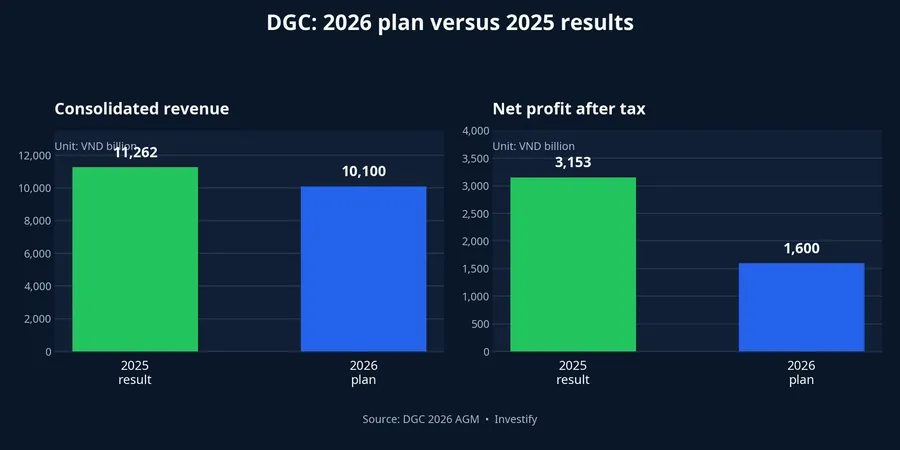
Shareholders approved a 2026 plan for VND 10,100 billion in consolidated revenue and VND 1,600 billion in net profit after tax. DGC also plans VND 2,400 billion of investment in the Duc Giang Nghi Son Chemical Complex, with operation targeted for the fourth quarter of 2026.DGC These targets show that the company retains an operating and investment plan. They are not a guarantee that the targets will be met.
In 2025, DGC reported VND 11,262 billion of consolidated revenue and VND 3,153 billion of net profit after tax.DGC The figures show that the 2026 profit plan is materially below the 2025 outcome. It would nevertheless be an unsupported leap to attribute the entire gap to personnel changes. DGC's disclosure does not make that allocation, and a chemical producer's results depend on both market and operational variables.
For the Nghi Son project, the useful markers are observable ones: construction progress, commissioning timing, actual capital spending and the date of commercial operation. A delay against plan would require explanation because it bears directly on capital deployment and the new team's execution capability. Conversely, a completed milestone would validate that milestone, not resolve the entire governance record.

The next disclosures will supply the answer
The central conclusion is straightforward. DGC has completed an important repair of authority, but there is not yet enough evidence to close the assessment of governance quality. A CEO who is also the legal representative makes accountability easier to identify. The effectiveness of that arrangement must be tested in the company's subsequent operations.
The next reporting periods should be read for revenue from key products, margins, receivables, inventory, operating cash flow and costs connected to the case. Project progress at Nghi Son, along with the timeliness and completeness of disclosures, matters as well. If these traces remain on plan, the risk of operating disruption should gradually fall. If cash generation weakens, delivery slips or information remains inconsistent, replacing the CEO will not by itself be enough to persuade the market.