


More than $220 billion is large enough to conjure an image of an enormous pile of digital assets sitting in Vietnamese wallets. That is not what the number says. The report cited in recent coverage measures on-chain transaction value associated with Vietnam from July 2024 through June 2025, or more than $600 million a day.VnExpress
Think of it as the value of goods passing through a road over a year, not the inventory left in a warehouse at night. Confusing the two can lead a new investor to overstate what people actually own, how many people are active, and how safe the market is.
What the $220 billion metric actually measures
On-chain refers to movements recorded directly on a blockchain. In Chainalysis's framework, the focus is the cryptocurrency value received on-chain by services and estimated by country. It is a measure of activity flowing through a period, not a balance sheet of individual users' holdings.Chainalysis
One coin can move from a personal wallet to a platform and then to another wallet. Each receipt can leave an observable trace, even though the sender's total wealth does not increase merely because the asset moved. Adding up those transfers and treating the result as the amount held by Vietnamese investors therefore mixes up two different units of measurement.
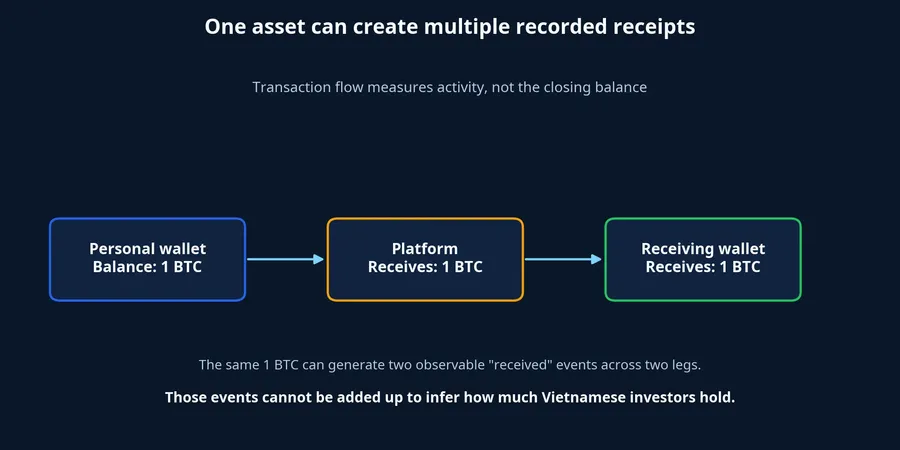
The distinction matters further because trades matched inside a centralised platform's order book may not create additional on-chain records. Chainalysis has explained that on-chain data can observe deposits and withdrawals, while internal matching is not captured in the same complete way.Chainalysis The figure is neither total trading volume nor net wealth.
It is still a meaningful figure: it indicates substantial activity associated with Vietnam. It does not answer how many dollars remain in wallets, how many users are profitable, or how much purchasing power is available for the next trade. Data earns trust when it is not asked to answer a question it was never designed to measure.
Why user estimates are not a headcount
Market reports often refer to people who "own," have "participated," or are "trading." Those are not the same population. Someone who made a small purchase years ago, someone who still holds an asset, and someone who trades regularly are three very different investor profiles.
A wallet address is not a national ID. One person may use several wallets, devices, or accounts across platforms. Conversely, one platform-controlled address can pool assets for many clients. Counting addresses, accounts, or web visits therefore does not automatically produce a verified count of unique people.

Resolution 05/2025/NQ-CP, which governs Vietnam's pilot digital-asset market, permits an investor to open accounts with multiple organisations but only one account at each organisation.Government of Vietnam That is not evidence of a current account count. It is a useful reminder that, even within a formal framework, account numbers and investor numbers belong in separate columns.
Estimates of market reach should therefore be treated as a signal of interest, not as a denominator for calculating "assets per user." The arithmetic may be correct, but the denominator is not a verified headcount, so the result says little about an individual's financial position.
A pilot framework creates guardrails, not price insurance
Vietnam's pilot framework matters because it shifts attention from a fragmented market to the accountability of service providers. Resolution 05/2025/NQ-CP sets conditions for operators and client-protection mechanisms during the pilot.Government of Vietnam
Put plainly, those are filters for service providers, not a promise of returns. Identity verification, segregation of client money and digital assets from a provider's own assets, fee disclosure, and system-security obligations can reduce counterparty risk. They do not make an asset's price less volatile or turn a poor investment decision into a reimbursable loss.

The resolution requires a provider to resolve and compensate losses of client money or assets caused by an insecure system, intrusion, or fraud.Government of Vietnam That is not insurance against every loss. A failure in the provider's security is different from a price decline, a transfer to the wrong address, or credentials a user disclosed. In all cases, the cause must be established and the investor may need to follow the applicable complaint or dispute-resolution process.
Do not confuse an effective date with universal application
The government has issued Decree 284/2026/ND-CP on administrative sanctions in this field, and it takes effect on 1 September 2026.Government Gazette That is a fixed legal milestone. For transactions outside licensed providers, however, the application date also depends on a transitional condition: six months after the first service provider is licensed under Resolution 05.
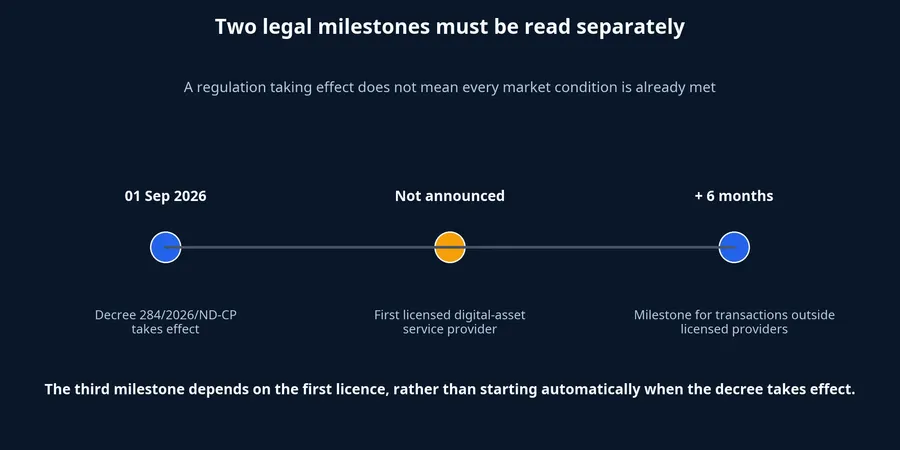
This distinction changes how a legal headline should be read. An issued decree does not confirm that the first provider has already been licensed, nor does it mean that every off-system transaction is immediately sanctioned on the date of this article. Ask three separate questions: has the text been issued, has it taken effect, and has the condition for this particular application been met?
Check where the money is going before you transfer it
Start with the legal entity and licence information published by the competent authority, not a verification badge on social media. The domain name, receiving bank account, and contracting party should match that entity. A familiar interface is no substitute for clarity about who is accountable.
Then read the custody arrangements. How are client funds and digital assets segregated? Who controls access keys? Which channel will be used to notify users of an incident, and where can they file a complaint? Fees and withdrawal or lock-up terms should be clear before money moves, not discovered after a problem appears.
Finally, retain transaction confirmations, terms of service, and all related correspondence. Those documents do not remove market risk, but they help distinguish a market loss from an operational or security dispute. That distinction matters when responsibility has to be established.
The core conclusion is straightforward: $220 billion is evidence of transaction flow, not a report of Vietnamese investors' wealth and not a safety certificate for any platform. For a newcomer, the useful next step is not to turn the figure into a price forecast. It is to check whether the methodology, the actual licence, asset segregation, and incident-handling process answer the basic questions they should.