


The US government sold the full USD 25 billion of 30-year bonds offered on 13 August. Yet it had to accept a high yield of 5.216% to complete that borrowing. That was the highest result for a comparable auction since August 2001. The number does not say that America has run out of lenders. It says lenders require more compensation for committing capital for three decades.TreasuryDirect
For Vietnamese investors, this is not an instant forecast for the VN-Index. The broader picture is that the world’s largest economy is being priced at a higher long-term cost of capital. If that level persists, it can travel through several channels: global yields, exchange rates, capital flows, and the way markets value cash flows that sit far in the future.
A market price, not an administrative decision
A Treasury auction is where demand becomes a borrowing cost. Investors submit bids stating how much they want to buy and the yield they will accept. The Treasury ranks bids from the lowest yield upward and awards securities until the offering is filled. In a single-price auction, the final accepted bid sets the common yield for all successful competitive and non-competitive bidders.TreasuryDirect
Put simply, 5.216% is the return the market demanded to absorb the issue. The price was USD 98.627017 per USD 100 of face value; a price below par corresponds to a higher yield for the buyer. It is therefore misleading to treat the figure as a rate chosen by the Treasury. It is the outcome of a negotiation between the government’s funding need and investors’ required return.TreasuryDirect
That distinction matters for new investors. “Sold out” does not mean cheap financing or unconditional confidence. A borrower can complete its funding plan while still paying more to persuade buyers to hold an asset for a very long time.
Demand exists, but it is not cheap
Total bids were 2.39 times the amount offered. In the most intuitive terms, every dollar of bonds on sale drew roughly USD 2.39 of orders. That ratio rejects the idea that buyers have collectively abandoned US government debt. It does not negate the message from the high yield: demand was there, but only at a more expensive price of capital for the borrower.TreasuryDirect
Within competitive awards, indirect bidders received 66.8%, direct bidders 21.6%, and primary dealers 11.5%. The mix shows that primary dealers did not take the bulk of the allocation. But “indirect” is not another name for foreign investors: TreasuryDirect defines the category as customers bidding through intermediaries, which can include institutions inside and outside the United States.TreasuryDirect
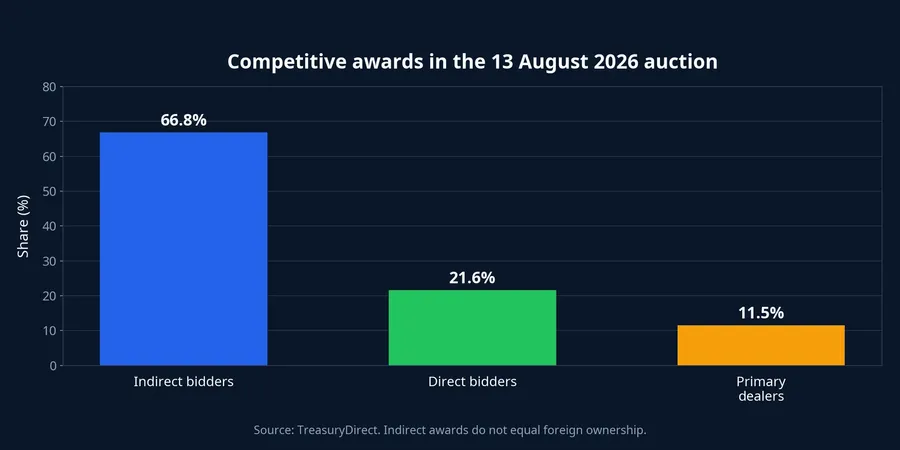
The point is not to assign the buyers an identity too quickly. The bid-to-cover ratio answers how broad demand was. The awarded yield answers the terms on which that demand appeared. Both can be high at the same time, and that combination is precisely what makes this auction notable.
Why a 30-year bond needs a larger premium
A buyer of a 30-year bond accepts fixed cash flows over a very long horizon. If average inflation turns out higher than expected, the purchasing power of later payments falls. If market interest rates rise, an existing bond with a lower coupon loses value in the secondary market. The longer the horizon, the more exposed the holder is to those changes.
Debt supply belongs in the calculation as well. When the Treasury issues more debt to fund a deficit, investors have more alternatives and may ask for a higher yield. But attributing the full 5.216% result to inflation alone or to deficits alone would go too far. The offering size, pre-auction trading positions, hedging demand, and prevailing secondary-market yields can all affect bidding.
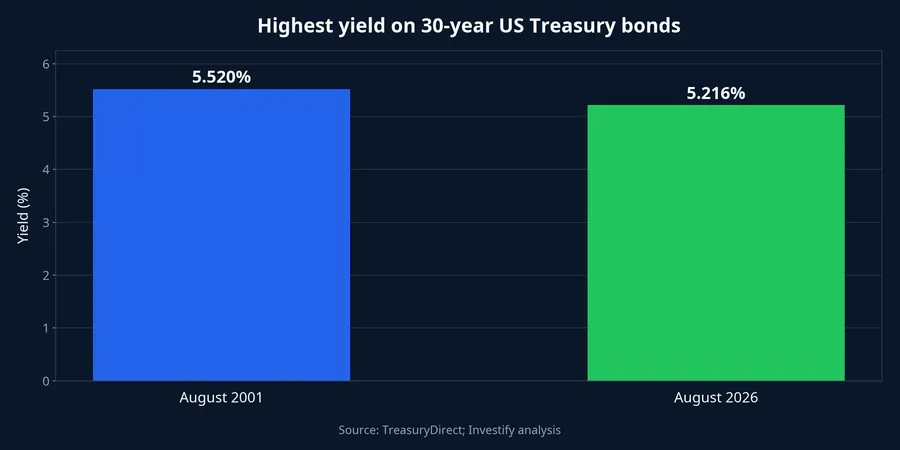
Auction data reveal the final price and allocation, not each investor’s motivation. The tightest conclusion is that the market required more compensation for several long-term uncertainties at once. That is significant, but it is not enough to turn one auction into evidence of an imminent financial shock.
How US yields reach other assets
Long-dated Treasury yields commonly form a base rate for the global cost of capital. When that base rises, companies borrowing in bond markets generally add their own credit spread to a higher starting point. Long-term fixed-rate loans, especially in markets that reference US yields, can face the same pressure.
For equities, the main effect is valuation. A higher discount rate reduces the present value of earnings far into the future. Companies priced largely on distant cash flows are usually more sensitive than companies already producing stable cash. This is a financial mechanism, not a rule that every share must fall after a single auction.

Vietnam has an additional layer of transmission through the exchange rate and capital flows. If US yields remain high while the dollar strengthens, emerging-market assets may have to compete harder for capital. The 13 August result, however, does not establish the cause of any move in the VN-Index or USD/VND. Events that occur near each other do not automatically have a causal relationship, particularly when the auction announcement and local trading hours do not coincide.
The signal is a sequence, not one number
The core conclusion from this auction is straightforward: America can still borrow, but long-term capital costs more. The risk becomes a wider story only if the signal repeats in subsequent issuance and arrives alongside persistently high secondary-market long yields, a stronger dollar, or capital leaving emerging markets.
Conversely, continued stable demand and cooling yields would suggest that 13 August was primarily a repricing of the long-term premium. Investors do not need to turn 5.216% into a prophecy for the next trading session. The useful watch list for the coming weeks is subsequent auctions, long-end yields, the dollar’s strength, and the actual response of capital flows. Those signals will show whether the higher cost of capital is becoming a trend or remains one striking data point.