


An emissions allowance does not become a tradable order simply because a factory owns it. The asset must first be recorded in the national registry, assigned an identifier, deposited into an account and checked for an available balance. Only then can an order enter the trading system.
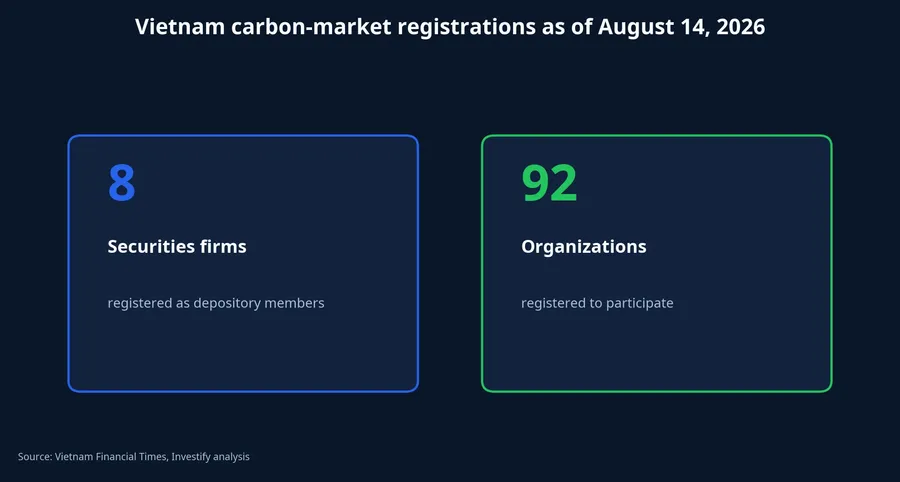
That is why securities firms appear in a market that may initially sound like an environmental matter. As of August 14, eight securities firms had registered as depository members and 92 organizations had registered to participate in Vietnam's carbon market. Steel, cement and thermal-power businesses featured prominently among the registrants.Vietnam Financial Times The figures show that participants are entering the infrastructure, but they do not turn the carbon exchange into another stock market.
Put simply, the market is using familiar securities-market rails to carry a very different kind of asset. New investors need to separate two ideas: a securities firm is a service intermediary, while carbon allowances and credits are not corporate shares that a standard brokerage account can freely trade. The key question is therefore not who profits immediately, but why a control gate is needed before an environmental asset changes hands.

The product is an emissions right, not a share
Products on the carbon exchange can include eligible greenhouse-gas emissions allowances and carbon credits. An allowance is an emissions right allocated to a regulated facility. If the facility emits less than its allocation, the remaining amount may be traded under the rules. If it emits more, it must find offsets and meet its surrender obligation.
Carbon credits begin elsewhere. They are the verified result of emissions reductions or removals from a programme or project that has undergone measurement, reporting and verification. Planting trees, replacing equipment or saving electricity does not automatically create a credit for sale. The project must sit within a recognized mechanism, and the reduction outcome must be issued or confirmed under the applicable rules.
The rules also do not open the same door to everyone. Facilities allocated allowances may trade allowances, while agencies and organizations in Vietnam may trade credits.Government Gazette That boundary matters: a securities firm is not automatically trading these assets for its own account, and an individual investor does not qualify merely by opening a brokerage account.
Why the asset has to pass through custody
Think of an allowance as a certificate with value, but one that can be traded only when the system can establish who owns it and whether it has already been committed elsewhere. Under Decree 29/2026/ND-CP, allowances and credits must be centrally registered in the national registry before custody or trading. The Ministry of Agriculture and Environment records the asset information, assigns a domestic code and sends the necessary data to HNX and the Vietnam Securities Depository and Clearing Corporation, or VSDC.Government Gazette
When an owner wants to bring an asset to the exchange, it identifies its custody account and the amount to deposit. Ownership information is checked before VSDC books the asset into the custody account. The sequence may sound procedural, but it answers a fundamental question: does the seller actually possess the asset being offered?
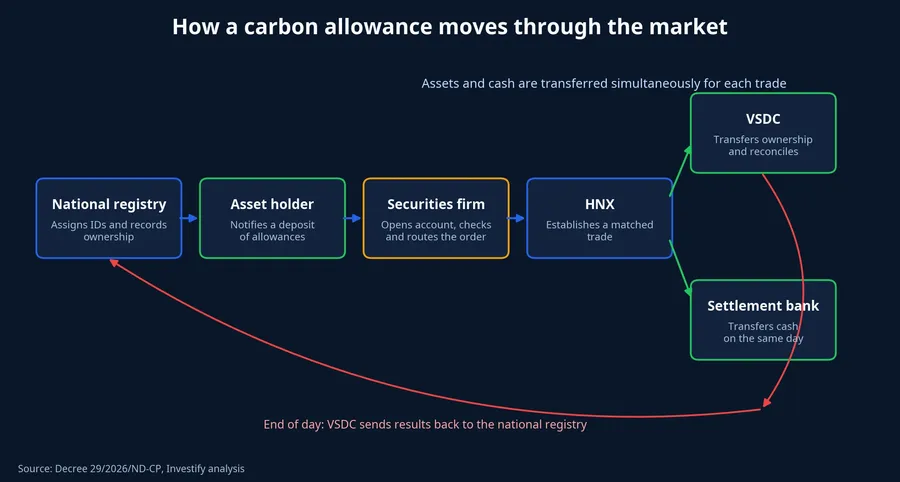
The securities firm sits in the middle of this process. Eligible parties register a custody account with a VSDC-approved depository member. When they place an order, they use a trading account at a carbon-market trading member; the carbon component must remain separate from ordinary securities transactions.Government Gazette That separation prevents the allowances, credits and cash reserved for carbon trading from being mixed with other assets.
This is also why a securities firm is more than a screen for submitting orders. It checks account information, balances and order validity, keeps records and reports the result to its client. Its role resembles a control gate: it does not create allowances, but it helps ensure that only assets with a traceable and eligible path enter the transaction.
A matched order is not a completed trade
HNX operates the trading system, but after an order is established, the data must still reach VSDC to determine settlement obligations. The settlement bank transfers cash according to the authorization from the depository member, while VSDC transfers ownership. Cash and assets move simultaneously, for each trade, on the same day.Government Gazette
For readers accustomed to shares, this is an easy point to miss. A match on the screen does not mean every step is over. If cash or assets are insufficient, a code is ineligible or an account has not been recorded, the trade may not complete settlement. VSDC ultimately returns settlement results and balances to the national registry so that ownership can be updated.

Viewed as a system, the Ministry of Agriculture and Environment keeps the master record of assets and owners. HNX matches orders. VSDC provides custody, reconciliation and ownership transfer. The settlement bank handles funds. Securities firms face the clients and control order entry. Dividing the roles does not remove all risk, but it creates an audit trail when something does not match.
Eight members do not yet describe the profit pool
The presence of eight securities firms signals that intermediaries are preparing to join the custody infrastructure. It should not, however, be turned directly into a conclusion about earnings. Trading members may charge transaction-service fees, while depository members may charge custody and settlement fees. Fee schedules, client activity, assets under custody, order flow and systems costs will determine actual revenue.
During the pilot period, VNX, HNX and VSDC will not collect service fees through December 31, 2028; those infrastructure entities begin collecting fees on January 1, 2029.Government Gazette That does not mean every securities-firm service is free. Yet without data on actual fees, trading value and operating costs, treating membership as an earnings indicator remains an inference.
A more practical reading is to watch three data layers as the market operates: the number of eligible clients, the volume of deposited assets and net service revenue after related costs. These indicators will show whether the infrastructure has become an economic activity or is still primarily a readiness capability. Registration itself is an important preparation step, not a confirmed business result.
Individual investors remain outside the direct market
Individual investors are not currently among the parties allowed to directly trade allowances or credits on the domestic exchange. Carbon credits should therefore not be treated as a new stock ticker, and a brokerage account alone is not an admission ticket. The safer lens is to monitor the indirect effects on companies and service providers.
For emitting businesses, the cost of buying allowances may feed into production costs. For businesses that cut emissions effectively, saved allowances or recognized credits may create additional revenue. For securities firms and banks, the opportunity lies in account, custody, trading and settlement services if demand becomes sufficiently large. These possibilities can coexist, but the source evidence does not establish the contribution of each one.
The appropriate conclusion today is that the carbon market is building a disciplined infrastructure layer, while its economic payoff must wait for operating data. The next signals to watch are assets actually deposited, trading value and service fees actually collected. When those numbers arrive, the securities firm's role as a gateway can be assessed as a measurable financial contribution.