

SCIC has put 66 companies into a full-divestment plan for 2026–2030. That is worth watching, particularly because the list includes NTP, DMC, PPC, VGT and SEA. But new investors need to keep one boundary clear: a company appearing in a plan is not a share-sale notice, and it is certainly not an immediate price signal.
Think of the list as a map for a long journey, not a departure time for each trip. The central point is simple: the information becomes actionable for supply-and-demand analysis only when SCIC publishes a company-specific sale plan. Until then, the underlying business matters more than the divestment narrative.
What the plan says and what it does not say
Under its 2026–2030 capital-restructuring plan, SCIC expects to fully divest from 66 companies while continuing to invest in and hold stakes in 21 others.Thời báo Tài chính VN The proposed divestment group includes Tien Phong Plastic (NTP), Domesco (DMC), Vietnam Steel Corporation (TVN), Vinatex (VGT), Seaprodex (SEA), Pha Lai Thermal Power (PPC), Licogi (LIC) and Construction Materials No. 1 (FIC).
The retained portfolio includes Vinamilk (VNM), FPT, Sabeco (SAB), DHG Pharmaceutical (DHG), Traphaco (TRA), Bao Minh (BMI), Vietnam National Reinsurance (VNR) and Song Da Corporation (SJG). SCIC also plans to retain a 100% stake in SCIC Investment One Member Company Limited.Thời báo Tài chính VN This is therefore a portfolio classification exercise over several years, not a simultaneous exit from every large company.
The details the market needs most are still absent: the sale method, shares offered in each tranche, reserve price, registration window and buyer conditions. Without them, investors cannot estimate the actual supply reaching the market or tell whether a stake conveys governance influence. The list itself may be adjusted for company performance, market conditions and classification criteria.Thời báo Tài chính VN
That distinction is particularly useful for retail investors. A portfolio plan tells readers where SCIC intends to direct its work; it does not disclose the transaction terms an investor would need to judge dilution, control or likely demand. Treating the two as the same event creates false precision before the relevant documents exist.

Every stake presents a different problem
It is tempting to view 66 names as one uniform group. They are not. SCIC owns about 37.1% of NTP, 34.71% of DMC, equivalent to more than 12 million shares, and about 63.38% of SEA.Nhà đầu tư Those percentages create very different propositions for buyers and for market absorption.
A large block can appeal to a strategic buyer if it provides meaningful governance participation. Such a buyer may weigh cash flow, assets and influence rather than a few sessions of market price movement. A smaller holding may be suitable for more financial institutions, but it still needs a price and terms that work.
Liquidity deserves the same attention. A quoted price reflects the day-to-day orders that can match; a large block sale is a different exercise. A home may trade regularly in a neighbourhood, but selling an entire apartment building calls for a different buyer. One stock's price reaction therefore cannot be projected across the entire list.
This does not mean ordinary market trading is irrelevant. It gives useful context for how easily investors enter and exit at normal size. It simply cannot answer the separate question of whether a specific block, at a specific price and with specific rights attached, will find a buyer.
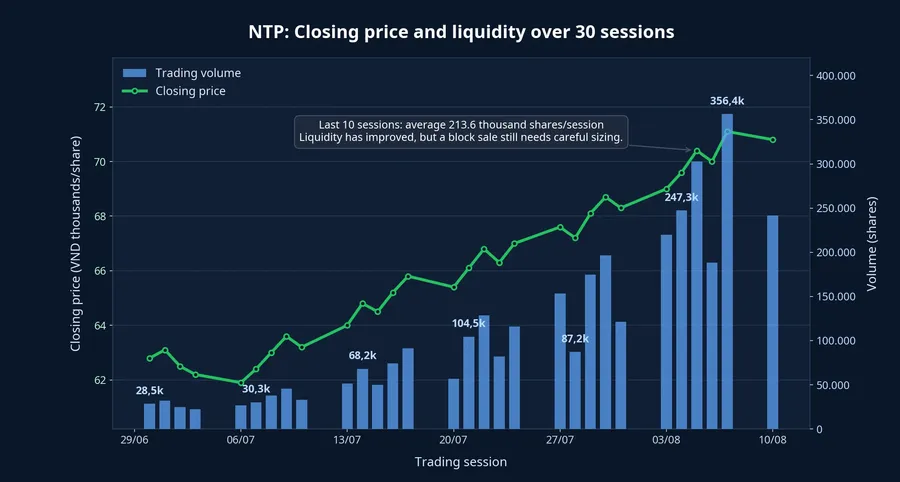
The NTP chart shows that average turnover in the final 10 sessions rose to about 213.6 thousand shares a session. That is a trading snapshot, not proof that the market can absorb a large SCIC block. Moving from normal liquidity to a transaction requires the offer size, lot structure and eligible buyer base.
What DMC shows about the gap between a plan and a deal
DMC is a useful reminder that a divestment plan does not guarantee execution. SCIC previously offered a block of 12,054,467 DMC shares with a reserve price above VND 1,531 billion, or approximately VND 127,000 a share, but the transaction was not completed.Nhà đầu tư
The report does not state a specific reason. It would therefore be inaccurate to blame only the reserve price or only thin liquidity. Several factors may have mattered at once: the block terms, the valuation buyers accepted, the ownership structure and institutional appetite. What the available evidence supports is narrower: a deal closes only when price, terms and demand meet.
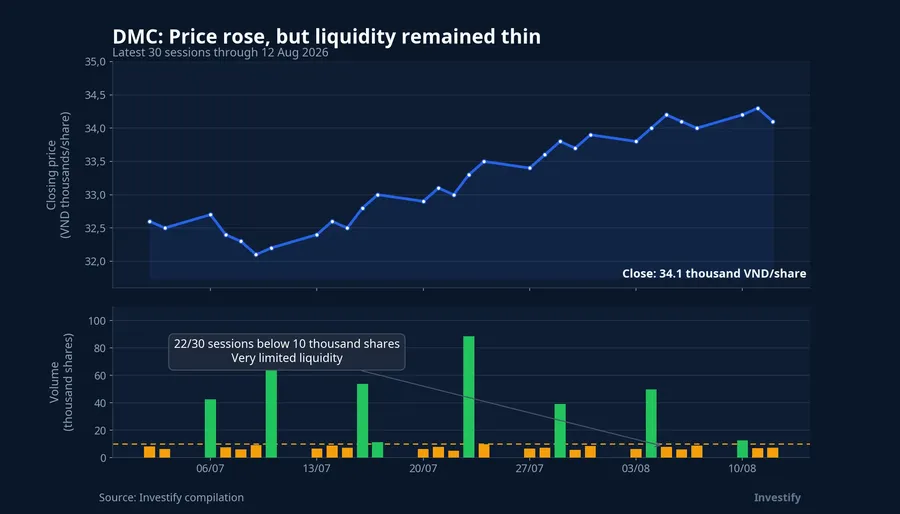
The 30-session DMC series also shows why price and volume need to be read together. Twenty-two of the 30 sessions traded fewer than 10 thousand shares. Thin turnover does not decide a transaction's outcome, but it cautions against treating short-term exchange moves as the value of an entire block.
For that reason, a headline about a listed company can be the start of research rather than the end of it. Investors should resist filling in missing terms with a preferred story, whether optimistic or pessimistic. The documents released for the individual transaction are what will test that story.
Three paths after a detailed plan emerges
The constructive path is a clear SCIC sale plan, a reserve price the market accepts and a buyer with sufficient capacity. If the transferred stake brings governance influence, the buyer's identity and the post-deal ownership structure will matter more than the company's original appearance on the list.
A second path is a longer timetable. The reserve price, lot size or sale conditions may not fit demand when the offer arrives. An auction may then draw too few registrations, sell incompletely or require a different route. That is not a negative forecast; it is a normal possibility when a seller and buyer are finding a common price.
The third path is a revised list. The plan itself allows adjustment for company conditions, market developments and classification criteria.Thời báo Tài chính VN The year 2030 is therefore a planning horizon, not a commitment that every transaction will be completed by then.

A compact watchlist for new investors
The broader plan comes with milestones for developing and approving capital-restructuring plans. A government dispatch requires the relevant plans to be completed and approved by August 31, 2026, while the Ministry of Finance is tasked with consolidating the plans within the regulatory scope for submission to the Prime Minister by August 25, 2026.Báo Chính phủ Those are planning milestones, not sale dates for NTP, DMC or SEA.
For an individual name, start with the sale document: has it been released, or is the company only on the list? Then examine the offer size, method and reserve price. Next ask whether the block changes control, whether buyer interest or auction results exist, and whether the business remains compelling without a divestment story.
The useful next signal is not another headline about the list. It is an upgrade in information: a sale plan, price, volume, date and buyer. Those are the variables that can change a supply-and-demand assessment. Before they appear, the sounder reading is to keep SCIC's plan on a watchlist and let each company's fundamentals lead the analysis.