
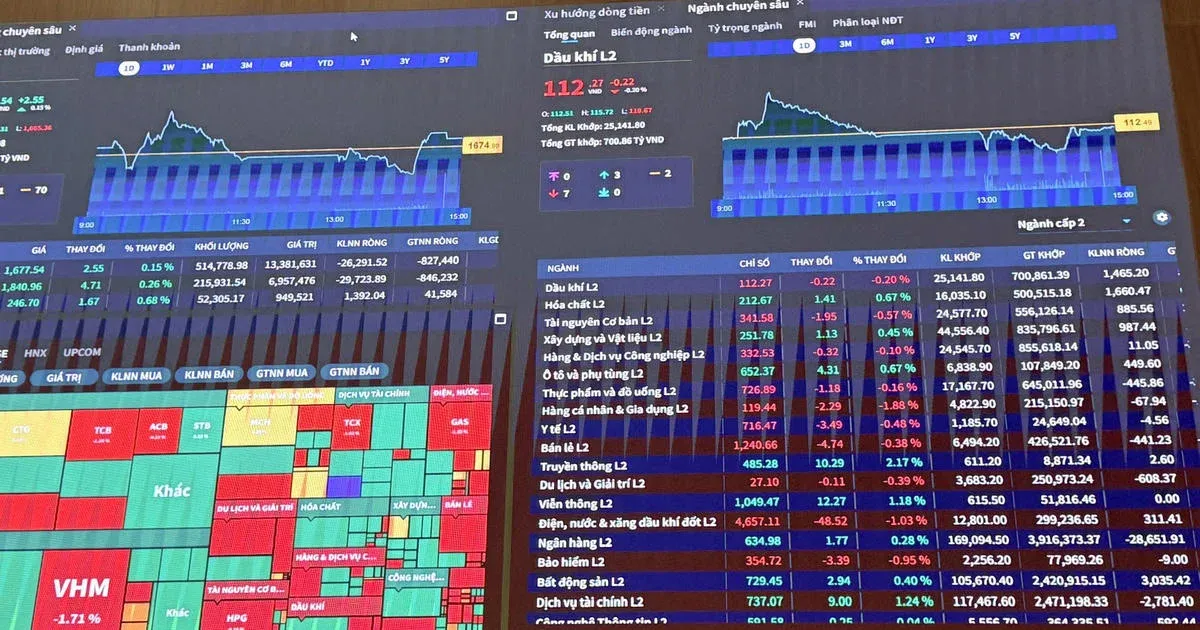

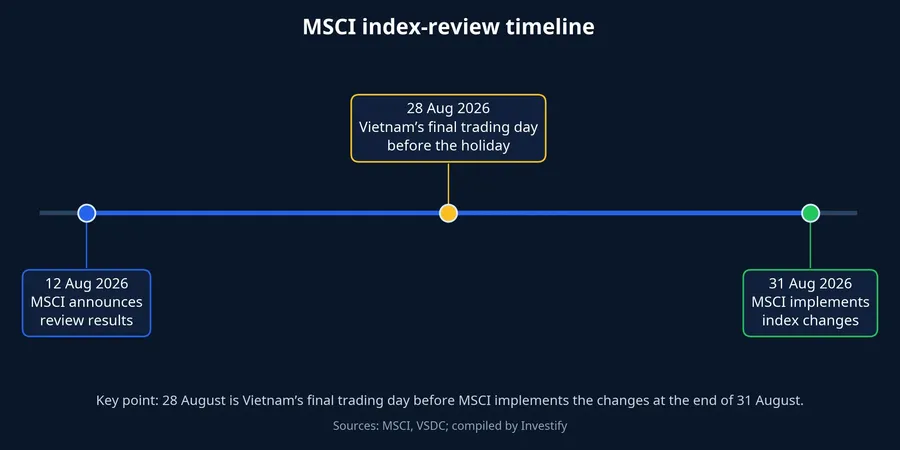
31 August 2026 is a date worth marking for ACB, SSB and MSB. The point, however, is not to predict that all three shares will move in the same direction. It is to understand the mechanics. MSCI will implement the index changes at the end of 31 August, while Vietnam’s market is closed for the National Day holiday from 31 August through 2 September. That makes 28 August the final domestic trading session before the event.MSCIVSDC
The central message is straightforward: index inclusion creates the possibility of rebalancing flows; it does not promise a price gain. Newer investors can read this event through three questions. Which funds actually track the index? What weight will each stock receive? And how much stock remains accessible to foreign investors?
What MSCI changed
In its August review, announced on 12 August, MSCI added ACB, SSB and MSB to the MSCI Vietnam Index. CEO, DGW and HDG were removed from that index at the same time.MSCI This is a change within the Vietnam index in MSCI’s frontier-market system. It is not a new judgment on each company’s fundamentals or earnings outlook.
One easily missed detail is that CEO, DGW and HDG have not vanished from MSCI’s entire index family. They moved into the frontier-market small-cap list.MSCI Saying they were simply “dropped from MSCI” therefore overstates the negative implication. They left the main index and entered a different segment.

Think of the MSCI Vietnam Index as a reference list. Funds, asset managers and investors use such a list in different ways. Some buy shares precisely at the stated index weights; others use it only to benchmark their portfolios; others may watch the changes without trading. An addition to the list cannot, by itself, be converted into a specific amount of money that will buy a share.
That distinction matters because index news is often read as if it were corporate news. A stronger earnings report can change an investor’s view of a company’s cash generation. An index review instead changes the stock’s place in a measurement framework. The two may coincide, but neither proves the other. A portfolio manager can welcome a company’s inclusion while still deciding that its valuation, liquidity or sector exposure does not fit the portfolio.
Several steps separate inclusion from a buy order
The MSCI Frontier Markets Index is designed to represent large- and mid-cap stocks across frontier markets, covering about 85% of each country’s free-float-adjusted market capitalization.MSCI An index is a measure, not a fund that directly deploys cash into the market. That distinction is the right starting point for any “index inclusion” headline.
Actual purchases arise only when a fund or portfolio chooses to replicate the index. Even a passive fund can use representative sampling rather than own every constituent. For an active fund, MSCI may be only a performance benchmark. The manager can raise a weight, leave it unchanged or select another stock if the firm’s own investment case does not fit.
The next variable is a stock’s new index weight. A company with a large market capitalization does not necessarily create large rebalancing demand if its index weight is small. Conversely, a meaningful weight matters only when enough assets are managed by funds that track that particular index. Without both inputs, claims about how much a fund “must buy” remain assumptions.
Foreign-investor access is the final screen. MSCI applies free-float adjustment to reflect the shares that are genuinely available to international investors.MSCI Put simply, headline market capitalization and the stock foreign funds can still acquire are not always the same thing. When the remaining foreign ownership capacity is low, both the calculated weight and the practical ability to trade can differ materially from what an investor might infer from the company’s market value.
Why 28 August matters more than 31 August
MSCI states that the changes take effect at the end of 31 August.MSCI Vietnam, however, closes trading and settlement for the National Day break from 31 August through 2 September.VSDC These dates do not conflict: one is the timing for a global index change, and the other governs when Vietnamese shares can trade.
Investors should therefore not expect an “MSCI rebalance session” on HOSE or HNX on 31 August. 28 August is the final pre-holiday session, so it is the session to watch if funds need to complete Vietnam trades before MSCI implements the change. Still, being worth watching does not mean all orders will arrive that day. Funds may trade earlier to reduce price impact, use block trades or tolerate temporary tracking differences.
This also prevents a common attribution mistake: assigning every price or volume move to MSCI. A late-session move on 28 August, accompanied by volume materially above its recent baseline, would be a more relevant clue to possible rebalancing. Yet even then, public data rarely separates index-tracker activity from trades placed in anticipation by other investors.
Prices already moved in different directions
By the end of the morning session on 13 August, ACB was down 0.22% at VND 22,700 per share, SSB was unchanged at VND 15,450, and MSB was up 0.93% at VND 16,200. Among the stocks leaving the main index, CEO stood at VND 12,300, DGW rose 3.54% to VND 42,450, and HDG gained 0.60% to VND 16,650.
Those figures do not prove that MSCI has no effect. They show that prices do not follow a formula in which additions rise and deletions fall. Expectations may have been priced in before the announcement; short-term positioning, each company’s own outlook and broad market conditions also coexist in a single session. The evidence does not yet allow an exact allocation of how much each factor contributed.
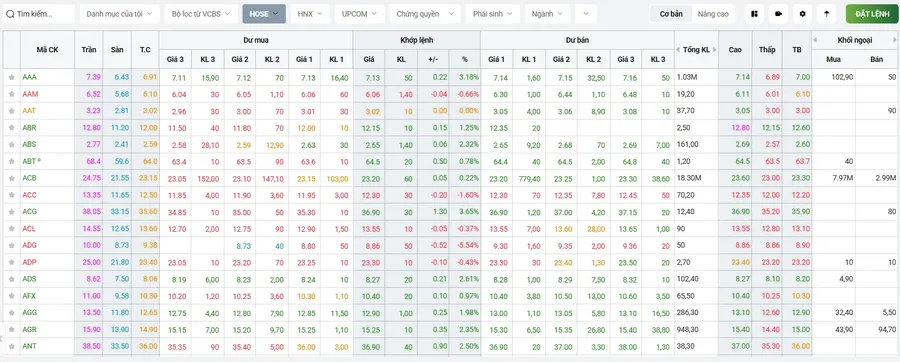
For newer investors, trading volume can be more useful than a single price candle. A price gain with volume well above the recent baseline indicates that new money is participating, but it does not confirm that the buyer is an MSCI-tracking fund. Likewise, net foreign buying aggregates many types of overseas investors. It is not a receipt for a specific index fund.
There is also a practical timing lesson. A price move that happens immediately after the announcement may reflect investors positioning before the formal implementation, while a move near the effective date may reflect portfolio mechanics. Both interpretations can be plausible, and neither should be treated as certain without supporting information on volume, counterparties and the relevant fund base. Separating observation from attribution is especially useful when a headline arrives in a thin or volatile market.
A concise watch list for the next two weeks
First, check whether the fund or portfolio being discussed actually replicates the MSCI Frontier Markets Index or merely uses MSCI as a benchmark. The difference determines whether a constituent change could generate technical buying or selling demand. The name of an index is not enough to infer a flow.
Next, wait for each stock’s official weight in MSCI’s updated constituent material. Weight is a much more direct input than the label “added.” It is also important to separate current foreign ownership from the remaining capacity foreign investors can buy. The terms sound similar, but their meanings are opposite.
Finally, follow volume from the announcement through the 28 August session, especially sizeable trades near the close. The thesis here is that the MSCI event creates a flow-monitoring milestone, not a directional commitment for ACB, SSB or MSB. That view would change only if the weights, index-tracking fund base and actual liquidity together point to a sufficiently large rebalancing force.