
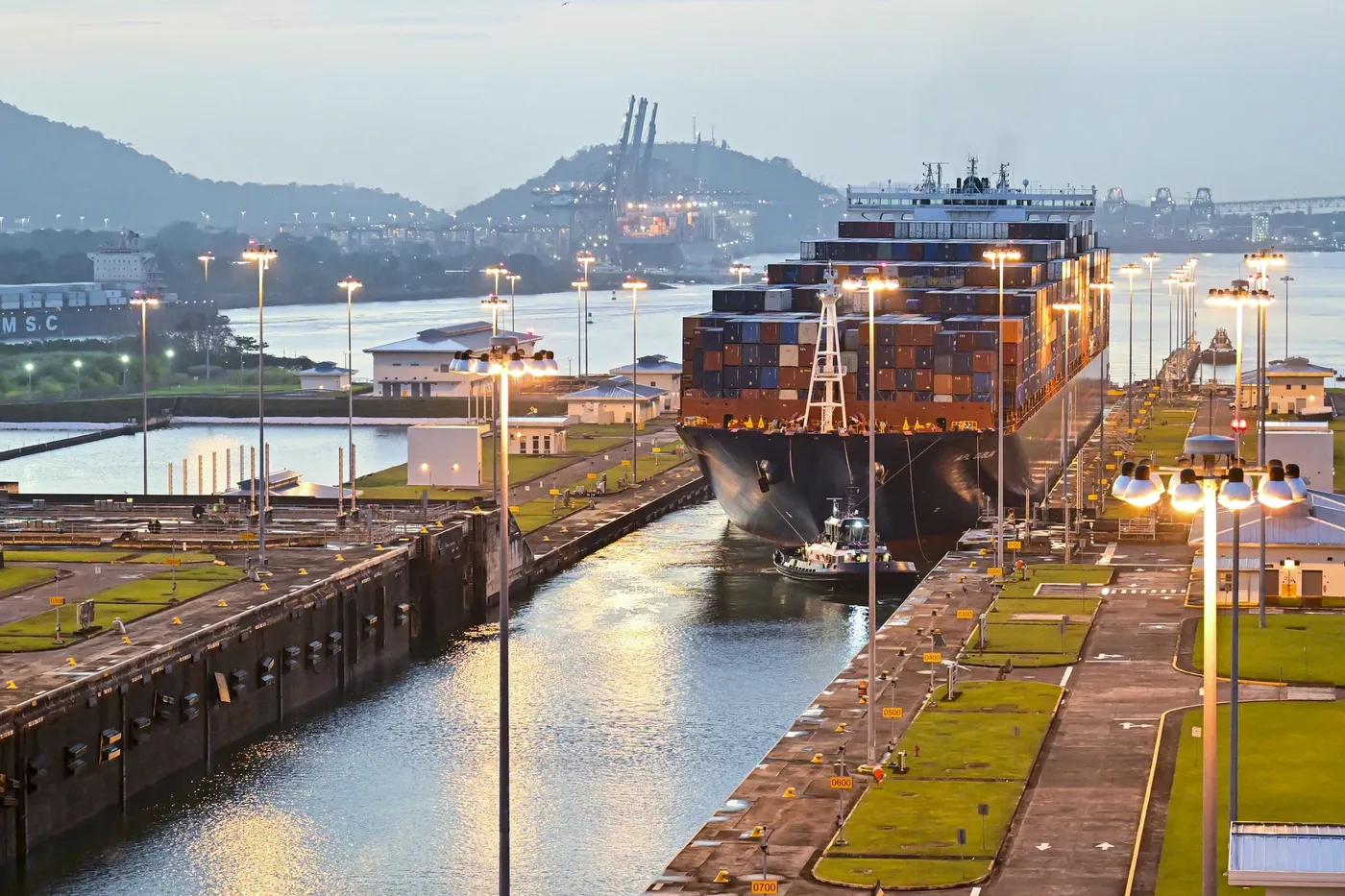

The Panama Canal’s latest data makes an easily missed point about shipping: not every payment by a shipowner is a transit charge. In July, 306 booking slots were offered through auction and 247 were used. That does not mean the Canal raised fees across the board. It shows that a guaranteed date of passage can itself become a scarce product.Panama Canal
The wider picture is one of trade routes being reshaped while commercial shipping through Hormuz remains nearly shut, AP reported on August 11.AP Yet the available evidence does not support calling Panama a system-wide bottleneck. The more useful thesis is that the price of urgency is rising first; a capacity problem matters only if transit slots and operating times deteriorate together.
Three costs that should not be bundled together
A transit fee pays for use of the Canal. A booking fee pays for a predictable passage date, allowing a ship to be matched with loading windows, delivery commitments and contracts. When a normal reservation no longer fits or cargo must move early, an operator can bid for a slot; the highest bidder wins and the bid becomes that voyage’s booking cost.Panama Canal
That distinction is more than technical for anyone watching commodity markets. A high winning bid is the bill for a particular need, not automatic proof that freight rates across the market are rising. It depends on the urgency of the cargo, the number of vessels seeking the same date and the slots offered at that moment.
The practical implication is to separate a marginal price from the average cost of moving goods. Auctions reveal what the most time-sensitive operator is willing to pay at the margin. They can be an early warning that schedules are becoming less flexible, but they do not by themselves tell us what every container, tanker or dry-bulk cargo will cost to transport.
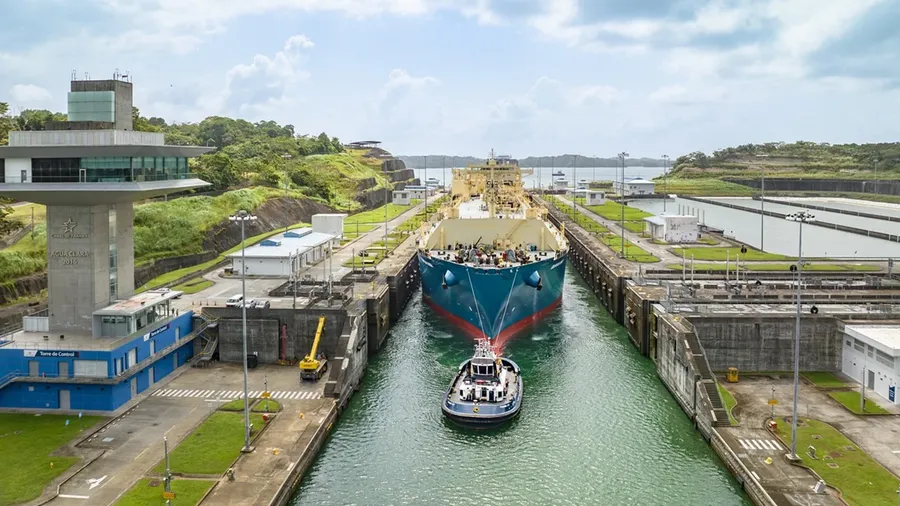
For a high-value fuel cargo or a contract with heavy late-delivery penalties, waiting outside the Canal may cost more than paying for an earlier passage. Sailing around the bottleneck is not free either: both fuel use and voyage time increase while the buyer still expects delivery on schedule. Auction prices can therefore be high without a broad, system-wide queue.
Hormuz changes the trade, not a single route map
It is misleading to picture every vessel simply avoiding Hormuz and then steaming through Panama. The two locations are not sequential points on a typical voyage. The connection emerges when buyers change their supply source or destination: energy once sourced from the Middle East for Asia may be replaced with cargo from the US Atlantic coast, with Panama becoming the cut-through from the Atlantic to the Pacific.
This is a chain of commercial adjustments: suppliers, loading ports, buyers and delivery dates can all change. If the delivery date still holds, demand for a Canal slot on the right day can increase. That mechanism is consistent with pressure on reservations, but it does not allocate all competition at the Canal to Hormuz. Seasonality, fleet scheduling and the cargo mix are also plausible contributors.
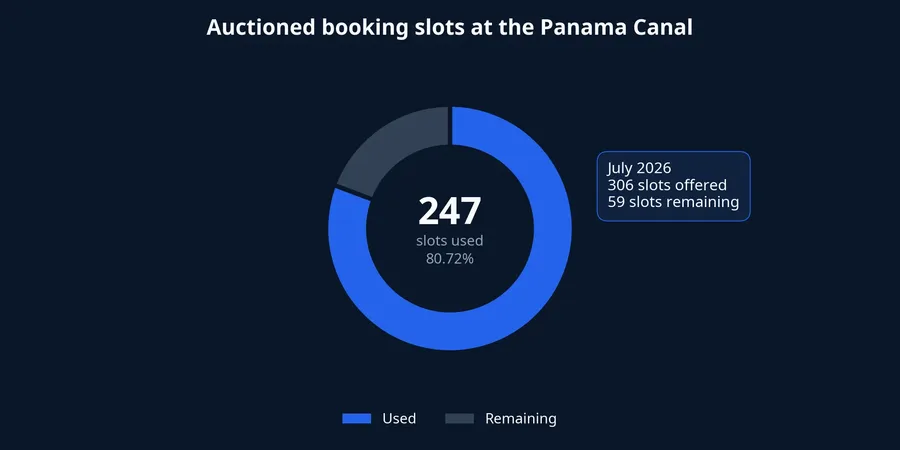
July’s 80.72% utilisation rate should be read as a measure of absorption in one segment of the reservation market, not as total Canal transits.Panama Canal The 59 unused slots also mean this data alone does not describe absolute scarcity. Investors get a clearer signal by putting it alongside vessel traffic, waiting times and operating notices.
Operating data does not yet describe paralysis
The Panama Canal recorded an average of 34.03 oceangoing transits a day in July. Vessels spent an average of 25.38 hours in Canal waters, while the actual transit averaged 10.87 hours.Panama Canal The gap includes dispatching, preparation and other operating steps, so it should not be treated entirely as time spent in a queue.
The 34.03-transit figure also needs the context of the authority’s stated sustainable maximum of roughly 36 to 38 transits a day. The Canal is operating near that range, but the figures do not show a system that has lost control of its flow.Panama Canal A notice issued on August 5 said the Panamax and Neopanamax locks’ capacity remained stable and that available transit slots had not been reduced.Panama Canal
An expensive auction, then, cannot substitute for a fuller set of operating indicators. If bids rise while slots and operating time remain stable, urgent rescheduling of individual cargoes is the more plausible explanation. If slots are cut and time in Canal waters lengthens at the same time, the story shifts from the cost of urgency to a clearer shortage of capacity.
That distinction matters because markets often turn a vivid anecdote into a macro conclusion too quickly. A Canal is a physical system with several constraints: lock availability, water, vessel mix and scheduling discipline. The relevant question is not whether one ship paid a striking price, but whether these constraints are beginning to reinforce one another in the published operating data.
El Niño is showing up in draft limits
Water risk is not hypothetical. Each lockage uses water from Gatún Lake; on August 11, the official lake level was 84.4 feet, or approximately 25.73 metres.Panama Canal The Canal authority is conserving water by lowering the maximum draft for Neopanamax vessels, the permitted depth of a ship’s hull below the waterline.
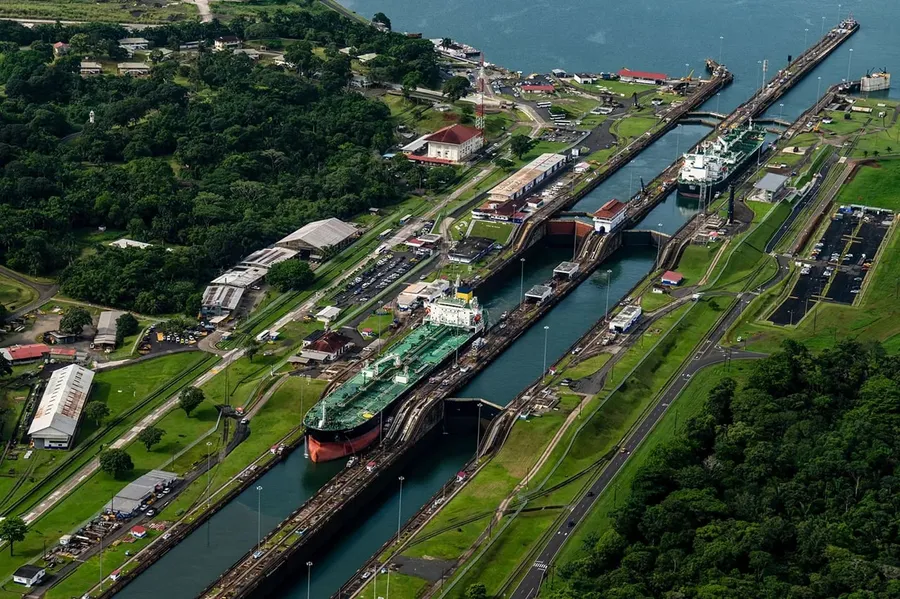
The limit is scheduled to fall to 14.63 metres on August 26 and 14.48 metres on September 3.Panama Canal A vessel may have to carry less cargo to remain within the limit, raising transport cost per unit even if the number of transits does not fall. That is a narrower but more defensible impact than claiming El Niño has already caused a broad reduction in Canal capacity.
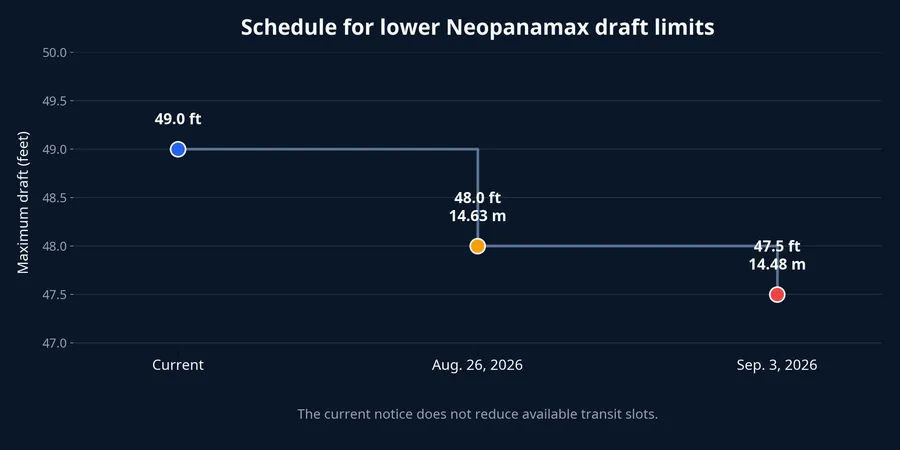
The relevant dashboard combines Gatún Lake levels, permitted drafts, available slots, average traffic and time spent in Canal waters. A draft change first affects cargo carried per vessel. The risk to corridor-wide capacity only steps up if it arrives alongside slot cuts or persistently longer operating times.
For commodity buyers, the distinction also separates a logistics cost issue from a supply shock. Lighter loads can make individual voyages less efficient, while a reduction in slots constrains the number of voyages the corridor can process. They can compound over time, but treating them as the same event before the data shows it would overstate the current disruption.
Read the price of urgency for what it is
For retail investors, a single winning auction bid is not a complete proxy for marine transport costs, much less a stand-alone signal for oil prices or a company’s margins. It says that someone was prepared to pay more to preserve a specific delivery schedule. The more useful question is whether that behaviour spreads into the operating data.
The watch list is therefore concrete: subsequent water-level readings, the announced Neopanamax draft schedule, any change in available slots, daily transit volumes and the duration vessels spend in Canal waters. Taken together, those signals can distinguish a temporary scramble for timing from a material tightening in the trade corridor.
The current conclusion is coherent: Panama is not in a broad capacity reduction. Hormuz may continue to shift sourcing patterns and create urgent passage requests, while El Niño is currently appearing first through lower draft limits. This view would need revisiting if future notices start cutting transit slots or if time indicators show a sustained loss of operating capacity.