

The VN-Index closed at 1,793.18 on August 12, up 1.11% for the session. A rising market naturally brings the familiar question back to the screen: which stock should I buy today? Đầu tư Chứng khoán For an investor who cannot spend hours each week tracking companies and prices, however, a more basic question comes first: do I need to run every part of my portfolio myself?
A fund certificate is not a box that turns risk into safety. It changes the division of labour. You delegate security selection, trading and rebalancing to a fund manager within a disclosed mandate. In return, you still have to choose the right job for your money and monitor the party that has been given that mandate. The central point is simple: a fund can operate a portfolio for you, but it cannot define your financial goal for you.
What work does a fund manager take over?
With a fund certificate, much of that operating work moves to the fund-management team. It researches assets, builds the portfolio, executes trades, monitors limits and rebalances according to the fund charter and prospectus. You do not approve each order. You accept the scope within which the manager is allowed to act.
Think of it as hiring a driver for a trip whose destination has already been agreed. The driver chooses the lane and responds to traffic; the traveller still has to say where they are going, when they must arrive and how much discomfort they can tolerate on the road. Handing over the wheel does not create the destination.

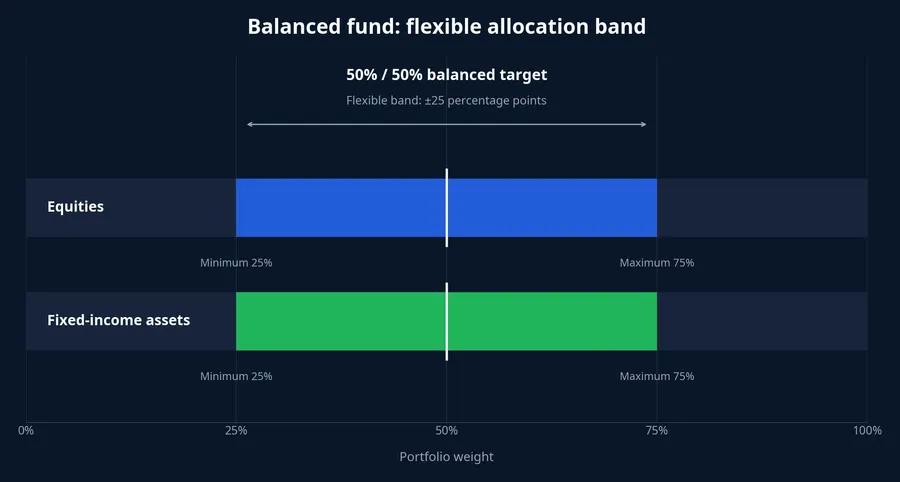
For example, a VCBF balanced fund discloses an equity target of 50%, with a band of plus or minus 25 percentage points; the remainder is allocated to fixed-income assets. VCBF That gives the manager room to change the allocation within stated limits. The investor is not merely buying a label of “stocks and bonds”; they are accepting delegated discretion between those two asset groups.
A process does not remove market risk
This is where new investors often get the wrong impression. An equity fund still moves with the equity market. A bond fund still carries interest-rate, liquidity and credit-quality risk. A balanced fund combines sources of risk at a specified weight; it does not turn them into a bank deposit.
The practical value of a fund is its process. A fund can also make poor decisions, but its decisions should be filtered through an investment objective, allocation limits, risk controls and disclosure requirements. What an investor is buying, then, is not only today’s holdings but also the way those holdings are meant to be managed when the market changes direction.
Short-term returns should not be used to pronounce that process good or bad. A fund’s NAV can fall in a declining market while its manager remains faithful to the strategy. Conversely, a period in which NAV rises with the market does not establish superior skill. Read performance alongside the mandate, benchmark, volatility and the discipline visible across different market conditions.
Read the portfolio before trusting the label
A fund name is an introduction; the portfolio is the asset exposure you actually own indirectly. A balanced fund may be allowed to move its allocation materially, so investors should read the prospectus and the latest portfolio disclosure to understand what it may hold, where its limits sit and whether concentration lies in an industry or issuer.
In VCBF’s example, the largest securities group accounts for 20.7% of NAV, while the portfolio includes bank and retail equities as well as corporate bonds. VCBF That figure replaces the vague promise of “diversification” with a testable question: if one asset group comes under pressure, how exposed is the portfolio?
Portfolio disclosure also prevents overreading a product label. There is no evidence that a balanced fund must suit everyone, or that an allocation to bank stocks will necessarily benefit from every rally in that sector. The result also depends on actual weights, the entry point, the broader market and the fund’s other holdings.
If these materials are difficult to find or do not clearly show what the fund is permitted to do, that is a monitoring problem, not a minor detail.
Fees are returns you do not keep
Fees are part of investment results, not a footnote outside them. Management fees are reflected in a fund’s operating costs and therefore in NAV. Redemption fees, switching fees and bank charges can directly affect the cash received when a plan changes. The same fund may consequently work for a long-term holder while being unsuitable for someone who may need the money in a few months.
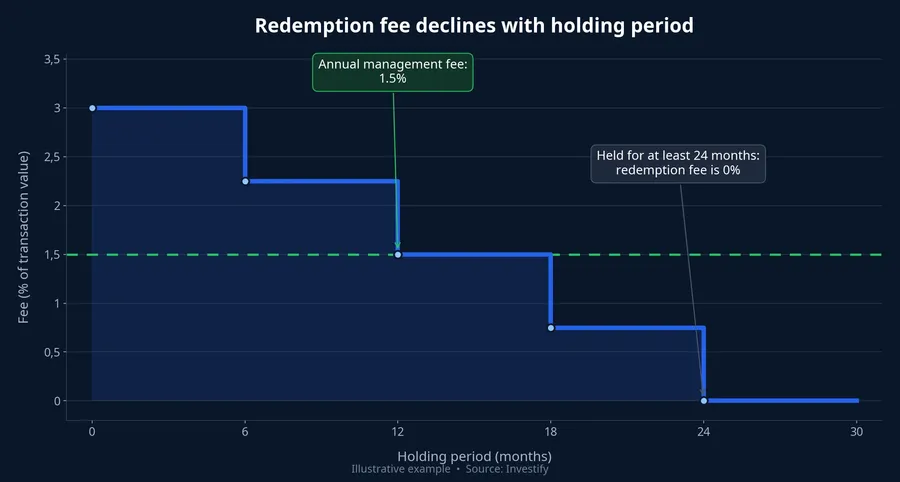
Under VCBF’s published fee schedule, the management fee in this example is 1.5% a year. The redemption fee declines from 3.0% for a holding period of no more than one month to 2.0% for more than one to 12 months, 0.5% for more than 12 to 24 months, and zero after that. VCBF This is not a verdict that the fee is high or low across all funds. It shows why the intended holding period should be set before comparing returns.
Put plainly: if the money may be needed for tuition, home repairs or an emergency fund, early-redemption costs and settlement timing matter as much as expected returns. Before buying, check dealing days, how long cash takes to reach the account and the redemption terms. Liquidity in an open-end fund is not the same as an ETF’s ability to trade intraday on an exchange.
What remains your responsibility
Some work cannot be delegated. A fund manager does not know whether your money is for a home purchase in two years, a child’s education or retirement unless you have first defined it. A fund that follows its strategy correctly can still be unsuitable if the investor’s time horizon and ability to tolerate volatility do not match it.
Before searching for a fund name, state the role of the money: what goal it serves, how long it can remain invested, what decline would make the plan untenable and when it may need to be withdrawn. Only then compare fund type, portfolio, fees and dealing calendar. The sequence can feel slower, but it helps prevent a decision based solely on an attractive performance table.
Monitoring does not stop on the purchase date. The fund page in this example publishes NAV reports through the August 11, 2026 dealing date. VCBF Current data does not automatically make a fund good, but regular disclosure is the minimum condition for an investor to inspect the authority they have delegated.
Fund certificates work best when they solve a specific problem: providing access to an investment process that you do not have the time or desire to run every day. Risk remains, but it sits in a framework that can be read and monitored. After investing, the useful signals are not a fund’s weekly ranking but whether its portfolio remains within its stated mandate, whether costs still fit the plan and whether your own need for liquidity has changed.