

On August 12, KSB rose by its daily limit of 6.74% to VND 14,250 per share. Trading volume reached 4,355,500 shares, nearly eight times the preceding session. The same day, the National Assembly discussed a draft resolution on the investment policy for Ring Road 5 in the Hanoi Capital Region, a project with preliminary investment of VND 288,268 billion.Người Quan Sát
Those facts invite a tidy story: a major project is coming, a construction-stone producer will benefit, and its share price rises. The word that deserves scrutiny is “will.” A project’s size describes demand that may emerge in the future. It does not identify the supplier that will win work, the volume it can deliver, or the profit it can retain.
That distinction is not a dismissal of KSB’s potential. The conclusion closest to the available evidence is narrower: the price move reflects expectations around the public-investment theme, while no public evidence yet supports assigning Ring Road 5 revenue directly to KSB. For newer investors, separating those two statements changes how a limit-up session should be read.
The project remains at the investment-policy stage
Ring Road 5 is not yet a completed procurement exercise or a material order allocated to suppliers. The National Assembly is discussing a draft resolution on investment policy. Under the government’s proposal, the route would run roughly 349 kilometres through seven localities, with preliminary investment of VND 288,268 billion.Người Quan Sát
That large figure is not a single pool that immediately becomes construction spending. The project is expected to contain 22 component projects, including compensation, support, resettlement, the main route, parallel roads and major bridges. Compensation, support and resettlement alone are estimated at VND 78,143 billion. That is land-clearance expenditure, not revenue from stone, cement or construction work.Người Quan Sát
The timetable also illustrates the distance between policy and earnings. About 116 kilometres are prioritised for investment in 2026–2030, while land acquisition across the full route is expected to cover around 4,011 hectares. Until the funded sections, land-clearance progress and individual packages are specified, assigning a share of project revenue to a named company gets ahead of the documents.Người Quan Sát
A project budget is not a listed company’s revenue
Think of the preliminary investment figure as the budget for an entire new district. It includes land, roads and bridges, consulting, project management, resettlement and many construction packages. A materials supplier can capture only a small portion, and only if it has a suitable quarry, can enter the supply chain and receives a specific contract.
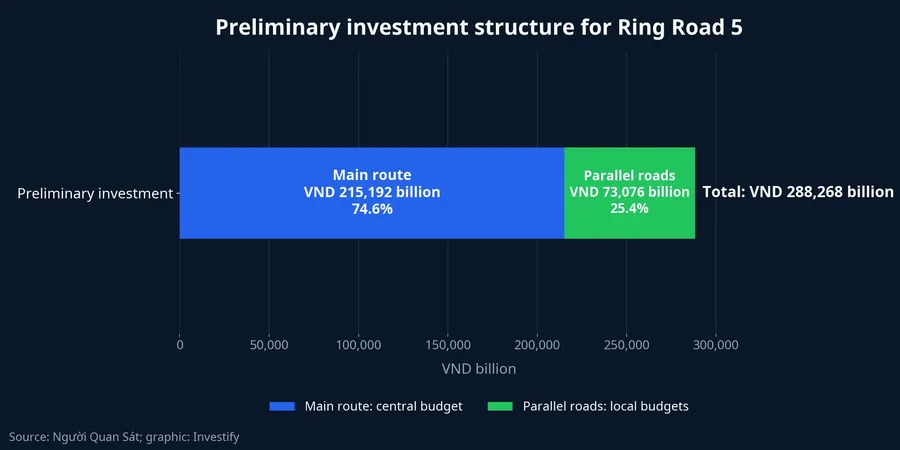
The chart separates the two funding components in the proposal: VND 215,192 billion for the main route from the central budget and VND 73,076 billion for parallel roads from local budgets. It shows the scale of the project, not a revenue allocation for KSB or any other company.Người Quan Sát
For construction stone, geography is a business variable, not a footnote. Stone is heavy, its value per unit of weight is modest, and freight can quickly compress profit margins. A nearby quarry generally has a natural advantage over a distant one, even if the latter has good reserves. Ring Road 5 runs through northern localities, while KSB’s corporate profile lists its quarries in southern Vietnam.KSB
That is why two claims must be kept apart. KSB may draw market attention when the public-investment narrative strengthens. That is different from saying it will directly supply Ring Road 5. At the time of review, the company’s disclosure page showed no contract or materials-supply announcement for this project.KSB
The five gates from a project to financial statements
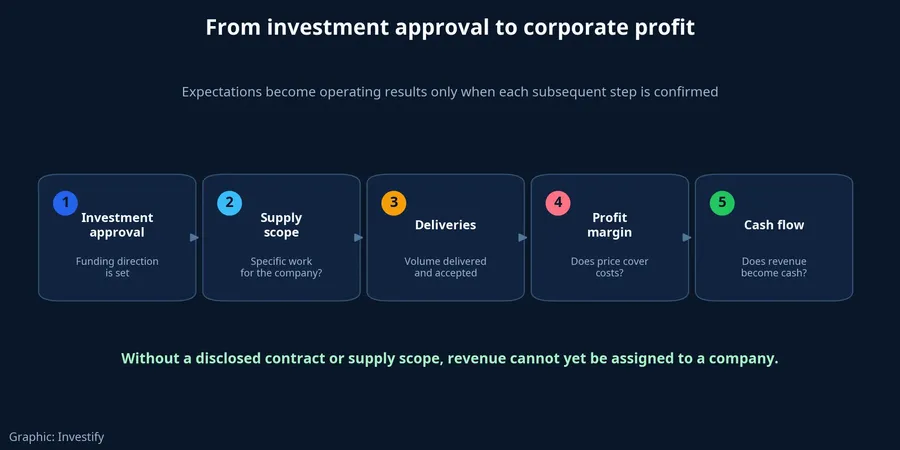
Put simply, a project becomes operating performance only after a chain of confirmations. Investment policy comes first. The company then needs an actual supply scope or contract. That is the point at which a market expectation gets a company name and a piece of work that investors can examine.
Next comes actual delivery volume. A large contract does not automatically become quarterly revenue if the site lacks cleared land, work progresses slowly, or deliveries have not been accepted. Once materials move, investors still need to ask whether pricing covers fuel, freight, labour and depreciation. Higher revenue with lower margins does not create proportionate value for shareholders.
Cash collection is the final link. Reported revenue may precede cash when a company is waiting for acceptance and payment. If receivables grow faster than operating cash flow, the business must finance working capital for longer and may incur additional borrowing costs. A huge project should therefore not be treated as a complete positive simply because its headline number is large.
The limit-up move says more about expectations than contracts
What the screen does confirm is demand for the shares. During the morning session on August 12, KSB hit its ceiling, while FCN, HHV, LCG and VCG also rose as a group. That breadth supports the view that capital was buying the public-investment theme rather than pricing a KSB-specific contract.Người Quan Sát
Still, timing should not be turned into an unproven causal claim. Expectations of faster year-end disbursement, demand for stone from southern projects that are geographically better suited to KSB, and short-term group trading could all have contributed to the move. Public evidence does not let us allocate the contribution of each factor precisely. It supports a broader sector story more clearly than Ring Road 5 revenue specifically belonging to KSB.
Conclusion: wait for company-level evidence
The thesis is straightforward: VND 288,268 billion is the size of a proposal under discussion, not KSB revenue or profit that can yet enter a forecast. The 6.74% gain and unusual turnover show that public-investment expectations are being reflected in the price. They are not substitutes for contracts, deliveries and cash flow.
The next signals to monitor are disclosed supply scope, contractor-selection outcomes, sales volume, profit margin and KSB’s cash from operating activities. If these signals point in the same direction, the story can move from a market theme to a company-specific business case. Until then, the careful reading is to distinguish a large project from the value a company can demonstrably capture.