


HHP announced a 6.5% stock dividend while its shares closed at the daily floor on August 12. For newer investors, that combination can feel contradictory: if shareholders are receiving more shares, why can the price still fall? The answer is that a stock dividend changes the number of units owned, while the price on the screen reflects supply, demand, and expectations at a particular moment.
The key point is simple. Eligible HHP shareholders will receive additional shares, but the total value of their holding does not automatically rise by 6.5%. The August 12 fall was an actual trading move. The reference-price adjustment on the August 18 ex-rights date is a separate technical mechanism and needs to be read against a different benchmark.
How HHP is issuing the additional shares
On August 12, HHP said it planned to issue more than 5.6 million shares as a 2025 stock dividend at a 6.5% ratio. The ex-rights date is August 18 and the record date is August 19. If completed, the company's charter capital is expected to rise from VND 886 billion to VND 921 billion.Vietstock
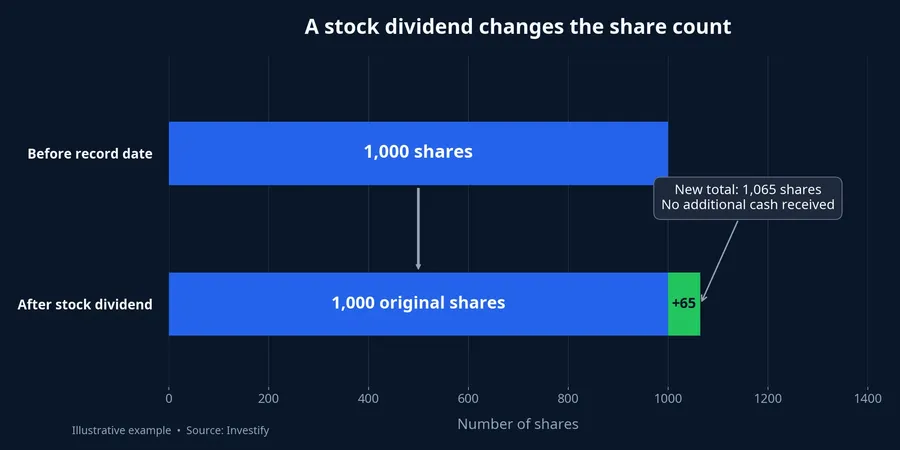
Take a holding of 1,000 shares. A 6.5% ratio gives the shareholder 65 additional shares, bringing the total to 1,065. Those new shares are an additional ownership unit, not cash equal to 6.5% of the investment arriving in the account.Vietstock
In practical terms, the company converts an eligible portion of equity into share capital. HHP does not send cash out of the business, so it retains resources for operations. But the ownership pie has more slices. The long-term benefit therefore depends on whether the capital retained can generate additional earnings and cash flow.
There is also a timing distinction worth keeping in mind. New shares are not necessarily tradable the moment an investor sees an additional entitlement in the account; completion and listing procedures can take time. That does not change the economic logic of the adjustment, but it does mean that an increased displayed share count and immediate ability to sell can be separate events.
Why the holding is not automatically worth 6.5% more
Assume that 1,000 shares trade at price P immediately before the ex-rights date. Once the share count becomes 1,065, the theoretical reference price is adjusted to roughly P divided by 1.065, before exchange rounding rules apply. The theoretical value is the same on either side: 1,000 times P before the adjustment and 1,065 times the ex-rights price afterwards.
Vietnam Securities Depository and Clearing Corporation explains that reference prices on ex-rights dates are adjusted for the value of dividends or entitlement ratios, subject to specific exchange rules.VSDC A larger share count on a portfolio screen is therefore not proof that a matching profit has just been created.
Cash dividends work differently in form, but not in the need for careful accounting. With cash, the shareholder receives money and the reference price is adjusted for the payout. With a stock dividend, the immediate change is the share count. In both cases, the right measure is the value of the whole holding, not one figure that has increased on the screen.
This is particularly important when a dividend ratio is presented prominently in a headline or notification. The ratio tells an investor how many new shares will be issued for each block already owned. It does not state an investment return, and it does not predict what buyers and sellers will do once trading resumes on the new reference-price basis.
August 12 and August 18 are not the same event
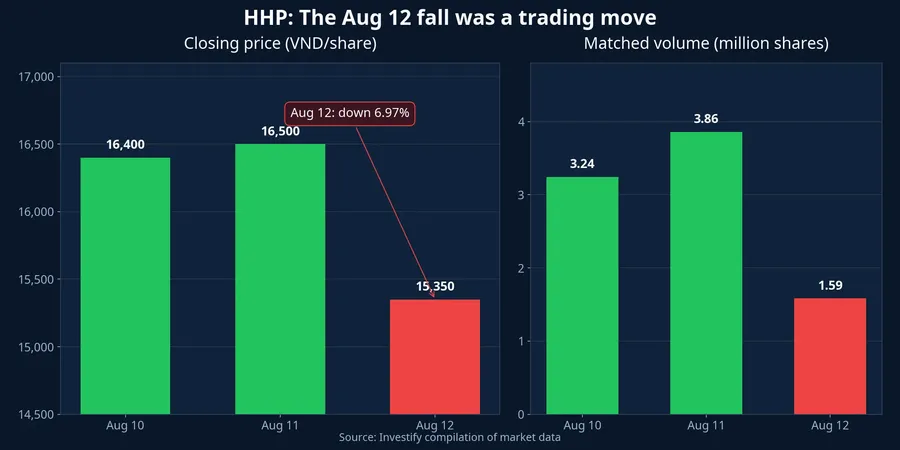
HHP closed at VND 15,350 on August 12, down 6.97%, with 1,585,300 shares matched. It was still 38% above its level at the start of the year. In the preceding session, it closed at VND 16,500 on matched volume of 3,860,000 shares.Vietstock
That was a one-day market move while the dividend entitlement was still attached to the share. Buyers and sellers were trading on the same entitlement basis, so the decline reflected orders meeting in the market. It was not a technical adjustment for the upcoming dividend.
August 18 has a different meaning. A buyer from that date will no longer receive this dividend, so the reference price is adjusted to separate the entitlement from the share price. A lower reference price at the start of the ex-rights day, before any trade occurs, does not by itself mean the market has reassessed the company downward.
The comparison point matters. To judge the actual move on August 18, investors should compare trades with that day's adjusted reference price. Comparing directly with the August 17 close and calling the whole difference a loss would mix a market move with the mechanical separation of the entitlement.
The distinction is not merely technical. A red quotation caused by sell orders can carry information about market expectations, liquidity, or risk appetite. A lower reference price caused by the entitlement adjustment is an accounting convention that keeps the comparison fair. Both may appear near the same date, but they should never be treated as the same signal.
One down session cannot establish a cause
Nothing in the dividend notice establishes that the stock dividend itself caused the limit-down session. HHP gained 6.84% to VND 16,400 on August 10, then closed at VND 16,500 on August 11 before falling the next day. That sequence is consistent with possible profit-taking after an advance and softer buying interest, but it is a plausible interpretation, not a confirmed cause.Vietstock
Other explanations remain possible. Expectations for business performance may have shifted, session liquidity can amplify price swings, or several order flows may have acted at once. Without evidence that allocates the contribution of each factor, the more disciplined reading is to report the coincidence rather than attach one corporate event to one definitive price driver.
A dividend entitlement is not a substitute for business analysis
In the second quarter of 2026, HHP recorded revenue of approximately VND 764.6 billion, down 20.3% year on year, and net profit of approximately VND 18.9 billion, down 4.1%. First-half operating cash flow was approximately VND 152.9 billion, while borrowings at the end of the second quarter were approximately VND 2,331.5 billion. These are HHP figures pre-verified in Investify's internal database.
The more useful questions are not about the 65 new shares. They are whether revenue can recover, margins can hold, and operating cash generation can support debt obligations. A stock dividend can make sense when retained capital is used productively. If earnings do not rise in step with the enlarged share count, each slice of ownership has no reason to become more valuable on its own.
For a new investor, the practical checklist is therefore short. First, identify whether the distribution is cash or shares. Next, write down the ex-rights date and use the adjusted reference price when reading that day's movement. Finally, return to the business itself: earnings quality, cash generation, borrowings, and the price being paid for the shares carry more information than the entitlement alone.
That is the durable lesson from HHP. The entitlement changes the share count and reference price; the market sets the traded price. A 6.5% stock dividend is not a cushion beneath the share price. The signals that matter after the ex-rights date are business results, cash flow, and borrowings.