

CoreWeave and Supermicro both received a positive market response after their latest results. For an AI-infrastructure company, though, revenue growth is only the first page of the story. The more important page comes after it: how much capital that revenue requires, and when it becomes actual cash.
Think of the two companies as working at different points on the same construction site. CoreWeave builds and rents out a computing factory. Supermicro sells the server systems that let customers build their own. Both can report very large revenue as AI demand expands, yet the points where cash gets tied up are entirely different.
The central conclusion is straightforward: one reporting season is not enough to call either company a proven case of durable growth. CoreWeave still needs to show that scale can offset its cost of capital. Supermicro needs to show that earnings are not sitting too long in inventory and receivables.
Same AI demand, different products
CoreWeave provides computing capacity and cloud services under contract. Before it records revenue, it must have servers, facilities, power, and operating systems ready to go. This is a model that spends up front in exchange for revenue that can extend over several years.
At the end of the second quarter, CoreWeave reported USD 104.2 billion in remaining performance obligations, up 246% from a year earlier. That indicates contracted demand, not cash already collected. The contracts become revenue only when computing capacity is placed into service on time and to the required customer standard.CoreWeave
Supermicro runs on a different rhythm. It buys components, assembles servers, storage systems, and cooling equipment, then delivers them to customers. Orders can turn into revenue faster than a long-term infrastructure lease, but the company commonly has to pay for components before customers have paid in full.
Put simply, CoreWeave has to ask whether it can build fast enough without borrowing too much. Supermicro has to ask whether it can ship at scale while collecting fast enough. That distinction is why the same revenue metric cannot decide which stock has the better business quality.
CoreWeave: revenue momentum comes with a large capital bill
CoreWeave reported second-quarter revenue of USD 2.575 billion, up 112% year on year. Its adjusted operating margin improved to 5% from 1% in the first quarter of 2026. That is constructive: as more infrastructure is used, fixed costs can be spread over a larger revenue base.CoreWeave
Capital expenditure is the figure that has to be read alongside revenue. In the second quarter, CoreWeave generated USD 679 million in operating cash flow but spent USD 9.352 billion on capital expenditure. The gap does not mean the company made a loss equal to that difference. It does show that expansion still requires a large amount of outside capital.CoreWeave
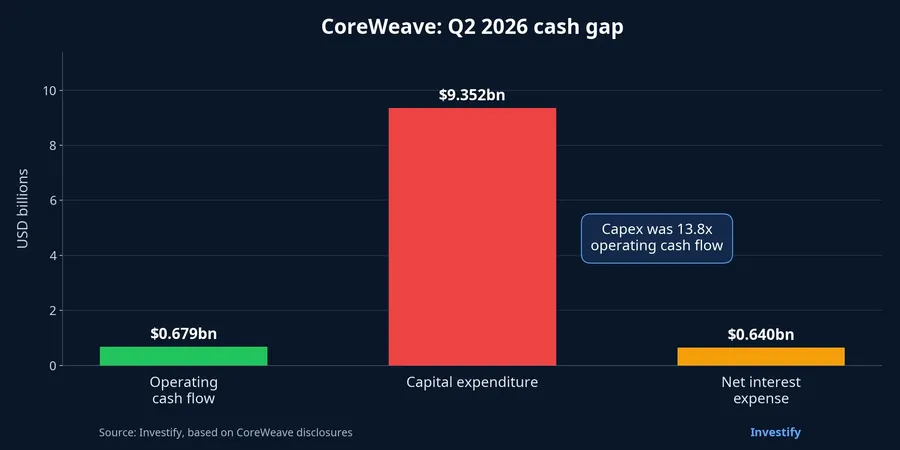
Capex was roughly 13.8 times operating cash flow in the quarter, which makes the pressure tangible. Funding can come from debt, equity issuance, or other financing structures. Each has a cost: debt raises interest expense, while equity can dilute existing shareholders.
The full-year outlook retains the same trade-off. CoreWeave expects revenue of approximately USD 12.4 billion to USD 13.2 billion and capital expenditure of approximately USD 35 billion to USD 39 billion. A large contract base matters, but it does not by itself confirm growth quality. The key questions are whether operating margins keep improving and how much additional capital each new dollar of revenue requires.CoreWeave
Supermicro: earnings may not yet be cash
Supermicro reported fiscal fourth-quarter 2026 revenue of USD 11.120 billion, approximately 93% higher than a year earlier. Gross margin was 17.5%, versus 9.5% a year earlier, and net income rose to USD 1.178 billion. The results were released on August 11, and the figures remain preliminary and unaudited.
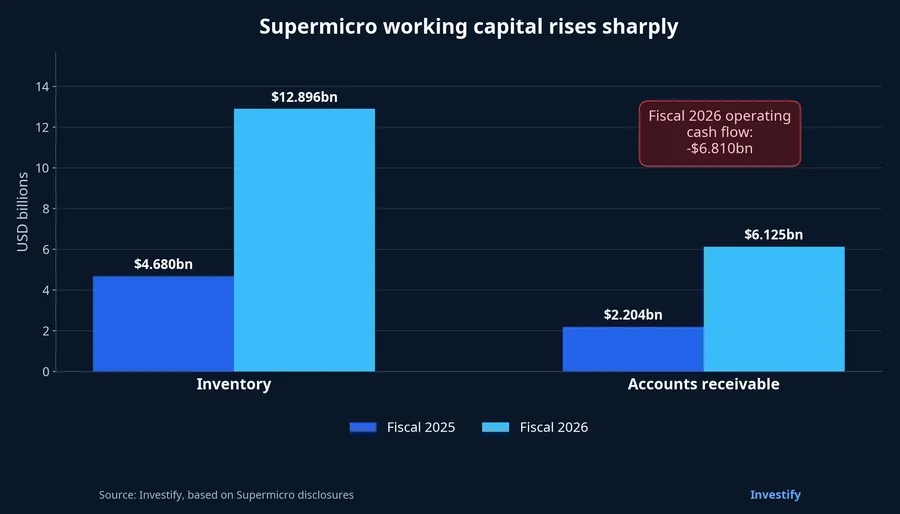
Looking only at the fourth quarter, the picture is bright. The full-year report raises a different question: why did net income reach USD 2.230 billion while operating cash flow was negative USD 6.810 billion? The answer is working capital: cash tied up in inventory and invoices that customers have not yet paid.
At fiscal year-end 2026, Supermicro's inventory was USD 12.896 billion, up from USD 4.680 billion a year earlier. Receivables rose from USD 2.204 billion to USD 6.125 billion. With deliveries growing rapidly, these figures may reflect component demand and product moving through the supply chain. They also mean cash can arrive later than the earnings reported on the income statement.
That is not automatically negative. A fast-growing company often needs to stock components and tolerate higher receivables. Other explanations still require monitoring: deliveries may slow, customers may take longer to pay, or inventory may be accumulating faster than needed. The available report does not provide enough evidence to assign an exact share of the cash-flow gap to each explanation.
Margins also deserve more than one time window. The 17.5% fourth-quarter gross margin was helped by a favorable customer and product mix, while the full-year gross margin was 10.8%, below 11.1% in the prior year. One good quarter may be the start of improvement, but it cannot yet establish that the margin will persist as large orders are fulfilled.
Reading beyond the revenue headline
For CoreWeave, a new investor can begin with three lines: revenue, capital expenditure, and interest expense. More revenue is positive, but it becomes durable only if the added cost of infrastructure and financing does not grow faster than profitability. Remaining contract value shows demand; cash flow and margin show how efficiently the company can serve that demand.
For Supermicro, put earnings beside operating cash flow, inventory, and receivables. If revenue rises while inventory and receivables rise even faster, cash may continue to leave the business. If those balances begin to grow more slowly and operating cash flow turns positive, the earnings on the income statement become more convincing.
The common point is not a buy-or-sell answer. Both companies benefit from spending on AI, but they face different tests. For CoreWeave, the decisive signal in coming quarters is whether the gap among operating cash flow, capital expenditure, and financing costs narrows. For Supermicro, it is the pace at which orders become cash, together with the direction of inventory and receivables.
The most honest conclusion for now is to wait for the next reports to confirm the direction. If CoreWeave improves operating margin while capital required per unit of revenue falls, its growth quality will strengthen. If Supermicro turns earnings into positive operating cash flow and controls working capital, its picture will become clearer too. Until those signals arrive, a post-results price move is an initial market reaction, not final proof.