


A suspicious transfer rarely begins with a complicated financial calculation. It begins when the sender is rushed: an offer is supposedly about to expire, an account is said to be at risk of being frozen, or a payment is demanded immediately. If a recipient-account warning appears at that moment, the decisive issue is not what the system says. It is whether the sender is willing to pause.
That is the right lens for SIMO, Vietnam's information system supporting the management, monitoring and prevention of payment fraud risk. Technology can detect signals and place a warning at the point of action. It cannot verify someone’s identity for the user, end a coercive call, or decide not to send the money. For new investors, understanding that boundary is more useful than believing a warning layer can automatically make every transfer safe.
What the figures say about pausing
At an August 11 press briefing, Lê Anh Dũng, Deputy Director General of the Payment Department at the State Bank of Vietnam, said SIMO had issued alerts to 4.9 million customer instances through July 31. After receiving those alerts, approximately 1.6 million instances of suspected scam transfers were paused.Người Quan Sát
Those figures do not establish that 1.6 million scams were stopped, nor do they count unique people. They refer to alert and transfer events. Still, the roughly 32.7% ratio captures an observable behavioural change: close to one-third of alerted transfer events were not carried through immediately.
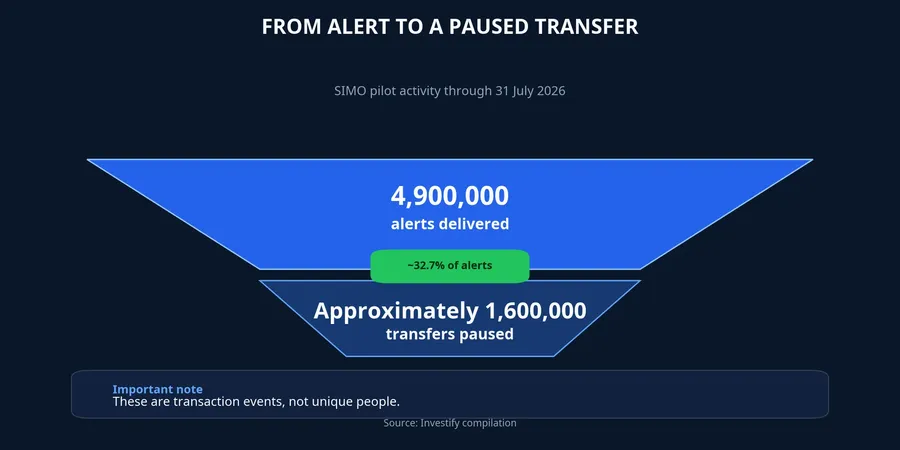
Put simply, SIMO does not need to be perfectly predictive to be useful. In a transfer driven by psychological pressure, a few minutes to leave the call, ask a family member, or find an official hotline can matter. The alert changes the user’s state from hurried compliance to deliberate checking. That is the gap a scammer usually tries to eliminate.
Where SIMO sits in a transfer
Under the published explanation of its operating mechanism, participating institutions can report suspicious accounts and share information through SIMO. Using that centralised data, credit institutions can warn customers, block a transaction, or ask for further authentication before an online transfer is completed.Báo Chính phủ
For a customer, the visible moment normally comes after entering recipient details. The system checks the information and displays a signal when an account needs caution. A participating bank has said that the customer retains the choice to continue or stop. A notice on the screen should therefore be treated as a prompt to verify, not evidence that the account holder has committed wrongdoing.
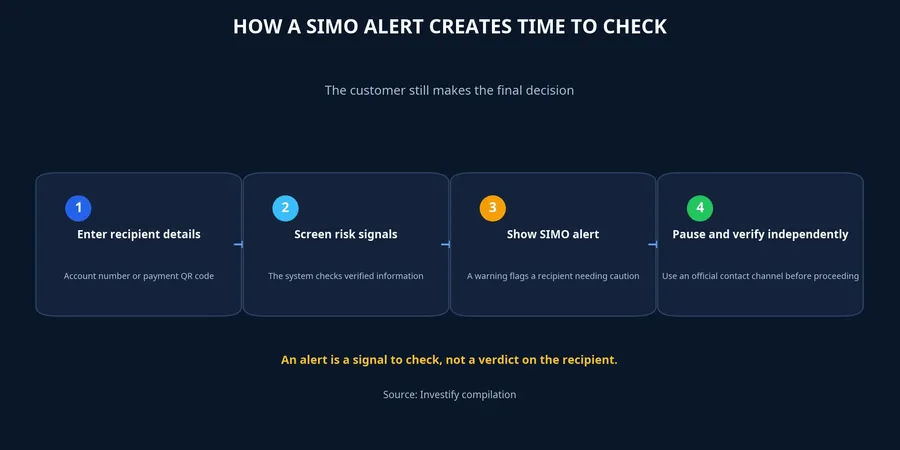
The reverse is also true: no warning does not mean a transfer is certainly safe. A recipient account may be new to the data, information may not yet have been updated, or fraudsters may rotate accounts quickly. Whether an alert appears or not, it cannot replace the sender’s own independent check.
The pilot’s scope also needs to be stated precisely. Through the end of July, SIMO was being piloted at 16 institutions: 13 commercial banks and three payment intermediaries. That does not mean every bank, e-wallet and transfer in Vietnam is screened in the same way; the State Bank of Vietnam said the system would continue to expand and move toward official industry-wide deployment.Người Quan Sát
What to do when a warning appears
First, do not press ahead merely to see whether the transfer will go through. Stop the transaction and end the communication channel creating the pressure. If the other party insists that the matter must remain secret, that the call cannot be ended, or that nobody else may be asked, the demand itself deserves caution.
Next, verify the recipient through a channel other than the one that delivered the request. A text asking for money should be checked by calling a number already saved in your contacts. Anyone claiming to represent a bank, brokerage, or government agency should be checked through the official hotline on the institution’s website or on your bank card, not a number supplied by the caller.
This matters especially to investors funding a brokerage account. Use only beneficiary details shown in the brokerage app or on its official website. Do not transfer money to a personal account because an adviser says they will “record it on your behalf”, even if the name seems familiar or the explanation sounds urgent.
Then compare the account holder name, receiving bank, payment reference and the real purpose of the transfer together. If doubts remain, contact the bank before money leaves the account. Never provide passwords, one-time authentication codes, or access to your phone. If a transfer has already been made and fraud is suspected, contact the bank and police promptly so that tracing can start sooner. That does not guarantee recovery, but delay usually narrows the available options.
A waiting period is a different layer of protection
A SIMO warning and a waiting period are not the same feature. The warning responds to a recipient account that displays suspicious signals. A waiting period creates additional thinking time for online transfers to a new beneficiary account when the customer elects to set up that service.
The distinction matters because the two layers answer different questions. A SIMO alert asks the sender to examine a particular recipient account. A waiting period gives the sender time to reconsider a new-beneficiary transfer even when no account-specific alert is displayed. Neither substitutes for checking who requested the payment and why.
At the briefing, the default setting discussed was VND 400 million with a minimum 24-hour waiting period. Customers can adjust the limit or choose not to use the service.Người Quan Sát Availability can vary by bank, so the reliable next step is to check your own banking app or call the official hotline.

A waiting period should not be treated as an “on equals safe” switch. People who regularly move money between a bank and a brokerage account need a limit that reflects genuine needs, so that protection does not obstruct legitimate transfers. Equally, setting the limit too high simply to make every payment faster can remove the very pause needed for a new or unusual transfer.
Conclusion: an alert is only the beginning
The SIMO story has a clear thesis: protection does not come from how often a warning appears, but from whether it makes the sender stop and verify. The pilot data records a meaningful share of transfer events being paused, yet it does not justify treating the system as an absolute shield or every alerted account as guilty.
The signals worth watching are therefore not a single on-screen prompt, but each person’s transfer discipline: verify the recipient through an independent channel, use only official funding details, and call the bank when something does not fit. SIMO can extend its reach and a waiting period can add a further layer. The best-protected money is still the money that has not left the account when the sender regains control of the decision.