
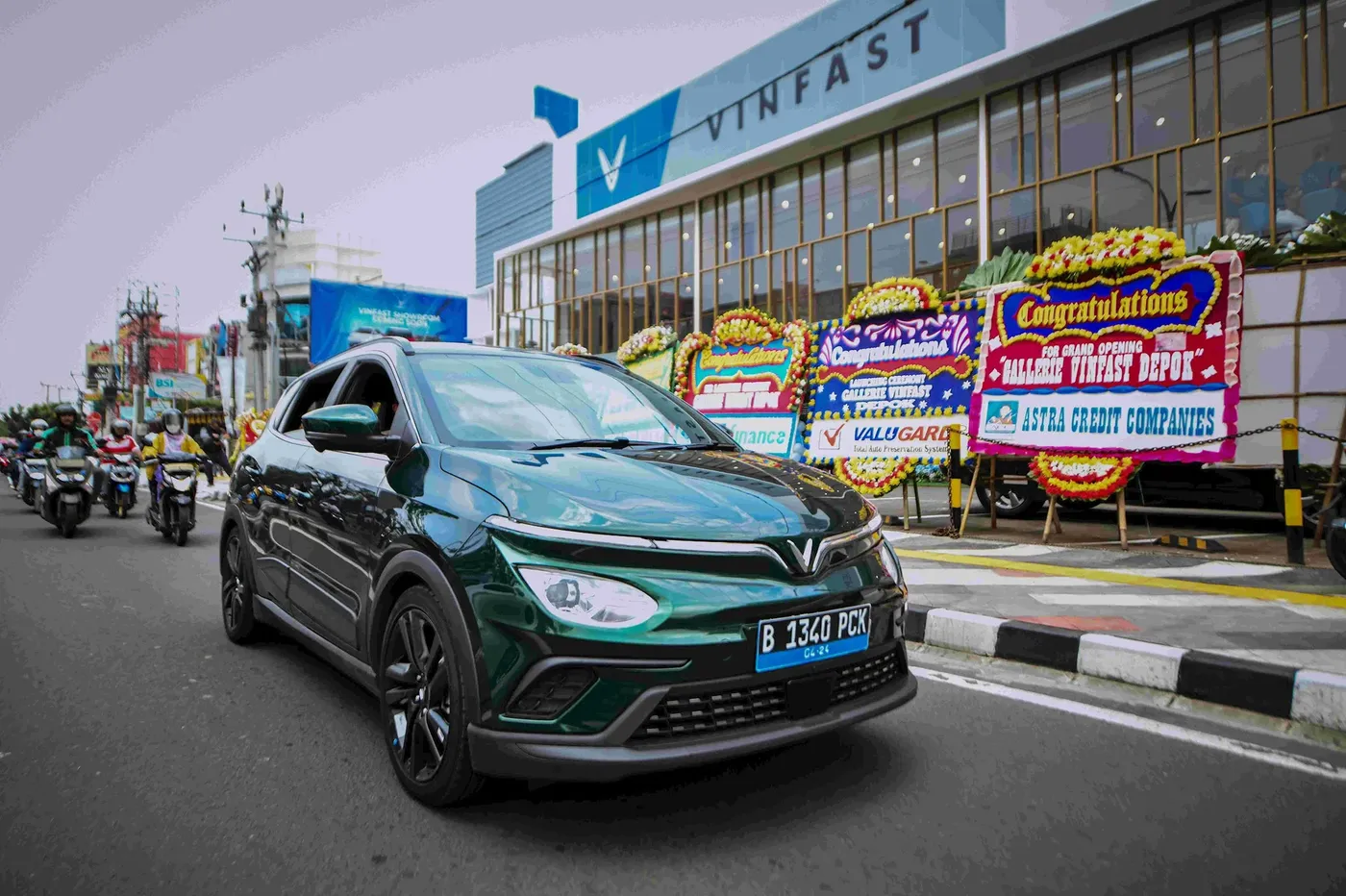

VinFast has expanded its Indonesian after-sales network to more than 100 authorised service workshops. It is a visible step forward, particularly for an electric-vehicle brand that is still new to the market. Investors should nevertheless separate a completed service capability from the outcomes it is meant to support: vehicle deliveries, margins and cash generation still require operating evidence.
The next useful observation point is 31 August 2026, the order deadline for VinFast Indonesia’s free battery-rental offer. The date does not, on its own, determine underlying demand. It creates a clearer test: as part of the promotional support changes, deliveries and support cost per vehicle should reveal how far the market can stand on genuine customer demand.VinFast Indonesia
What do more than 100 workshops solve for buyers?
For an EV buyer, the decision is not limited to the list price or driving range. They also need to know where a damaged vehicle will be repaired, whether parts are available, how long a repair takes and whether residual value will be protected. Good after-sales support is therefore not an accessory; it reduces the risks customers perceive before signing a contract.
On 11 August, VinFast signed memoranda of understanding with 10 automotive-service partners and said its Indonesian network had surpassed 100 authorised service workshops. Those facilities can provide maintenance, repairs, bodywork and genuine-parts distribution.Người Quan Sát That coverage matters because a buyer outside a major centre will be less inclined to choose a vehicle if every warranty visit requires a long trip.
Put simply, a workshop is a promise that a vehicle will be cared for after delivery. It can reduce anxiety about repair cost, downtime and resale value. A broad network does not, however, tell us how many vehicles are entering each workshop, whether it is producing service revenue or whether it is waiting for demand to arrive.
This is the distinction to retain when reading infrastructure announcements. A facility that has signed a partnership, one that is authorised and one that receives vehicles every day represent three very different economic states. Only the last begins to demonstrate repeatable commercial activity.
Incentives are removing early barriers
VinFast Indonesia’s current promotion page lists free battery rental for up to two years, subject to applicable conditions. For the VF MPV 7, it also lists free charging at V-Green through 31 March 2029, an 80% buyback-value guarantee subject to conditions and a seven-year vehicle warranty.VinFast Indonesia These are not duplicate offers under different labels. Each addresses a distinct concern for a prospective buyer.
Free battery rental lowers the initial cost of use. Free charging can improve the comparison with a petrol vehicle while customers are still becoming comfortable with charging infrastructure. A longer warranty reduces durability concerns, while the buyback commitment directly addresses a difficult question for a new brand: what will the vehicle be worth at replacement time?
These policies may improve customer conversion. Their benefit to buyers is not automatically a benefit to shareholders, however. Electricity cost may be borne by an ecosystem partner, supported by VinFast or shared under contract. Free battery rental may also defer early cash receipts. Until the company separately discloses how Indonesian programmes are funded and accounted for, it would be inappropriate to add the incentives together and infer a precise cost figure.
The three data points that turn reach into evidence
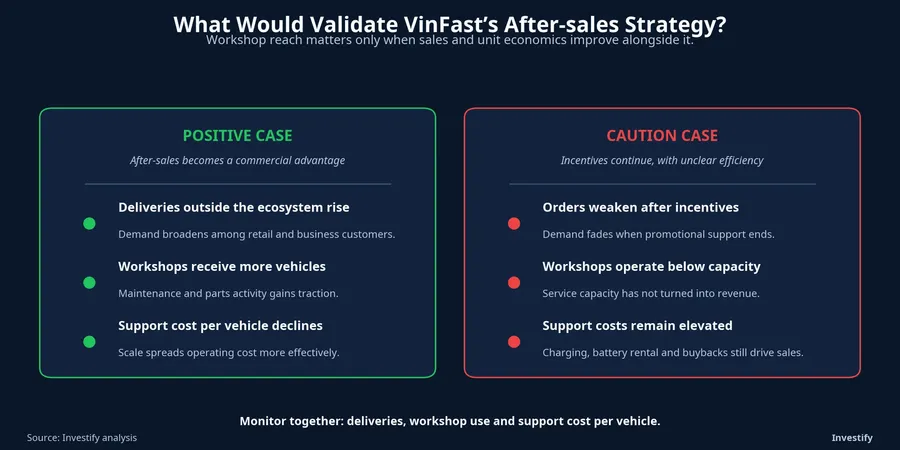
Investors do not need another slogan to assess the next stage. They need deliveries, workshop utilisation and support cost to be monitored together. Each answers a different question: are customers buying, are they using the system, and is growth becoming less costly?
First, look for Indonesian end-customer deliveries. Vehicles moved to a dealer do not prove demand if they have not reached the final customer. The disclosure becomes more informative if it distinguishes retail customers, commercial fleets and related parties. Higher deliveries to customers outside the ecosystem after the incentive period would be the most direct sign that early adoption barriers are easing.
Second, workshop utilisation is the bridge between a service-point map and genuine activity. Intake volume, maintenance revenue, parts revenue, repair time and parts availability all matter. If a city gains a workshop without a corresponding rise in deliveries or service visits, reach alone cannot establish a commercial advantage.
Third, track support cost per vehicle. Investors do not need every charging or battery-rental invoice to see the direction of travel. Over time, margins, revenue deductions, selling expenses and provisions associated with buyback commitments should show whether the support burden is falling with scale. Sales lifted by continuing incentives and sales sustained by product acceptance are fundamentally different stories.
Two cases to watch after the promotion period
In the positive case, after-sales coverage and incentives perform their intended market-launch role. Customers become less concerned about repairs, charging and resale value, allowing deliveries to rise. As the vehicle base grows, workshops receive more maintenance visits, parts turnover improves and operating costs have a better chance of being spread across more vehicles. At that point, network reach becomes more than a communications metric.
That relationship should not be treated as causal simply because more workshops open. Deliveries may also be shaped by product range, pricing, dealer execution, credit availability or demand from business customers. Regional data would test the proposition more directly: do areas with additional workshops also record more deliveries and service activity?
In the caution case, deliveries remain heavily dependent on free charging, free battery rental and the buyback commitment. Sales may still rise, while unit economics do not improve. Each additional vehicle could carry support cost for years, with workshops operating below capacity. Adding service points without utilisation data would make the gap between capacity and results harder to assess.
Demand after 31 August is therefore worth watching, but it should not be over-interpreted. The deadline does not end every incentive; the promotion page still specifies other model-level conditions. A change in orders is only an early signal. It must be assessed alongside end-customer deliveries, workshop efficiency and the trend in support costs before it can support a reliable conclusion.
Conclusion: the infrastructure exists; efficiency needs evidence
The current thesis is straightforward: VinFast has improved its ability to serve customers in Indonesia, but public evidence is not yet sufficient to treat more than 100 workshops as proof of commercial efficiency. This is not a negative judgment on the network. After-sales infrastructure is an important condition for an EV brand to overcome a trust barrier.
The picture would change if three signals emerge together: deliveries to customers outside the ecosystem rise, workshops see greater use and support cost per vehicle trends down. One signal alone would not complete the story. Operating disclosures after the incentive period should clarify whether Indonesian coverage is becoming a more durable commercial advantage or remains capacity that has been built ahead of demand.