

More than $500 billion is the kind of number that can make it sound as though Nvidia has just received a vast new pool of cash. That is not what the August 10 announcement says. It describes independent financing platforms, built with major financial institutions, that aim to mobilize third-party capital for AI-computing infrastructure over time. For a new investor, the key is to separate three ideas: a funding target, committed capital, and reported revenue.Nvidia
Put simply, Nvidia is helping create another route through which its customers can finance data-center construction. That route could make purchases or leases of Nvidia-based systems easier to fund. But a new route is not the same thing as traffic moving through it, and it is certainly not the same thing as revenue in Nvidia’s accounts.
What the financial partners are building
Nvidia says it is partnering with Apollo, BlackRock, Blackstone, Brookfield, Goldman Sachs, and KKR to establish independent financing platforms. Their shared objective is to mobilize more than $500 billion of third-party capital to support the buildout of AI infrastructure. The words “aim to mobilize” matter: this is an aggregate target for several future platforms, not a single fund that already holds the money.Nvidia
Each participant brings a different capability. Apollo highlights flexible, long-term capital; BlackRock focuses on linking long-dated capital to infrastructure; and Brookfield points to building and financing infrastructure. Goldman Sachs refers to investing, distribution, and the development of credit markets secured by Nvidia compute, while KKR brings long-term capital, infrastructure experience, and capital-markets capability. Blackstone emphasizes its position as a major investor in the Nvidia ecosystem.Nvidia
That is different from six institutions sending money to Nvidia. The disclosed role is to create funding structures for customer projects. The end users of capital could be AI labs, cloud-computing companies, data-center developers, or businesses leasing compute capacity, depending on each platform’s terms.
Capital must pass through several gates
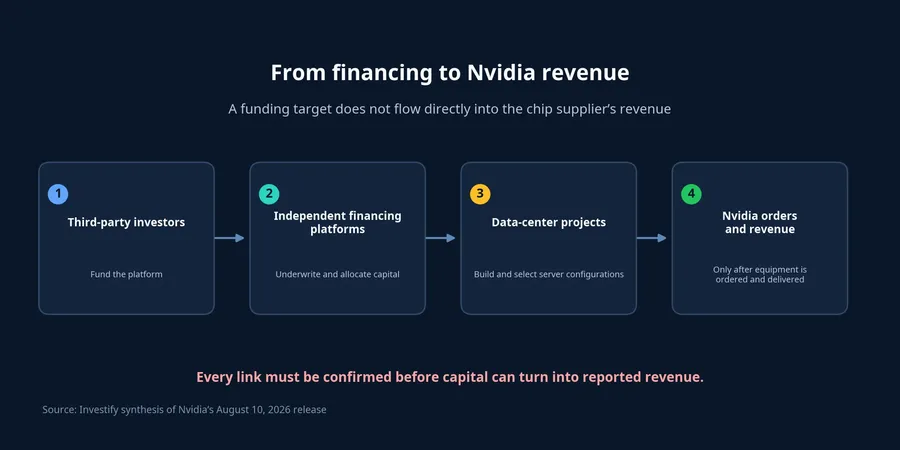
The path of the money explains why the $500 billion figure cannot be called revenue. First, institutional investors, insurers, or lenders need to fund a platform. The platform then needs to underwrite individual projects: who will lease the compute, what cash flow is expected, what collateral is available, and whether power supply and the construction site are viable.
Once a project is approved, capital can be committed and then disbursed according to its build schedule. The project must still choose a server configuration and suppliers. An Nvidia order exists only when a project orders equipment that uses Nvidia technology. Revenue follows only when delivery and the relevant contractual obligations have been met.

This is why it would be unsound to multiply the funding target by an arbitrary percentage and treat the result as an Nvidia revenue forecast. A data center also requires land, buildings, power, cooling, networking, servers, and many other components. Even the server portion does not automatically belong to Nvidia, and a project’s financing size says nothing about when equipment will be delivered.
Assets under management are not committed capital
The release cites the scale of several partners’ assets under management to show their ability to access capital. Apollo managed approximately $1.05 trillion as of June 30, 2026; Blackstone managed more than $1.3 trillion; and Brookfield managed more than $1 trillion. Those figures show the partners’ scale, but they do not state that all, or any specified portion, has already been allocated to Nvidia’s new platforms.Nvidia

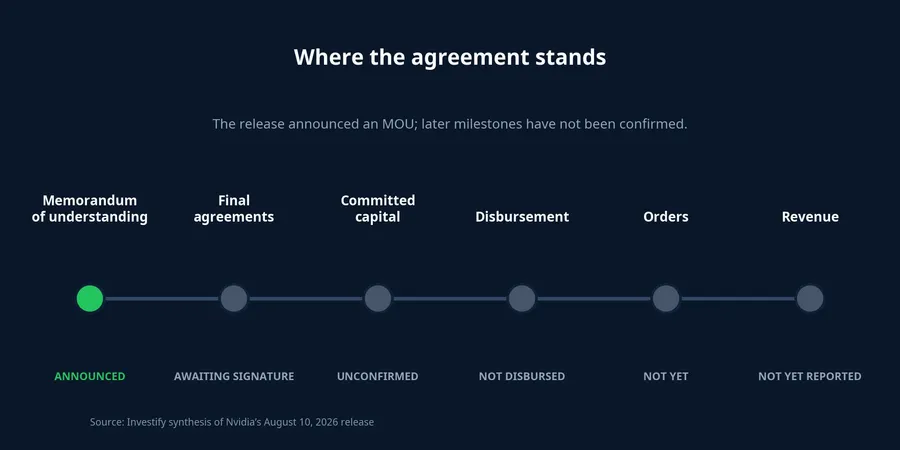
This distinction is useful for any investor. Assets under management measure the resources an institution manages for funds and clients; they are not a cash balance that can automatically be deployed into one transaction. Committed capital is the amount investors have agreed to make available to a specific structure or project. Disbursement is money actually transferred on a project schedule. These are three different layers.
The release also says the partnerships remain subject to final agreements. The disclosed milestone today is therefore a memorandum of understanding, not evidence of final contracts, committed amounts for individual platforms, or funds already disbursed to projects.Nvidia
The positive signal is financing capacity
The absence of reported revenue does not make the announcement meaningless. AI infrastructure requires enormous capital and a long payback period. If the new platforms help customers secure longer-dated funding or lower their cost of capital, projects that previously failed to clear financing requirements could move forward. Nvidia could then benefit indirectly because more customers can buy or lease compute built on its technology.
This is also a notable shift in how infrastructure can be financed. Instead of a technology company using its own cash or carrying all debt on its balance sheet, capital can be placed into project-level structures. Lenders can assess compute assets, lease contracts, and project cash flows. Such a structure can suit long-lived assets, but it still depends on whether end users pay consistently for the service.
Two explanations can therefore coexist. Strong demand for compute may be drawing financial institutions toward long-term cash flows. Equally, the cost of building AI infrastructure may have become high enough that some customers need an additional layer of financing. The current announcement does not provide enough evidence to assign a precise weight to either explanation.
Test the risks before reaching a conclusion
The risk also needs to be named precisely. If a technology supplier invests in, guarantees, or extends credit to customers who then use that money to buy the supplier’s products, the market may question the quality of demand. The revenue may still be valid, but the durability of customer cash flows becomes central to the analysis.
The current release, however, describes third-party capital and independent platforms. Its text does not support a conclusion that Nvidia has funded or guaranteed the full $500 billion. That is a condition to examine in final agreements, not a fact to assume today.Nvidia
The thesis is straightforward: this partnership improves the potential for Nvidia’s customers to obtain financing, but it does not increase revenue already reported. Watch for three forms of evidence: final agreements and committed capital for each platform, approved projects and disbursements, then orders and revenue in Nvidia’s financial statements. Until those milestones appear in the data, the $500 billion remains the target size of a funding pipeline.