


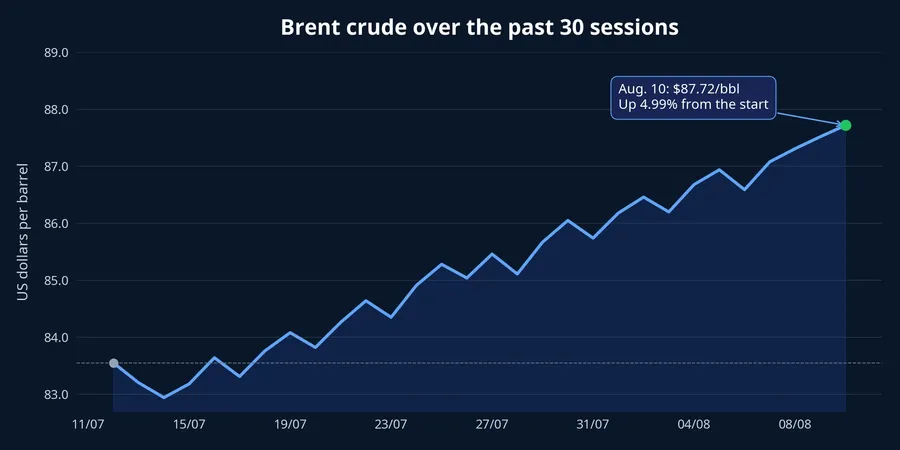
Brent crude rose from $83.55 to $87.72 a barrel in the August 10 session, a gain of 4.99%.AP That is large enough to change a Vietnamese investor’s pre-market checklist. It is not, however, a verdict on the VN-Index or a ready-made explanation for every oil-and-gas stock.
The first task is to understand what this move represents. The available evidence points to supply risk: the reopening of the Strait of Hormuz remains uncertain, and Iran has attached further conditions to resuming the shipping route. A transport-driven shock reaches markets differently from an oil rally led by recovering global demand. The central thesis is straightforward: the rise in Brent calls for testing transmission channels, not for immediately assigning a broad market-trading conclusion.

Oil is pricing a supply-risk premium
Oil is priced not only on the barrels available, but also on whether those barrels can reach buyers. The Strait of Hormuz has carried about one-fifth of globally traded oil and gas.AP When the timing of its reopening becomes harder to assess, buyers need to factor in delayed delivery, higher insurance costs and longer waiting times for vessels.
That is why a shipping-route update can move oil so quickly. An oil price rise driven by demand tends to signal an economy using more energy. By contrast, a rise driven by supply risk makes inputs more expensive while potentially weighing on growth. Both stories can produce a higher Brent price, but they do not carry the same implications for corporate earnings or inflation.
Still, one session does not establish a cycle. Intraday oil moves are also influenced by positioning, short covering, the US dollar and inventory data. August 10 is consistent with a Hormuz-risk explanation, but it does not prove a new oil bull cycle. The market needs time to test whether Brent can hold its new range as news on shipping conditions changes.
The broader market response was not a sell-off
Calm reading of the data matters more than urgency. In the same August 10 session, the S&P 500 fell 4.53 points, or 0.1%, to 7,753.11.AP That decline was far smaller than oil’s move. It suggests more caution among global investors, not a wholesale exit from risk assets.
For the same reason, a modest early move in Vietnam’s benchmark cannot by itself prove that the oil shock has spread through the entire market. The VN-Index closed August 10 at 1,776.77, up 8.71 points or 0.49%. This internal-database figure is a reference point ahead of the new session, rather than a forecast for what follows.
New investors should look beyond the index colour to breadth and turnover. If only a few oil-related names rise while most shares remain steady, the impact is still localised. If fuel-intensive sectors weaken as breadth narrows and turnover increases, the risk-off narrative has more confirmation.
The exchange rate is an earlier check than CPI
International oil does not flow directly into Vietnam’s CPI overnight. It passes through import prices, the exchange rate, freight costs, domestic fuel-price adjustment cycles and companies’ ability to pass costs to customers. Those buffers explain why a dramatic oil headline is not enough to say inflation has returned.
The exchange rate is often the earlier check. If oil rises while USD/VND also rises, importers pay more for the same barrel and then pay more again when converting into Vietnamese dong. On August 10, USD/VND stood at VND 26,162.50 per US dollar, down 0.21% from the prior session. That does not confirm a double squeeze on import costs.
Put simply, oil is the first signal and the exchange rate is the second test. Retail fuel prices, orders, margins and CPI data come later. If Brent cools quickly or the exchange rate remains stable, some of the initial pressure may not travel as far as the headline implies. If oil stays high while USD/VND rises, the chain of evidence warrants a more cautious reassessment.
Oil-and-gas companies do not share one earnings mechanism
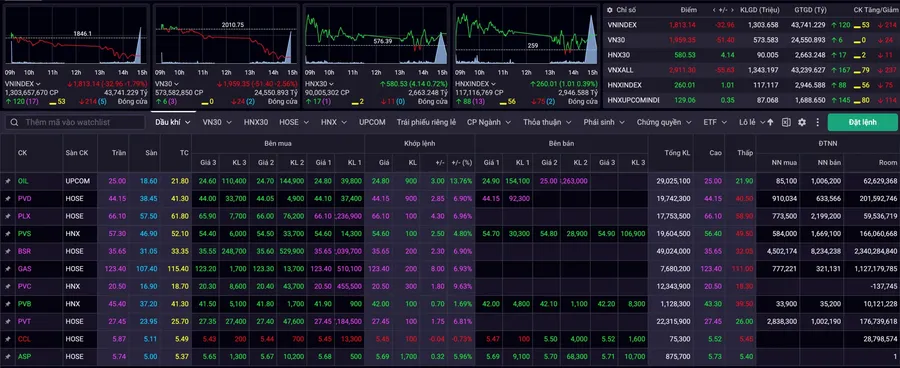
It is a common mistake to group the entire energy chain as beneficiaries. Producers may benefit when selling prices, volumes and costs allow higher oil prices to flow into earnings. Drilling and technical-service companies, however, also need orders, equipment day rates and project progress. A one-session Brent increase does not automatically create new revenue for PVD or PVS.
For a refiner such as BSR, crude is an input. Results also depend on the spread between refined products and crude, inventory composition, operating utilisation and the timing of selling-price adjustments. Higher oil can support inventory gains in some periods, but it can also increase working capital or compress refining margins. Treating Brent as a direct proxy for BSR earnings is too simple.
PVT and GAS sit at other points in the chain. Oil shipping is shaped by freight rates, distance, contracts and fuel costs; gas companies are affected through price formulas, volume and customer demand. On the other side, airlines, road transport and energy-intensive manufacturers may face higher costs. The eventual impact depends on hedging, competitive conditions and the ability to adjust selling prices.
These distinctions are not a way to predict which ticker will rise today. They help frame the right question: does the company sell oil, service the industry, or buy fuel to operate? The answer determines the next data point worth watching, and prevents a broad commodity headline from replacing company-level analysis.
Three signals to watch in the new session
First, watch Brent itself. Early August 11 data put Brent at $87.87 a barrel. This is a live reference price, not a closing level, and it can reverse quickly on new Hormuz developments. Whether it holds or loses the $87 area is more informative than a headline about the previous day’s gain.
Second, watch the exchange rate and the response of fuel-intensive sectors. Rising oil without a parallel USD/VND increase indicates that conversion pressure has not worsened. For equities, read price and turnover together. A strong open that fades is very different from a sustained move confirmed by money flow and the company’s own earnings outlook.
Third, watch market breadth. If a few oil-linked names rise while other sectors are undisturbed, the story remains one of dispersion. If fuel-intensive groups fall together, turnover rises and the index weakens, the risk may be broadening. These signals do not guarantee a direction; they separate a headline response from a material repricing.
The conclusion is that a 4.99% oil move should not replace a data-checking process. The picture becomes more adverse only if oil stays elevated, the exchange rate turns unfavourable and the market response spreads into cost-sensitive sectors. Until those links appear together, the appropriate frame is to follow the transmission mechanism and individual businesses, rather than treating Brent as a buy-or-sell signal for an entire portfolio.