


A factory, road, or infrastructure project can take years to produce enough cash to repay its funding. The bank deposits used to finance it may mature in just a few months. That difference in timing is why banks remain central to the economy, but cannot be expected to carry all medium- and long-term funding on their own.
As of July 31, outstanding credit in the economy was nearly VND 20.3 quadrillion, up 8.98% from the end of 2025. The scale shows that lending capacity has expanded, yet it does not erase the maturity problem.Vietstock The aim is not to replace banks. It is to build a capital market trustworthy enough to share the part of long-term funding that belongs there.
What a maturity mismatch means
Put simply, a bank sits between two promises. Depositors can withdraw or decide not to renew when their deposits mature. Borrowers building long-lived assets need time before those assets operate and generate cash. When deposits roll over normally, a bank can manage that difference. Pressure arises when short-term funding leaves faster than expected or when the cost of replacing it rises.
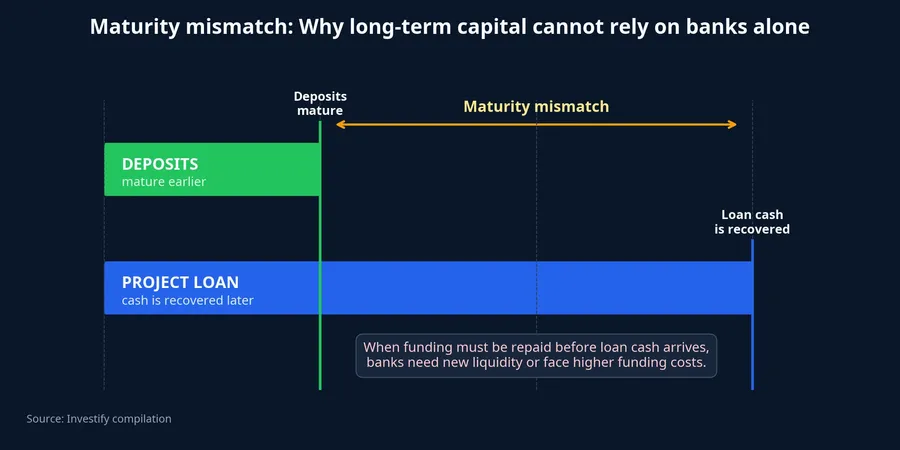
The bank must then find new funding to keep a long-term loan on its balance sheet. Its funding cost can rise, and its ability to meet payments on time becomes more important. This is liquidity risk. It does not mean that a sound project suddenly becomes a bad loan; it means that the date money must be repaid does not match the date loan cash arrives.
That is why prudential rules do not allow banks to use unlimited short-term funding for medium- and long-term lending. Reporting from the August 10 meeting said the maximum ratio had been raised to 40%.Vietstock A higher limit creates room to lend, but it does not turn short-term deposits into long-term capital by nature.

The issue becomes clearer when large projects require large sums. Information presented on August 10 put the additional funding need of 35 priority projects at approximately VND 1.7 quadrillion.Vietstock That does not mean every project should be bond-funded. It explains why concentrating all multi-year funding needs on bank balance sheets grows harder over time.
How bonds connect capital to projects
A bond is a direct lending contract: a company receives money from investors and commits to a defined schedule of interest and principal payments. If a project needs years to generate cash, a bond with a comparable term can better align the use of funds with the commitment made by the provider of capital. Banks can then play other roles instead of holding the entire long-term debt exposure.
Not every bond, however, is long-term capital. A short-dated issue used to roll over debt or cover a temporary cash shortfall does not solve a project's maturity mismatch. When reviewing an issue, three questions belong together: what is its actual tenor, what will the money fund, and when will that asset generate cash?

The market should not be judged by gross issuance alone. Companies may issue new bonds while buying back or repaying older ones. More useful measures are the net capital that remains, its term, and whether it funds new productive capacity or merely replaces an imminent obligation. That is the difference between a bigger pile of paper and stronger long-term financing capacity.
Yield is the easiest part to see
For a new investor, the coupon is usually the most visible number. The more decisive question is where the interest and principal payments will come from. Are sales, service fees, or operating cash flows stable and large enough to meet them? If the answer relies mainly on issuing another bond or selling an asset at an uncertain time, refinancing risk may be higher than the yield makes it appear.
Collateral should also be viewed as a recovery route in a bad outcome, not as an automatic safety label. Investors need to know who owns the asset, whether it secures other obligations, whether the security interest is registered, and who can enforce it after a breach. A valuation in a file is not necessarily the amount that can be realised when the bond comes due, especially for an illiquid asset.
Bond terms are often overlooked, yet they define a buyer's rights. Review early-redemption conditions, payment priority, disclosure obligations, and the procedure for bondholder consent. A bank or securities company distributing a product does not automatically guarantee payment. In a discussion of draft legal amendments on August 9, National Assembly delegates called for clearer separation between issuance agency, payment guarantee, and collateral-management roles so customers are not misled.Tuổi Trẻ
Credit ratings are useful because they describe risk through a more consistent method. They do not replace analysis of cash flow and terms, and they are not a promise that an issuer will pay on time. A rating is an input for asking better questions, not a stamp of safety.
What upcoming maturities tell us
Corporate bonds worth VND 106,155 billion mature in the final five months of 2026, including VND 59,621 billion from real-estate issuers, or 56.2% of the total.TCTD.vn This is not a verdict on the whole market. It is a clear reminder that long-term funding is durable only when repayment schedules fit the cash generated by the business or financed asset.
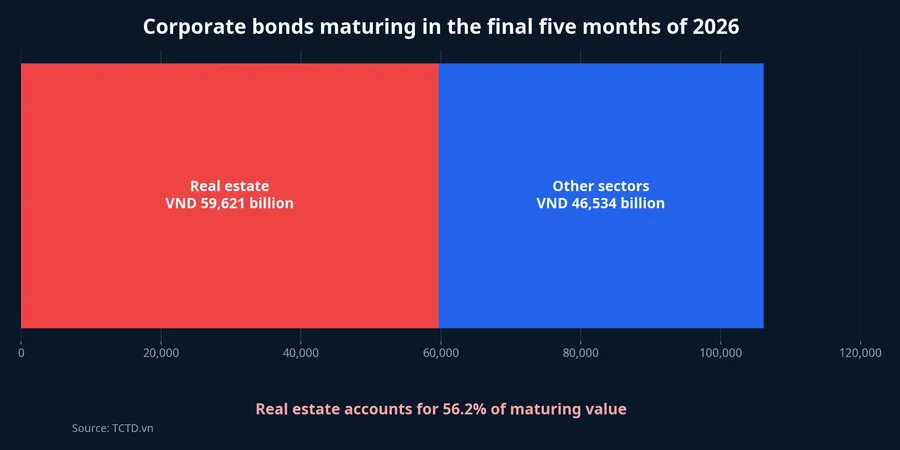
When an issuer repeatedly needs another buyer for the next bond to repay the last one, the obligation may be extended rather than solved. Investors should distinguish planned refinancing backed by verifiable cash flow from a rollover that merely buys time. They can look similar on issue date, but their eventual repayment capacity is very different.
A market needs gatekeepers
A mature bond market needs more than additional buyers. It needs issuers to disclose complete information, distributors to state their roles clearly, collateral managers to have defined duties, and workable remedies when an issuer breaches its commitments. VTV reported on August 10 that new rules assign provincial People's Committees to monitor issuance, inspect and handle violations by local issuers, and report periodically to the Ministry of Finance.VTV
Oversight does not make credit risk disappear. It can help identify inaccurate disclosure, improper use of proceeds, or conflicts of interest before the cost reaches buyers. Investors still need to read the documents themselves: supervision is a common guardrail, not a substitute for an individual decision.
The central point is straightforward. Banks should remain the main funding channel, while bonds should share the financing of projects that need time. That sharing works only when bond terms match the asset, repayment sources can be verified, and bondholder rights can be enforced. The next signals to watch are maturities being paid, disclosure quality, and how intermediaries explain risk to buyers. Those checks matter more than a headline coupon.