


VN-Index closed at 1,776.77, up 8.71 points or 0.49%. That makes Aug 10 an up day. For newer investors, however, the more useful question is not simply whether the index was green: it is how broadly that green was shared and whether it held into the close.
The session delivered a constructive but qualified message. HOSE breadth leaned decisively toward gainers, while the index surrendered part of its intraday advance late in the day. Those observations are not contradictory. They point to broad participation, but leave the strength of closing demand unconfirmed.
An index is not the whole board
Think of VN-Index as a scale on which large-cap companies carry heavier weights. A price move in a large constituent can shift the index more than small moves across many smaller names. Market breadth measures something else: it counts advancing and declining stocks, with each ticker counting once.
That distinction explains why many stocks can be rising while the index is flat, or why the index can retreat from its high without a broad market reversal. The two measures are describing different layers of the same session. Reading only the index risks missing whether the move is concentrated in a few heavyweights or shared more widely.
This also helps avoid a common mistake: treating an intraday screen shot as a verdict on the whole day. A screen captures a moment, not the durability of the move. It cannot show whether buying interest remains when prices are tested later, or whether a handful of large names are masking a narrowing market beneath the index.
At 9:45 a.m., VN-Index was down by more than two points even though the market had 301 gainers and 160 decliners. By 11:30 a.m., the index was up more than 12 points, with 385 gainers and 194 decliners. Breadth was therefore positive early, before the headline index fully reflected that condition.Người Quan Sát

The closing breadth was clearly positive
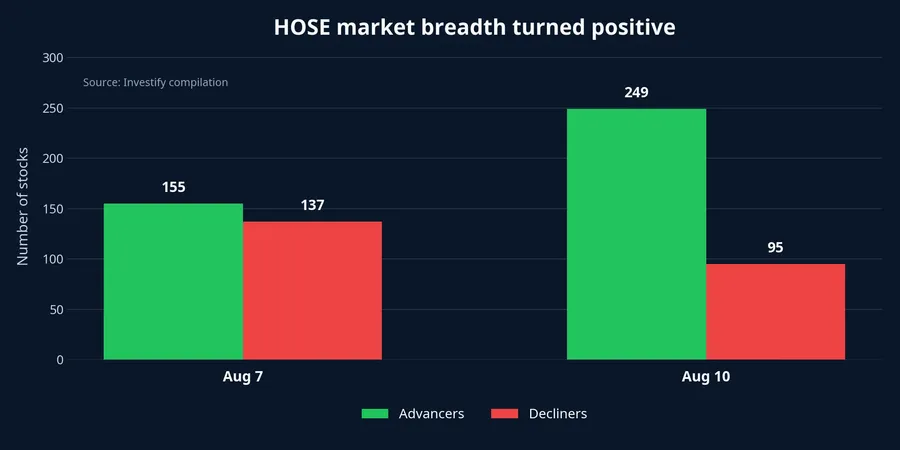
At the close, HOSE recorded 249 gainers, 95 decliners, 12 limit-up stocks and two limit-down stocks. That puts the advancing-to-declining ratio at about 2.6 to 1. For an investor learning to read the market, this is more informative than the headline point move because it indicates that strength extended beyond a handful of tickers.
Compared with Aug 7, the number of gainers rose from 155 to 249 and decliners fell from 137 to 95. That comparison supports the view that the advance had breadth. It does not mean every sector was equally strong, nor does it prove that prices could hold their intraday highs.
Breadth is best treated as evidence of participation rather than a buy signal. A broad session can still be followed by consolidation, and a narrow session can still finish higher if large constituents are strong. Its practical value is as a cross-check: it tells investors whether the index’s message is being echoed by a meaningful share of the board.
Early in the afternoon, 28 stocks across the market were at their daily price limit, including GAS, GVR, DCM and IJC. The 12 limit-up names on HOSE at the close are a different universe, so the two figures should not be compared as if they were like for like. What the data does establish is that a visibly enthusiastic phase emerged during the afternoon.Người Quan Sát
How a broad market can coexist with a softer index
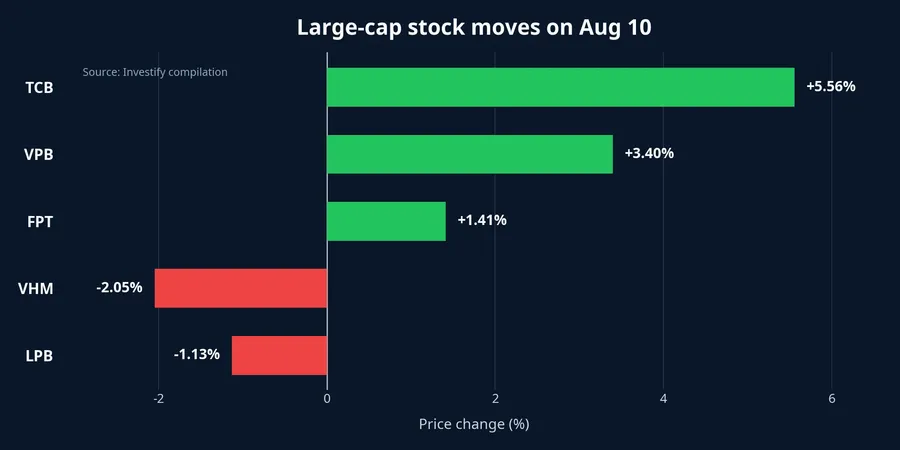
Among large caps, TCB rose 5.56% to VND 31,350 per share, VPB gained 3.40% to VND 25,850 and FPT added 1.41% to VND 71,800. These were meaningful supports for the index. On the other side, VHM fell 2.05% to VND 71,500 and LPB declined 1.13% to VND 52,300.
When high-weight constituents move in opposite directions, or when some of the leaders give back part of their gains, VN-Index can lose momentum even while a large number of smaller stocks remain positive. A retreat from the intraday high is therefore not proof that sellers controlled the whole market. The closing breadth shows that buyers remained present across a wider set of stocks.
There is no basis in the session data to assign one definitive cause to the late index moderation. Normal profit-taking in a few heavyweights is one plausible explanation; differing flows across sectors are another. What is observable is the combination of a lower close than the intraday high and a breadth reading that stayed positive, not a single confirmed causal chain.
The advance was not confined to banks. GAS rose 6.97% to VND 79,800, GVR gained 6.89% to VND 31,800, BCM added 6.99% to VND 41,300 and IJC rose 6.87% to VND 7,930. GEX gained 6.31% to VND 26,100, close to but not at its daily limit. This strengthens the breadth reading, although it does not establish a single driver for each stock: company news, sector flows and short-term trading can all matter.
Liquidity measures participation, not the late winner
VN-Index trading volume reached 732,713,082 shares, above 647,697,546 in the prior session. The implied increase is about 13.13%. In plain terms, activity improved, so the green close did not occur on an unusually thin board.
Still, a full-day volume total cannot determine who had the upper hand in the final hour. Higher turnover may reflect demand absorbing supply, but it may also reflect profit-taking at higher prices. The distinction requires time-matched data on price, breadth and volume, rather than a backward inference from the closing total.
For a simple daily routine, investors can compare the board at the same checkpoints across sessions: mid-morning, early afternoon and the close. They should use the same market universe each time, rather than mixing an all-market intraday count with a HOSE-only closing count. That small discipline makes the comparison more meaningful and prevents a convincing-looking number from answering the wrong question.
A trading screen filled with green and purple can be compelling. For an actual portfolio, the more useful test is whether leadership names retain their higher price ranges and whether breadth narrows sharply near the close. That is why volume should be read alongside price direction, not in isolation.
Three signals to follow next
First, compare breadth at the same time of day. If gainers expand in the morning but contract quickly in the afternoon, buying agreement is fading. Breadth that remains intact into the close offers a firmer base for the price move.
Second, watch whether leadership stocks such as TCB, VPB, GAS, GVR, BCM and IJC can hold their higher ranges. If they do so while the number of gainers stays elevated, there is more evidence that buyers are defending the move. If only a few heavyweights remain strong while most stocks fade, the index may look better than many portfolios feel.
Third, assess turnover during defended price moves. Rising volume while prices hold has a different implication from rising volume as prices slip. No single indicator can replace reading these three signals together.
The Aug 10 thesis is positive but conditional: breadth confirms that the advance was broad, while the late narrowing in VN-Index leaves closing demand unconfirmed. The next session will provide stronger evidence if breadth does not contract quickly, leadership holds its price range and turnover accompanies defended prices. Missing one of those signals does not prove that the market will fall, but it does mean the intraday green should not be treated as confirmation for the entire day.