


An AI company can be valued at USD 35 billion after raising USD 3.5 billion. Put together in one headline, those figures can look like USD 35 billion has just landed in the company’s bank account. It has not. The new cash entering the business is USD 3.5 billion; USD 35 billion is the implied value of the entire company after the transaction. Moonshot AI offers a particularly clear example of the distinction.Bloomberg Law
Think of a home valued at VND 10 billion. That valuation does not put VND 10 billion in the owner’s account. It is an estimate of what the whole home is worth; cash changes hands only in a specific transaction. The same separation matters for technology companies, especially when large AI numbers are competing for attention.
Two figures that answer different questions
Capital raised is the money investors actually contribute in a funding round. It can pay engineers, buy computing capacity, develop products, rent infrastructure, or fund commercial expansion. It becomes a balance-sheet resource, although the accounting timing depends on the transaction structure.
Valuation answers a different question: what price are investors willing to place on all of the company’s equity? If an investor buys a small stake at a stated price, that price is extrapolated to estimate the value of the whole business. It is an inference from a transaction, not a cash receipt for the company.
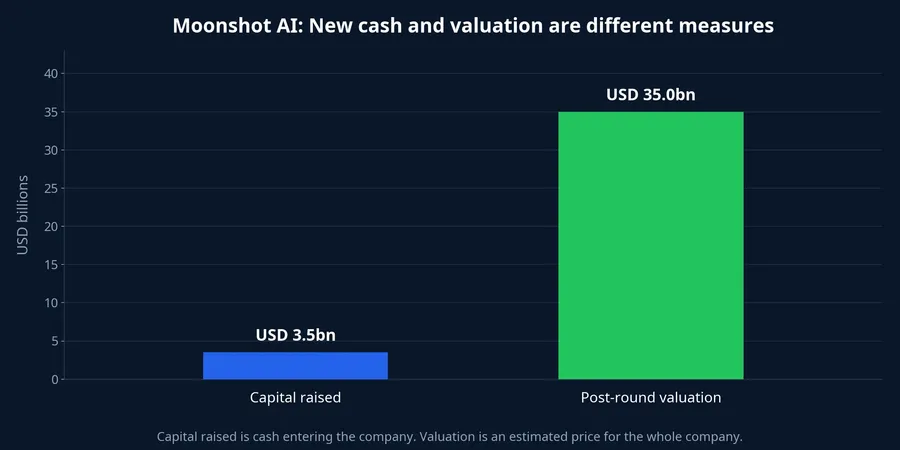
Moonshot AI reportedly closed a USD 3.5 billion financing round at a USD 35 billion valuation. The tenfold gap does not mean it has USD 35 billion to spend. It means investors in that round accepted an equity price far above the amount of fresh cash injected into the company.Bloomberg Law
Why capital markets can resemble a vast cash pool
When a country is described as having large stock and bond markets, it is tempting to picture a pool of money that can simply be opened and allocated to an industry. That picture is misleading. Equity market value is the number of shares outstanding multiplied by their trading price, so it can change every day without a company receiving any new capital.
A higher share price increases a company’s market value, but cash does not automatically flow into its account. A company receives new capital only when it issues shares, sells equity in a private round, completes an initial public offering, or executes another financing transaction. Market prices and balance-sheet cash are connected, but they are not interchangeable.
Bond markets require the same discipline. Outstanding bonds represent loans already issued to many borrowers for many purposes. An AI company receives resources only when it, or a lender financing it, completes an issuance and receives the proceeds. The loan then carries interest, a maturity date, and a repayment obligation.
This is why a headline about the size of a capital market should be read as evidence of financing capacity, not a line item in an AI company’s accounts. Deep markets can make it easier for companies to raise equity, borrow, list shares, or sell assets. They do not tell us how much of that capacity has been committed to a particular technology, on what terms, or whether the money has reached operating teams.
The distinction is useful for avoiding another common error: treating market capitalization as money available for spending. A listed company may become more valuable on paper because its share price rises, while its cash balance remains unchanged. Conversely, a company can raise substantial capital and still trade at a lower valuation if investors reassess future growth. One measure reflects an assessment of ownership; the other records a financing event.
From funding story to revenue-generating capacity
For deep technology businesses, a funding round is usually the beginning rather than the result. A laboratory may need time to turn a model into a product, build infrastructure, find customers, and show that the cost of serving each customer does not outpace revenue. Large funding therefore does not automatically mean large profits.
That point matters especially in artificial intelligence. Computing, staff, and data costs can arrive first, while revenue takes time to develop. A company that raises capital successfully may have a resource advantage; that is still different from proving a durable business model. Both statements can be true at the same time.
Investors should also resist assigning a valuation move to a single cause without evidence. A funding round may reflect product quality, market expectations, competition for ownership, or the liquidity conditions facing investors. Without transaction-level information, it is not possible to assign an exact contribution to each factor.
There is also a trade-off in every funding structure. New equity can extend a company’s runway without a fixed repayment schedule, but it dilutes existing shareholders. Debt can preserve ownership, but it adds interest expense and a maturity obligation. A company with an impressive fundraising announcement is therefore not necessarily in a stronger position until readers know the instrument, the terms, and the use of proceeds.
For early-stage AI companies, an additional layer is the distance between technical progress and commercial proof. A more capable model can improve the product, but it may also require larger infrastructure spending. Revenue growth, gross margin direction, customer retention, and operating cash flow offer more direct evidence of whether a model is becoming a business. They are more informative than a valuation headline alone.
Four questions before accepting a funding headline
Instead of starting with “what is the company worth?”, work from real cash to real results. First, how much new money was raised, and has it actually closed or is it only a target? Second, what did the company give up for that capital: equity, debt, or another instrument? Each creates different costs and claims.
Next, what is the money intended to fund? Capital allocated to computing capacity means something different from capital used for acquisitions, debt repayment, or sales expansion. Finally, track revenue, profit margins, and operating cash flow. Together, those measures show whether capital has moved from an announcement through the balance sheet and into value creation.
It can help to keep a simple timeline. At the announcement stage, the relevant facts are the proposed amount, investors, and instrument. When the round closes, the focus shifts to cash received and ownership changes. Over the following quarters, operating disclosures should show how the company deployed the money and whether that spending improved its product, customer base, or economics. Each stage answers a different question, so no single headline can substitute for the full sequence.

This framework is not limited to Chinese companies. When a Vietnamese or global business announces a valuation, market capitalization, or fundraising plan, the same filter applies. Do not add concepts measured in different units to create a story larger than the underlying data.
The conclusion is straightforward: valuation signals expectations, while capital raised is a resource a company can use. Expectations may help an AI business access funding on better terms, but they cannot substitute for revenue, profit, and cash flow. The next operating reports and financial results will show how much value that capital has actually created.