


A notice saying “20% dividend” naturally sounds substantial. For MCH, though, that figure first means VND 2,000 per share. Using the VND 136,900 closing price on August 7 as an illustration, the payment represents a gross dividend yield of about 1.46%, not a 20% return on the purchase price.
The distinction is straightforward: the announced percentage is calculated from par value, while yield measures cash received against the capital an investor paid. The denominators are different. Mixing them up can turn a prominent percentage in a corporate notice into an unrealistic expectation.
Start by converting 20% into cash per share
MCH's first 2026 interim cash dividend is stated as 20%, equal to VND 2,000 per share. The conversion shows that the stated rate uses the VND 10,000 par value: VND 10,000 multiplied by 20% equals VND 2,000. Whenever a dividend is presented as a percentage, the first useful step is to convert it into cash per share.
The cash amount is the number that can be compared with an investor's purchase price. A holder of 100 MCH shares is entitled to a gross dividend of VND 200,000. A holder of 1,000 shares is entitled to VND 2,000,000. The 20% stated rate is the same in both cases, but the cash flow depends directly on the number of shares held.
This also prevents a common confusion: par value is not the market price. The par value in the company's calculation is VND 10,000, while investors buy MCH at a market price. Because that purchase price may be far above or below par value, investors will not earn the same yield.
Yield must be measured against cost basis
Gross dividend yield equals the cash dividend per share divided by the purchase price per share. At the illustrative August 7 close of VND 136,900, VND 2,000 divided by VND 136,900 equals about 1.46%. That is the more useful ratio when comparing an investor's own cost basis with other investments.
Buy below VND 136,900 and the yield on cost is higher than 1.46%. Buy above it and the yield is lower. Two accounts can therefore experience the same announcement very differently simply because they bought at different times. The bold percentage on the notice should never replace an investor's own cost basis.
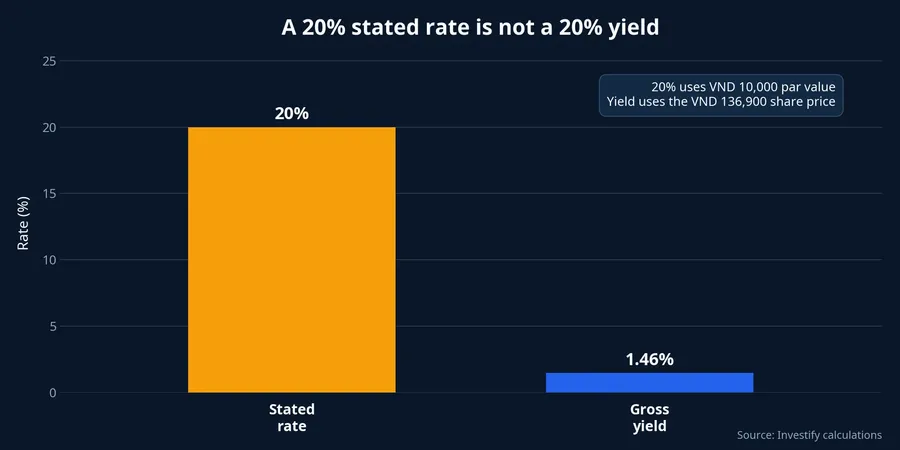
The chart makes clear why two percentages need their denominators. The 20% column is a rate on par value; the 1.46% column is gross yield on a VND 136,900 market price. They do not contradict one another, because they answer different questions.
When doing the calculation, it helps to write down both numerator and denominator: “VND 2,000 per share” and “my average cost.” It is a small discipline, but it removes ambiguity before a percentage turns into a trading decision.
The same framework also makes comparisons more honest. A headline dividend rate cannot be placed beside a bank-deposit rate, a bond coupon, or another stock's market-price yield without first asking what each percentage is divided by. A cash dividend is an amount per share. Yield is the investor-specific result that appears only after that amount is compared with the price paid.
For a new investor, it is useful to keep a simple two-line record for every corporate-action notice: the entitlement per share and the average cost per share. That record turns a marketing-friendly percentage into a number that can be checked. It also makes later review easier if the market price changes materially between the notice date and the ex-dividend date.
August 11 is not the last day to buy
MCH's ex-dividend date is August 10 and its record date is August 11. The Vietnam Securities Depository and Clearing Corporation explains that investors who bought and held shares before the ex-dividend date remain eligible, while buyers on the ex-dividend date do not receive the entitlement.VSDC
Applied to MCH's timetable, August 7 was the last eligible buying session for this dividend. On August 10, the entitlement had already separated from the share for new buyers. August 11 is the date used to establish the eligible shareholder list, not a deadline for purchasing shares and waiting for the cash payment.
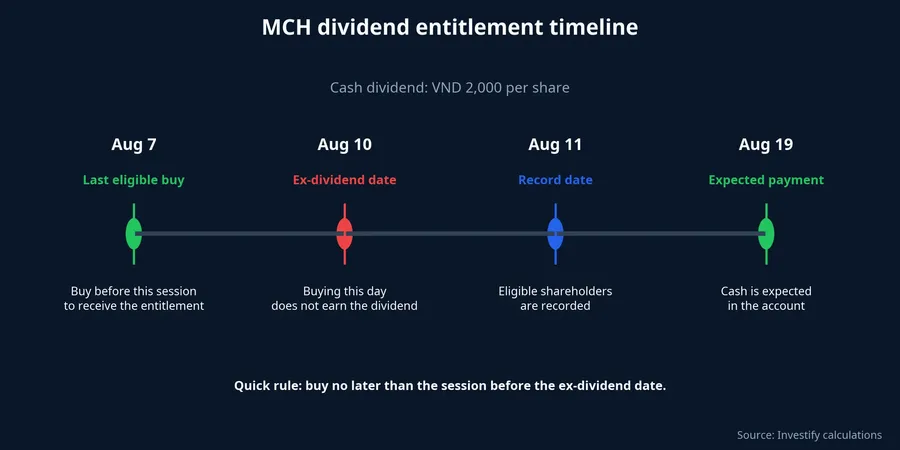
This is the most important practical detail in a dividend notice. Investors may see the record date and assume they can buy until that point. The correct reading starts with the ex-dividend date, then works back to the immediately preceding trading session to identify the final eligible purchase date.
MCH's expected payment date is August 19. The gap between establishing entitlement and receiving cash is a reminder that the ex-dividend date, record date, and payment date are separate milestones. Reading all three is more useful than focusing on the 20% headline.
The timetable matters even when an investor has no intention of buying for the dividend. It explains why a share bought on the ex-dividend date can trade without the accompanying cash entitlement, and why a seller may still receive the payment after selling on that date. These are settlement mechanics, not a signal about whether the company has become more or less valuable overnight.
A lower reference price is not free cash
The ex-dividend date does more than determine eligibility. VSDC explains that the reference-price adjustment reflects the value of the entitlement being separated from the share.VSDC If the only entitlement is the VND 2,000 cash dividend and VND 136,900 is used as the starting price, the theoretical adjusted reference price is VND 134,900.
That is simply VND 136,900 minus VND 2,000. The actual traded price may still be above or below the theoretical level because supply and demand determine the market. Economically, however, part of the share's value has moved into the cash dividend receivable for eligible holders.
Buying just before the ex-dividend date solely to “capture the dividend” therefore does not guarantee a profit. The final result also depends on entry price, price action after the entitlement separates, trading costs, and the tax treatment applicable to the account. Investors estimating net cash should check current tax rules and their broker statement rather than stopping at the gross dividend.
This is a useful distinction between a corporate action and an investment thesis. The former tells shareholders how and when value is distributed. The latter asks whether the business can generate cash, whether its valuation is reasonable, and whether future distributions are sustainable. A calendar event can be relevant, but it cannot answer those larger questions on its own.
A short checklist for any cash-dividend notice
The same sequence works for any dividend announcement. First, convert the percentage into cash per share. Next, divide that amount by your average cost to find your own gross yield. Then identify the ex-dividend date, record date, and payment date in that order.
Finally, check the items that can change net cash: taxes, fees, and the way the reference price is adjusted. This is also the point to separate the dividend event from the investment case for the company. One cash payment does not replace analysis of operations, valuation, or the capacity to sustain dividends in future periods.
For MCH, the practical conclusion is concise: 20% converts to VND 2,000 per share; at the illustrative price of VND 136,900, gross yield is about 1.46%. Eligibility for this payment was established before the August 10 session, so buying from that session onward did not include the dividend. Yield on cost and the entitlement timetable are the numbers that deserve attention, not the most prominent percentage in the announcement.