

An income statement can report both a gross loss and a net profit without containing an error. That was the case for CC1 in Q2 2026: it posted a gross loss of almost VND 94 billion, yet still reported VND 68 billion in after-tax profit.Vietstock The figures sit on different layers of the income statement. A large gain from investment transfers was booked as financial income and changed the final result.
For a new investor, it helps to picture the statement as a building. The ground floor is what remains from projects after their direct costs are paid. Higher up, financial income is added, while interest, administrative costs and other items are deducted before the company reaches net profit. A positive figure on the last line therefore does not, by itself, show that construction operations were profitable.
The central conclusion is straightforward. The investment-transfer gain was a real contributor to CC1's Q2 profit, but the available evidence does not make it evidence of a recovery in core earnings. The more useful test will come in subsequent quarters: whether construction gross margins recover and whether cash from the transaction is collected.
Revenue rose while the core business moved below zero
CC1 reported net revenue of more than VND 4.1 trillion in Q2, nearly 20% higher year on year. Its cost of goods sold, however, exceeded VND 4.2 trillion. The difference produced a gross loss of almost VND 94 billion, compared with a VND 173 billion gross profit a year earlier.Vietstock That is the layer to examine before moving down to net income.
Gross profit is not the whole corporate result, but it answers a basic question: after the direct cost of selling goods or delivering a project, does the business retain any value? In construction, this layer is closely affected by material prices, labour, subcontractors, execution progress and project acceptance. Revenue growth tells readers that more work was recognised. It does not reveal how much value each unit of revenue created.
The construction segment makes the gap particularly clear. It generated almost VND 3.2 trillion in quarterly revenue, close to 80% of CC1's total net revenue and roughly 26% more than a year earlier. Its costs rose by about 39% to around VND 3.3 trillion, turning an approximately VND 135 billion gross profit into a VND 135 billion gross loss.Vietstock Other segments remained gross-profitable, but were too small to offset construction.
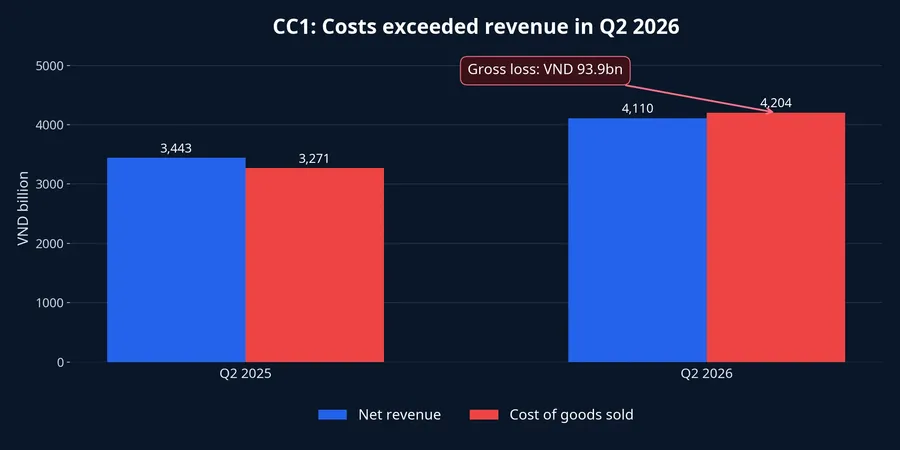
The chart does not say CC1 lacked revenue. It says direct costs rose faster than revenue at the point of recognition. In project businesses, the space between those two bars deserves more attention than the headline sales growth. If costs keep exceeding revenue, a bigger workload can put more, rather than less, pressure on gross profit.
The VND 333 billion gain was booked as financial income
Below gross profit, the statement records financial income and financial expenses. CC1 had almost VND 393 billion in financial income in Q2. More than VND 333 billion of this was a gain on investment transfers, or about 85% of financial income.Vietstock That gain was nearly five times the company's VND 68 billion quarterly net profit.
It did not turn loss-making construction contracts into profitable ones. The items are recorded at different layers. It does explain how a company can move from a gross loss to a positive after-tax result after financial income and the remaining expenses are taken into account.
One easy mistake is to equate transfer proceeds with the gain on a transfer. Vietstock cited disclosures showing VND 540 billion in share-transfer revenue from a transaction with CC1-Holdings, while the gain on investment transfers was more than VND 333 billion.Vietstock The transaction value must be reduced by the investment's carrying cost and related expenses before the gain is calculated. Treating VND 540 billion as profit would materially misread the statement.
CC1 also transferred its entire 48% interest in Dai Ngai Industrial Park Co., Ltd., representing VND 216 billion of contributed capital, in the same reporting quarter.Vietstock The public source does not establish that CC1-Holdings was the buyer of that stake. The careful reading is that the company had a related-party share-transfer transaction and separately divested the Dai Ngai interest, not that both disclosures describe one confirmed transaction.

A recognised gain is not necessarily repeatable earnings
Financial income is not less real because it comes from a transfer. Once the transaction is recognised under the relevant accounting rules, it has economic effect and it improved the Q2 outcome. The separate question is repeatability. An individual investment can only be sold once. To regard disposals as a recurring profit source, investors would need evidence of a remaining asset pipeline, an identifiable plan and a credible collection timetable.
The data available today do not justify assuming that the more than VND 333 billion gain will recur next quarter. A sale can represent a sensible capital-allocation decision, or it can be a one-off source of income; the cited disclosures do not establish which interpretation is definitive. Rather than attach a broader motive to the transaction, it is more accurate to keep it as a distinct variable when reading earnings.
Funding costs make that distinction more important. CC1's Q2 interest expense was close to VND 160 billion, around 60% higher year on year; for the first half, it was nearly VND 250 billion.Vietstock Without the sharp rise in financial income, the gross loss and interest burden would have been more visible in pre-tax profit. This is not a forecast for the next quarter. It is a way to identify the line items supporting this quarter's result.
The first-half figures tell the same story
The relationship between the core business and financial income also appears in the first-half results. CC1 reported VND 6,464 billion in net revenue, up 31.1% year on year. Construction produced VND 4,537 billion in revenue but a VND 54 billion gross loss, versus a VND 197 billion gross profit a year earlier. Financial income rose 293% to VND 424 billion, while pre-tax profit was VND 111 billion.Chất lượng và Cuộc sống
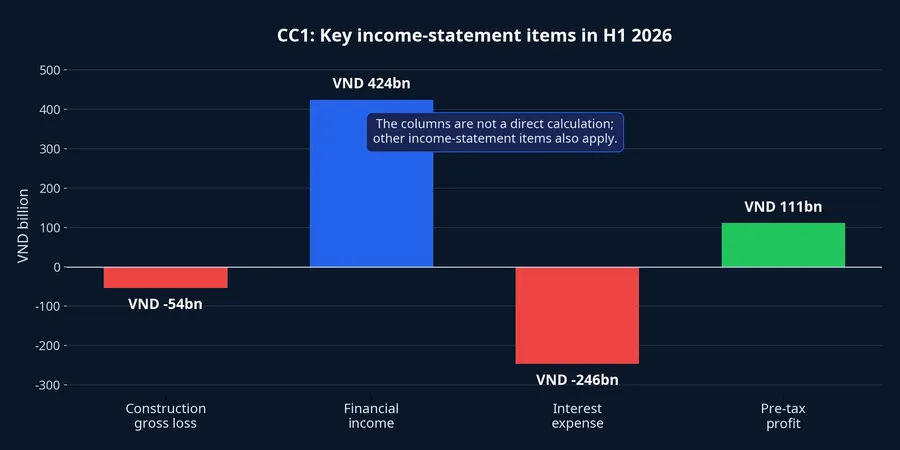
The columns in the chart are not a direct calculation because the income statement includes additional line items. Their purpose is to show the offsetting forces side by side. Financial income being larger than pre-tax profit does not prove the company relies exclusively on it. It does show that an assessment of earnings quality cannot set that income source aside.
What would make the earnings case clearer
The first signal is the construction gross margin. Compare construction revenue with construction cost each quarter. When costs rise more slowly than revenue and gross profit turns positive on a sustained basis, the core business will have shown a verifiable improvement.
The second is the composition of financial income. If profits again depend on transfers, the accounts should show what asset was sold, its carrying cost and how the payment is being collected. If profit rises without a heavy reliance on one-off transactions, the quality of the result would be more persuasive.
Finally, follow cash and interest expense. At the end of June, CC1 had more than VND 350 billion in other receivables from CC1-Holdings.Vietstock Watching whether this receivable converts into cash under the payment terms, alongside whether interest expenses stop rising faster than the core business, links the reported profit to cash generation.
The current conclusion is neither that CC1 has no profit nor that the transfer had no value. The Q2 profit is real, but it is not yet proof that construction has recovered. The next reports should answer the decisive questions: whether construction gross margins return to positive territory, whether non-recurring gains continue to dominate, and whether the receivable is collected on time.