


A gold-price screen can be reassuring: global gold rose 7.42% in a single week. Yet someone who bought an SJC gold bar on July 31 and sold it back on August 7 would, in this example, still lose VND 2.7 million per tael. There is no contradiction here. The return on a physical gold-bar trade in Vietnam is not determined by one international quote.
Over the same period, global gold rose from USD 4,042.97 to USD 4,343.13 per ounce. SJC’s selling price edged from VND 141.9 million to VND 142.2 million per tael, a gain of 0.21%. The central lesson is straightforward: following global gold is necessary, but it is not enough for an SJC holder. Investors also need to track the converted price, the domestic premium, and the price at which the dealer will actually buy the bar back.
Two price lines can move at very different speeds
The first distinction is between a dealer’s buying and selling quotes. When you buy a gold bar, you pay the dealer’s selling price. When you sell it back, you receive its buying price, which is lower. The roughly 0.94% weekly increase often quoted for this period refers to SJC’s buying price, which rose from VND 137.9 million to VND 139.2 million per tael. It is not the return earned by a new buyer.
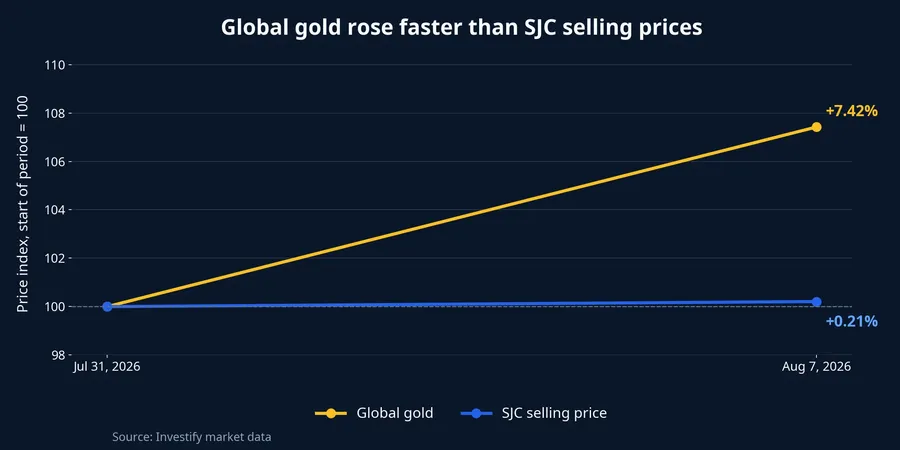
SJC selling prices barely moved while global gold advanced sharply. That does not mean SJC always reacts more slowly than international gold. It simply describes the July 31 to August 7 window. At another time, the domestic premium could widen and make SJC rise faster than the converted global price.
The two price boards measure different things. Global gold is the price of the underlying asset in international markets. SJC is a physical product sold in Vietnam, so its quote also reflects the exchange rate, available supply, local demand and the gap between SJC and converted global gold. Expecting SJC to rise 7% simply because global gold rose 7% leaves out the most important part of the calculation.
The international move had more than one driver
On August 7, weaker-than-expected US employment data pushed Treasury yields lower. That reduced expectations that interest rates would need to stay higher, an environment that is generally more supportive of gold because gold does not pay periodic income.AP
Still, one session should not explain an entire week. Gold had already gained 4.16% on August 5. The evidence supports a multi-factor reading: monetary-policy expectations shifted with labour data, yields fell at the end of the week, and demand for risk protection remained present. There is not enough evidence to assign the full 7.42% weekly gain to the jobs report or to any single event.

For a newer investor, the useful lesson is not to predict every headline. Treat the global quote as the starting point for understanding gold’s direction. Then convert it into the same unit as the product you own. Without that separation, it is easy to compare prices that are not on the same scale.
The exchange rate explains only a small part of the gap
After converting international gold into Vietnamese dong per tael, the equivalent price rose from about VND 128.04 million to VND 137.29 million, or 7.22%. Over the week, USD/VND slipped 0.19%, from VND 26,267.5 to VND 26,218.5 per dollar. Because the dollar weakened slightly against the dong, the converted gain was a little smaller than the gain measured in dollars.
But 0.19% explains very little. It cannot account for converted gold rising 7.22% while SJC’s selling quote rose just 0.21%. The larger part of the story is SJC’s premium over converted global gold: the extra amount a buyer pays for the domestic product.
On July 31, SJC’s selling price was about VND 13.86 million per tael above the converted global price, equal to 10.83%. By August 7, the difference had fallen to about VND 4.91 million, or 3.58%. The premium therefore narrowed by VND 8.95 million per tael in one week. International gold did not merely rise; it moved closer to an SJC price that was largely unchanged.
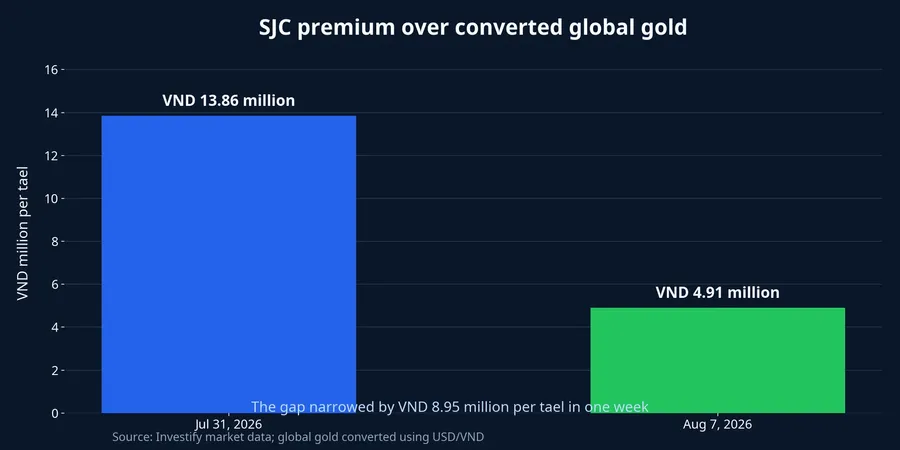
This is the variable investors most easily miss. Buying SJC is not only a view on whether global gold will rise or fall. It also means accepting that the domestic premium may narrow or widen. When it narrows, SJC may lag global gold, as it did in this period. When it widens, the effect can reverse. Neither direction is guaranteed.
Supply creates a separate pricing mechanism
SJC is not priced by taking the international quote and adding a fixed markup. It is a physical-goods market, where available stock and real buying and selling conditions matter. Decree 232/2025 ended the state monopoly on gold-bar production; qualified enterprises and banks can be licensed for related activities under the regulatory framework.VCCI
It would nevertheless be an inference to say that a specific supply change caused SJC’s response during this particular week. In the July 31 to August 7 window, there is no sufficiently current public evidence to attribute day-to-day moves to a fresh addition of supply. A more cautious view is that policy and supply set the framework for the premium, while short-term movements still need to be tested against actual data.
The buy-back quote decides the trade result
The bid-ask spread changes the result completely. On July 31, the dealer bought SJC at VND 137.9 million and sold it at VND 141.9 million per tael. The spread was VND 4 million, or 2.82% of the selling price. By August 7, it had narrowed to VND 3 million, equal to 2.11% of the selling price.
Put those figures into a simple transaction. Buying one tael on July 31 cost VND 141.9 million. Selling it back on August 7 returned only VND 139.2 million. The VND 2.7 million shortfall, a 1.90% loss, occurred despite the strong rise in global gold over the same period. This is not a forecast for the next week. It is a test of how a two-way price board affects the holder’s cash outcome.
That is why a percentage change in the displayed selling price is not a buyer’s return. To break even on a short-term trade, the buy-back price must exceed the price originally paid. The larger the bid-ask spread, the farther that price must travel. New buyers should therefore read both columns of the board, not only the headline percentage move.
A simple way to read the price board
Before trading a gold bar, put four inputs side by side: the global gold price, USD/VND, the converted gold price, and the buying and selling quotes for the exact brand. Subtract converted gold from the SJC selling price to calculate the domestic premium. It shows how much extra is being paid relative to international gold once both are expressed in the same unit.
Then use the dealer’s buying quote to test an exit scenario, not its selling quote. That is the number closest to the cash you would receive if you sold immediately. This process cannot predict tomorrow’s price, but it removes a common mistake: treating the movement of the underlying asset as the actual return on the product in hand.
The week’s conclusion is consistent: an international rally becomes an SJC profit only when the local buy-back quote keeps pace, the premium does not narrow too quickly, and the bid-ask spread is sufficiently small. In the coming days, the three signals worth monitoring are converted global gold, SJC’s premium over that converted price, and the dealer’s buy-back quote. Those are the variables that decide the outcome for a physical SJC gold-bar holder.