


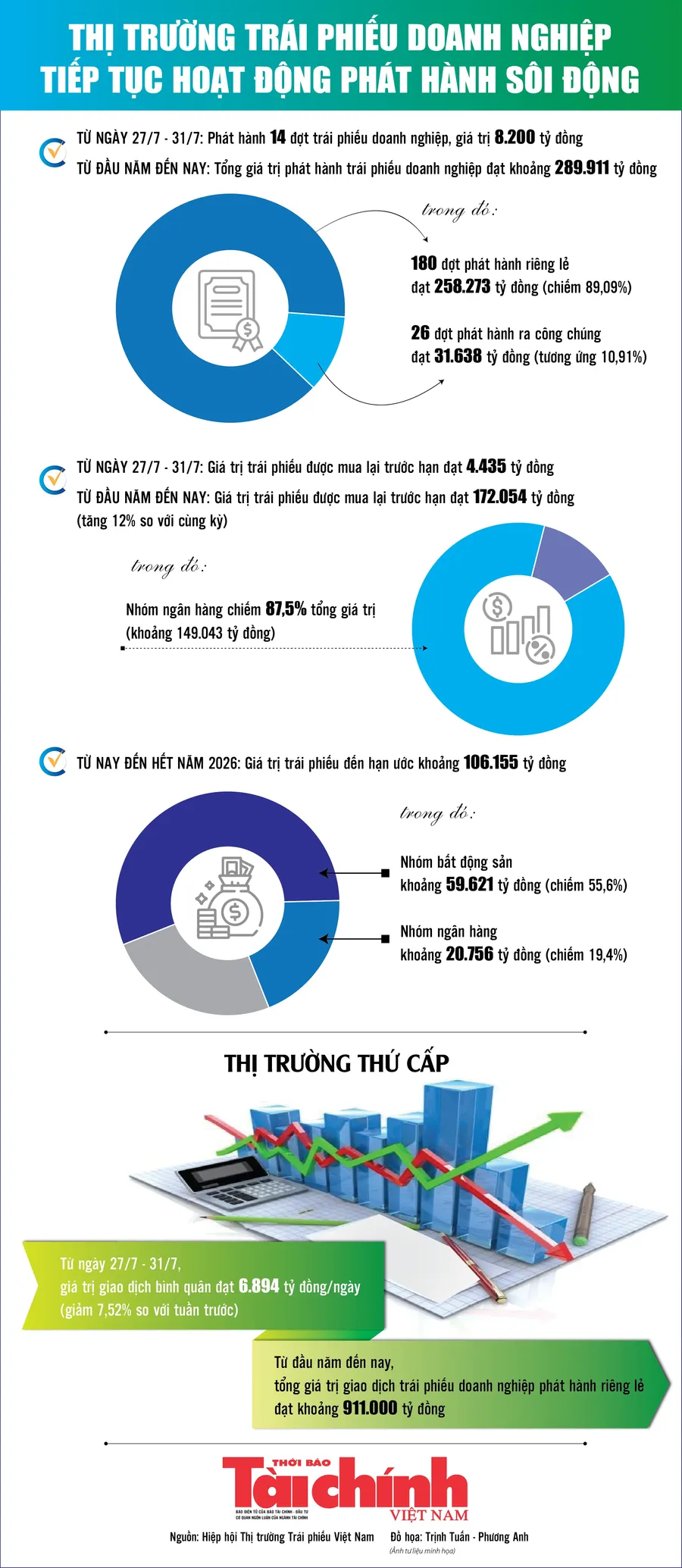
VND 289,911 billion is large enough to make corporate bonds look like a powerful source of fresh money for Vietnamese businesses. But it is a mistake to assume that all of it remains with issuers, or to subtract early redemptions and call the remainder “net new capital.” That calculation joins numbers that do not describe the same thing.
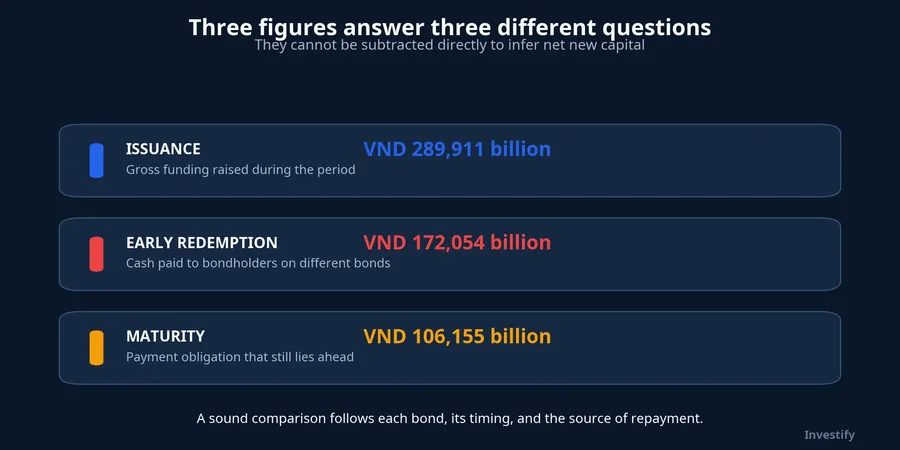
Put simply, issuance records money raised during a period. Early redemption records money paid back to bondholders on certain bonds. Maturity is a future obligation for principal repayment. All three concern bonds, yet they may relate to different issuers, different bond series, and different points in time. The central point is straightforward: issuance shows the activity of a funding channel; it does not by itself prove either net new capital or the safety of an individual investment.
What the headline figure says
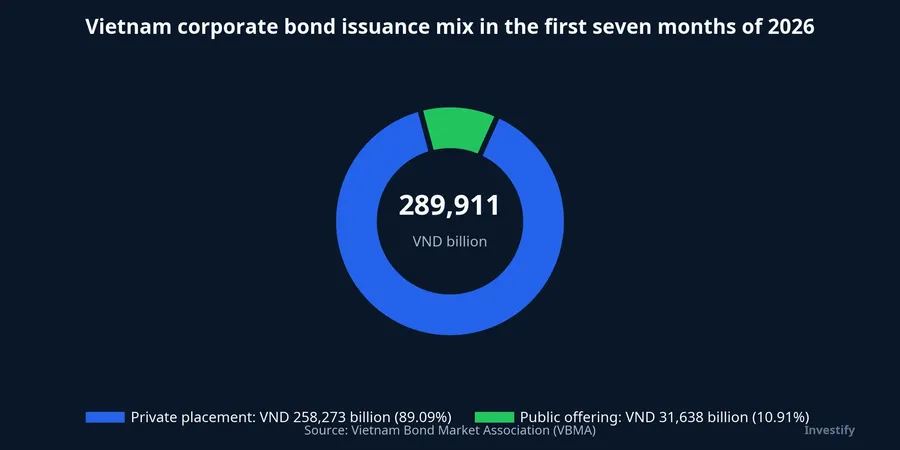
Data from the Vietnam Bond Market Association, reported by Thời báo Tài chính Việt Nam on August 8, put corporate bond issuance since the start of 2026 at approximately VND 289,911 billion. Private placements accounted for VND 258,273 billion, or 89.09%, while public offerings accounted for VND 31,638 billion, or 10.91%.Thời báo Tài chính VN
That is evidence that companies are still using bonds to raise funds. It also shows that private placements make up most issuance value. Yet a high private-placement share is not automatically positive or negative. An investor still has to examine who is borrowing, what the terms say, and how much information is available before committing money.
For a newer investor, the common trap is to view total issuance as one collective wallet for the market. In fact, it is the aggregate face value of many offerings. One company may issue bonds to support operations, while another may use the proceeds to restructure debt that is coming due. Both are recorded as issuance, but their cash-flow quality and repayment risk can be very different.
Why direct subtraction fails
The same dataset reports VND 172,054 billion of early redemptions since the start of the year.Thời báo Tài chính VN Subtracting that from VND 289,911 billion yields VND 117,857 billion. The arithmetic is correct, but there is not enough evidence to label the result net new capital.
The issue is the scope of the data. A bond redeemed in 2026 may have been issued in a previous year. A new issue may replace old debt, but it may also fund working capital or a specific project. Unless the dataset matches each bond by issuer, issue date, use of proceeds, and repayment cash flow, VND 117,857 billion is simply the difference between two aggregates. It does not establish how much money remains with companies.
Early redemption has no single interpretation either. A company may repay ahead of schedule because it has cash and wants to reduce interest costs. Another may refinance old debt with a loan or a new bond. Redemption can also be triggered by a right written into the original terms. Aggregate data do not tell us the share of each motive, so one market-wide causal story would go beyond the evidence.
Maturity is a schedule, not cash already spent
Approximately VND 106,155 billion of corporate bonds will mature from early August through the end of 2026.Thời báo Tài chính VN This is principal that must be repaid on a schedule in the remaining months. It is not cash that has already left issuers, so it cannot be subtracted from issuance to infer how much capital the market has “left.”
The maturity number is useful in another way: it directs attention to repayment capacity. A large obligation does not necessarily mean a company will miss payment. It may have operating cash flow, deposits, credit lines, or an asset-sale plan. Conversely, a modest obligation can still be risky when operating cash flow is weak, assets are hard to monetise, and access to new funding has narrowed.
The better question, therefore, is not whether total maturities are high or low. It is where the obligations sit, and what cash source will service principal and interest for each bond. That is the difference between reading a market headline and assessing a debt commitment.
Move from the aggregate to the bond
In plain terms, yield is the reward an issuer promises. The repayment source is what determines whether the promise can be met. Before focusing on the coupon, start with the issuer: how its business generates cash, what other borrowings are approaching maturity, and whether its principal-and-interest payment history is transparent. Financial statements and unusual-event disclosures often reveal more than a yield figure alone.
Then examine the use of proceeds. Working capital, project investment, and debt restructuring may all appear in an issuance plan, but they send cash along very different paths. Investors should compare the stated plan with the issuer’s subsequent disclosures rather than assume every fund raise creates a new asset or revenue stream.
Repayment sources need to be judged by their certainty, not merely by their labels. Existing operating cash flow differs from reliance on an unfinished asset sale or a future borrowing. When repayment depends heavily on an uncertain transaction, credit risk rises even if the collateral is described as valuable.
Collateral should likewise be viewed as an enforcement mechanism, not a line item on a document. Ownership rights, priority ranking, valuation, the asset manager, and the ability to turn the asset into cash in a stress case all matter. Finally, read bondholder protections: interest-payment timing, early-redemption rights, financial covenants, tenor-change conditions, and the process for handling a breach.

VBMA’s summary of the current rules says issuers are responsible for borrowing and repaying on their own account, using proceeds for the stated purpose, and meeting payment obligations in full and on time.VBMA That responsibility rests with the issuer; it does not replace a buyer’s own review of the bond documents.
Conclusion: do not let subtraction replace diligence
VND 289,911 billion of issuance is evidence of an active corporate bond market in the first seven months of the year. It is not a certificate that issuers received precisely that amount of net new capital, and it is not a direct measure of safety. Issuance, early redemption, and maturity belong to three separate layers of information.
The thesis to keep is this: use market-wide statistics to form questions, not as a substitute for answers. In the months ahead, useful signals will be issuer-by-issuer payment disclosures, debt-restructuring developments, and the actual funding sources behind maturing bonds. Moving from the aggregate to the specific company, bond series, and repayment source gives a new investor a firmer basis for understanding the yield on offer.